
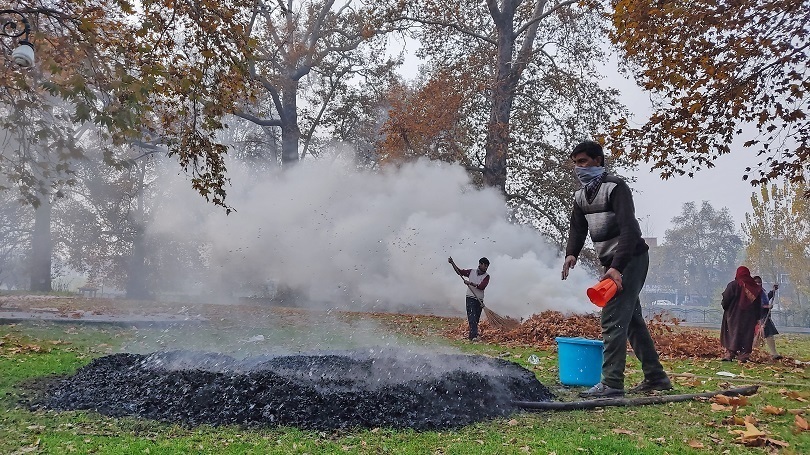
Srinagar- Kashmir’s winter air has turned dangerously polluted, with the Valley slipping into the severe category this week. Areas across Jammu and Kashmir recorded an Air Quality Index touching 288, while Srinagar remained between 147 and 172 in the past 24 hours, indicating poor to unhealthy air.
Data showed high concentrations of pollutants, with PM10 ranging between 136 and 243 micrograms per cubic metre and PM2.5 between 86 and 167 micrograms per cubic metre. Both exceed the World Health Organization’s recommended standards for safe breathing.
Cold temperatures, widespread use of firewood, vehicle emissions, waste burning and traffic congestion are contributing to the buildup of pollutants. The situation is being worsened by calm weather conditions that are trapping polluted air near the surface rather than allowing it to disperse.
Experts attribute this to a stagnation layer forming over the Valley. Cold and dense air settles close to the ground during winter, while weak winds fail to lift pollutants. Current Western Disturbances remain too feeble to trigger rainfall or snowfall that would help clear the air.
With temperatures dropping to around minus 4 degrees Celsius, the combination of intense cold and limited air circulation is keeping smoke and dust suspended across urban and semi urban belts of Kashmir.
Independent weather forecaster Faizan Arif Keng also said calm and cold weather is creating an atmospheric lid over the Valley. Pollutants remain trapped near the surface instead of dispersing upward or blowing away.
According to him, weak Western Disturbances are failing to produce rain or snow that could clean the air. A stronger weather system is required for any improvement. Until then, the current conditions are likely to continue.
Delhi continues to remain in the very poor category, averaging around 310 on the AQI scale. The gap separating big city pollution from the Valley’s readings has narrowed significantly, showing that hazardous air is no longer confined to major metros.
As per AQI classification, values between 0 and 50 indicate clean air, 51 to 100 moderate and 101 to 200 unhealthy for sensitive groups. Between 201 and 300, the impact becomes widespread and can affect overall public health.
Health professionals have reiterated caution for the coming days since pollution levels are expected to remain high until strong weather systems bring precipitation or winds capable of dispersing the trapped pollutants. (inputs from KNO)