Kashmir’s old traders liked to say that a good business begins long before the first sale.
It begins with patience, with a certain way of seeing the world, with the type of confidence that grows when families work with their hands and build something that lasts.
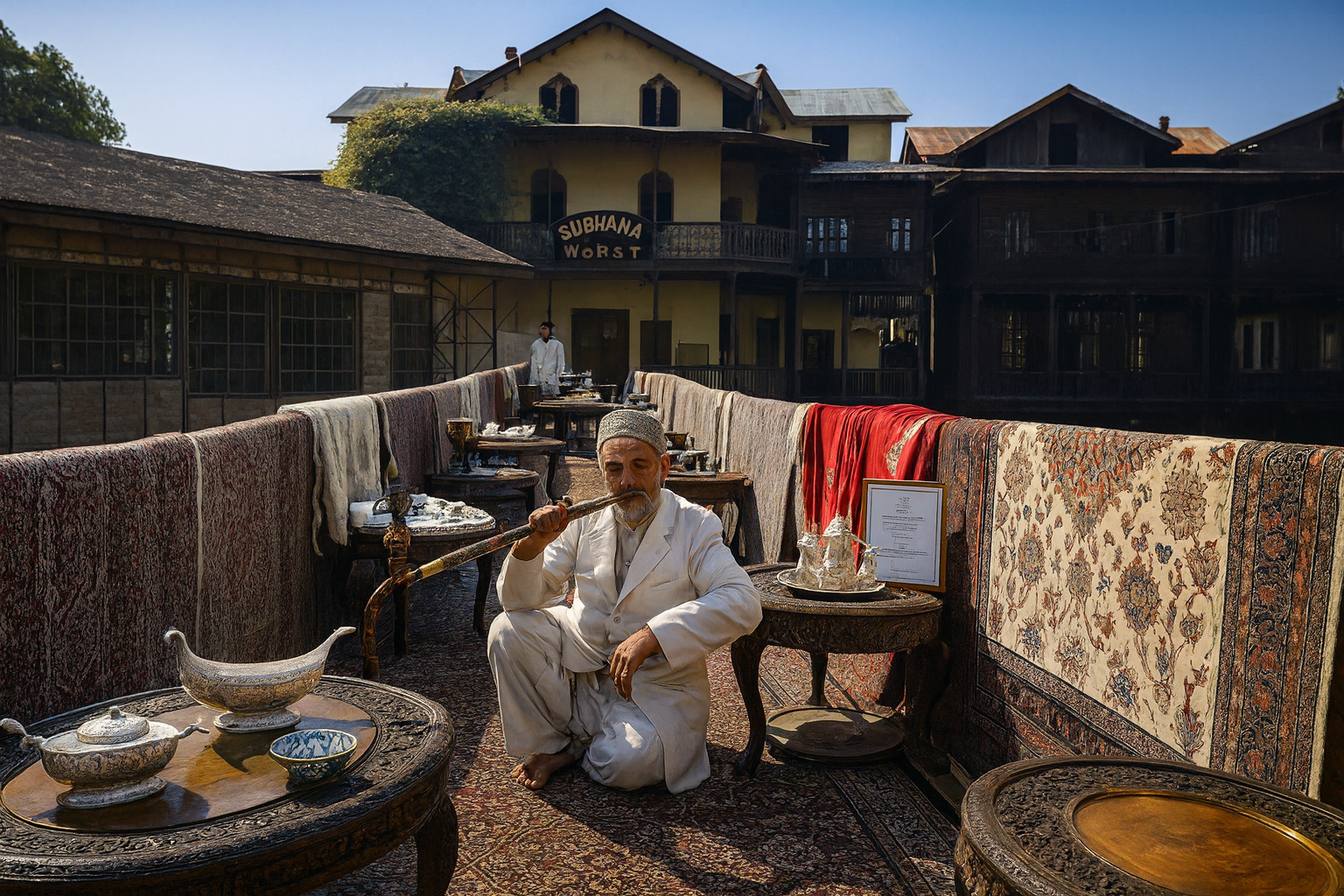
In the old quarters of Srinagar, that belief shaped entire neighbourhoods. Merchants studied wool at dawn, ran karkhanas through the day and checked accounts by night.
Artisans leaned over looms for hours, gently pressing colour into threads that would travel far beyond the valley.
A visitor could walk from Zaina Kadal to Khanyar and feel that the place breathed through its workshops.
Elders who grew up in that landscape describe a simple truth: Kashmir once thought like a business powerhouse.
Families who dealt in Pashmina, carpets, walnut woodwork and papier-mâché operated with the assurance of seasoned traders. They built export houses that survived on discipline rather than luck.
Anyone who has listened to their stories hears a pride that carries the weight of experience.
These families were early globalisers long before the word existed.
Many compare this drive to the Marwari business tradition of Rajasthan. Their story began in a desert where the land offered very little, pushing entire communities toward enterprise.
Generations learned to trust numbers, save carefully and take calculated risks. Children observed adults negotiate with the clarity of people who had no other safety net.
The world opened for them because they moved toward it, whether through railway towns a century ago or digital markets today.
Old Kashmir matched that ambition in its own way.
Exporters understood their craft down to the last thread and knot. They followed changing tastes in Paris, Dubai and London, and packed their shipments with the confidence of people who knew the world expected something special from them. They placed value on trust, sometimes above profit. A promise made in a karkhana carried the weight of a formal contract. Buyers returned because they never wondered whether a shipment would arrive.
The scale was immense for a small valley. Thousands of looms hummed in homes and workshops. Tens of thousands of families depended on these networks.
The memory of that world survives in stories told over evening tea: an uncle who travelled with samples to Delhi, a cousin who spoke with foreign buyers on crackling phone lines, a grandfather who saved every extra rupee to buy more wool and build a larger unit for the next season.
Time, however, has its own plans.
Political disruption, curfews and long closures made trade unpredictable. Transport stalled, taxes rose, and margins squeezed. Machine-made copies flooded markets abroad, reducing the worth of genuine handicrafts.
Researchers tracking the sector have noted falling export numbers, shrinking wages and a steep drop in young artisans entering the field.
Many grew up watching their fathers work long, exhausting hours without the stability needed to raise a family. Some decided the struggle was too heavy to inherit.
Families that once reinvested in karkhanas shifted toward safer, shorter routes: shop-to-shop trading, small commissions, land purchases that protect wealth but do not create new ventures.
Confidence suffered, ambition softened, and the result is visible in shuttered workshops, unsold inventory and skilled hands drifting toward other work.
During this period, Marwari business groups moved in a different direction. Their strength lay in steady adaptation.
When grain lost its charm, they entered textiles. When textiles struggled, they built factories for steel, cement and chemicals. Later, they opened offices for finance, retail and tech.
The movement was constant. Every generation trained the next by bringing children early into shops and offices, letting them learn through practice long before they studied in business schools.
Their courage came from a belief that distance does not weaken roots. They were willing to build wherever opportunity opened.
There is a lesson here for Kashmiri youth who often hear that business is risky or that the valley offers no space for big dreams.
History shows the opposite. The tools are different today, but the ground is not empty. A craft seller can show work on Instagram instead of waiting for a trade fair. A tour operator can build trust through honest reviews. A woodworker can upload catalogues, take digital payments and ship through reliable logistics networks.
The old barriers that once trapped people inside the valley have thinned.
But success still rests on the old values: skill that earns respect, honesty that keeps customers, clear accounts that prevent chaos, children learning from real work, and treating business as a craft instead of gamble.
Conversations with today’s young traders show a hunger for direction. Many want to build, but worry about instability. Some wish to sell globally, but feel unsure where to begin.
Their questions echo those of earlier generations, although the terrain is more open now.
Technology opens the market, but it can’t build the foundation. Trust, quality, and discipline still hold the weight.
A valley that once powered global trade can find that energy again. Evidence of this revival appears in small pockets: a young designer who collaborates with weavers, a tech graduate who markets local art abroad, a family that revives a dormant karkhana using modern systems.
These are early signs, small sparks waiting for larger winds.
Kashmir’s business spirit is not gone. It waits for a generation willing to build patiently, stay honest, use technology wisely, and reinvest with care.
Our ancestors proved that real prosperity grows when skill, effort, and values move together.
A small valley once sent its craft and courage to the world. It can do so again. The question is whether today’s generation will rise to that challenge.