
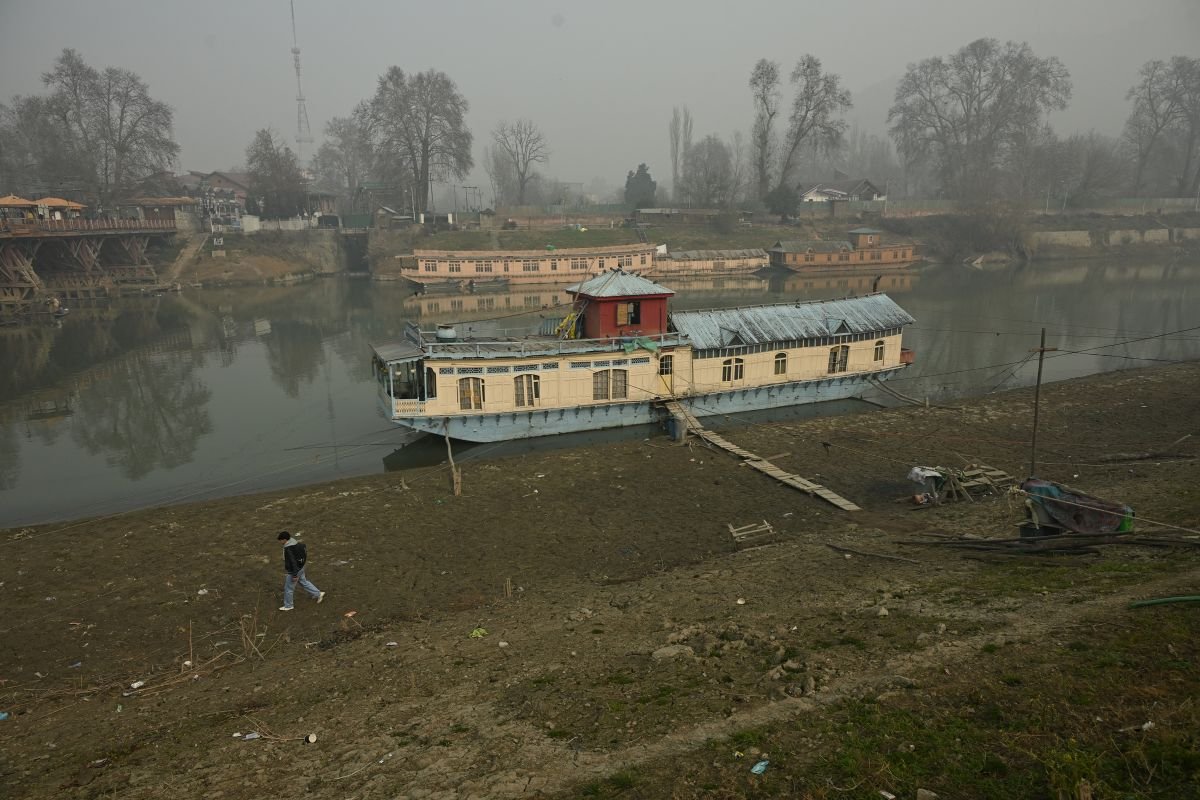
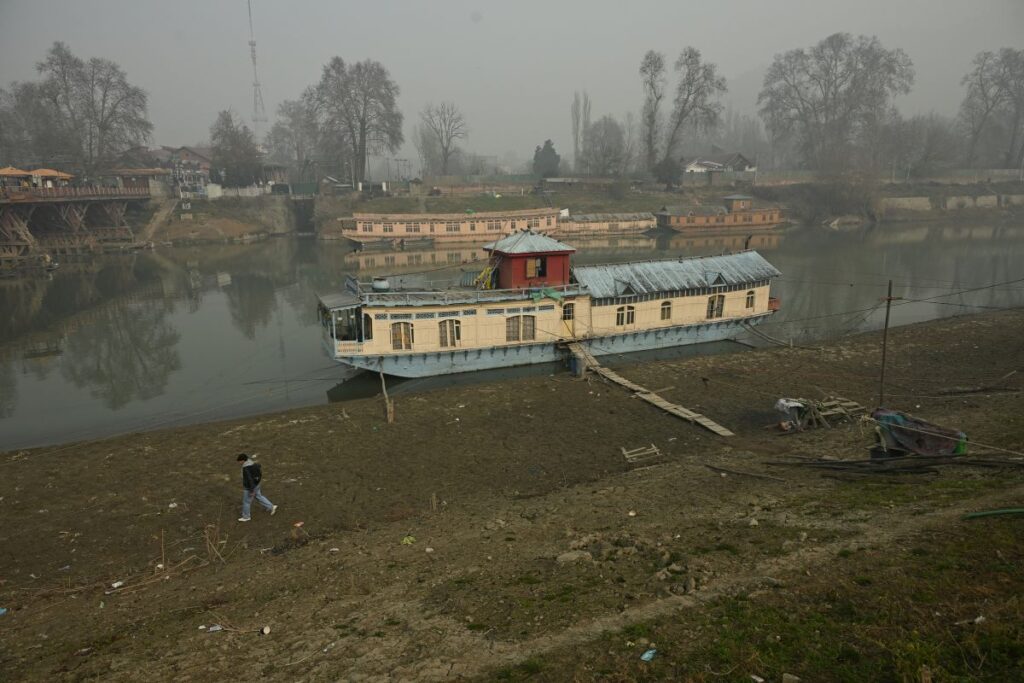
Srinagar- Reduced snowfall and a prolonged dry spell are increasingly straining Kashmir’s rivers, springs and overall ecological balance, triggering fresh concerns over climate stress in the Valley, officials and experts have warned.
Data shows that the Jhelum, considered Kashmir’s lifeline, has dropped to around 0.65 metres at key monitoring points such as Sangam and Pampore, marking its lowest level this season. Several tributaries have either dried up or recorded sharply reduced flows, while natural springs in parts of Pulwama, Shopian and Bandipora are witnessing depletion, affecting drinking water availability.
Officials said groundwater monitoring wells indicate a decline ranging between 0.5 and 3 metres at multiple locations, while shrinking wetlands are beginning to impact migratory bird habitats. Farmers have also raised concerns over limited irrigation water amid an already stressed agricultural season.
“Each year, the situation worsens. With limited snowfall and rainfall, both agriculture and household water supply are under pressure,” said Bashir Ahmad, a resident of Pulwama.
The India Meteorological Department has reported a 17 per cent rainfall deficit across Jammu and Kashmir during the post monsoon period from October 1 to December 10. Srinagar alone recorded a 47 per cent shortfall, while districts such as Baramulla, Bandipora, Shopian and Kargil saw deficits ranging from 65 to over 90 per cent.
Officials attributed the situation to the absence of active Western Disturbances, which traditionally bring winter precipitation to the region. Forecasts suggest that dry conditions may persist through late December, potentially aggravating water stress if substantial rain or snowfall does not occur.
Authorities have also warned that prolonged dryness and dry vegetation are elevating the risk of forest fires in the Valley. “Low river levels combined with sustained dry weather are alarming from both water security and disaster management perspectives,” an official from the Department of Disaster Management said.
Adding to environmental concerns, air quality levels in Jammu and Kashmir have deteriorated, with the Air Quality Index currently rated as poor. Recent data shows the AQI in parts of Srinagar ranging from approximately 172 to 200 or even higher, depending on the specific location and time of day.
Exposure to these PM2.5 levels for 24 hours has been likened to the health impact of smoking 10 cigarettes in a day, an alarming comparison highlighting the seriousness of the situation.
Health experts, including senior doctors at government hospitals, have explicitly stated that this repeated exposure increases the risk of Breathing problems, Heart disease, and other Chronic illnesses like Chronic Obstructive Pulmonary Disease (COPD), Lung cancer.
Chief Minister Omar Abdullah recently flagged climate change as a pressing challenge, recalling visible environmental shifts over the years. He noted that glaciers once prominent during childhood visits to Sonamarg have receded significantly, while areas like Gulmarg, which traditionally witnessed snowfall by December, are now seeing prolonged snowless periods.
“Kashmir’s winters are changing. It is no longer unusual to see December without snow,” he said, warning that air quality in the region is also deteriorating at a pace comparable to major urban centres.
Experts at Sher e Kashmir University of Agricultural Sciences and Technology of Kashmir stressed the need for urgent adaptation measures. Vice Chancellor Prof Nazir Ahmad Ganai said climate variability and water scarcity pose serious threats to agriculture, calling for drought resilient crops, improved water management and climate responsive planning.
Scientists have recommended accelerated research into regenerative agriculture, efficient water use technologies and long term climate adaptation strategies to mitigate the growing impact of erratic weather patterns. (inputs from KNO)