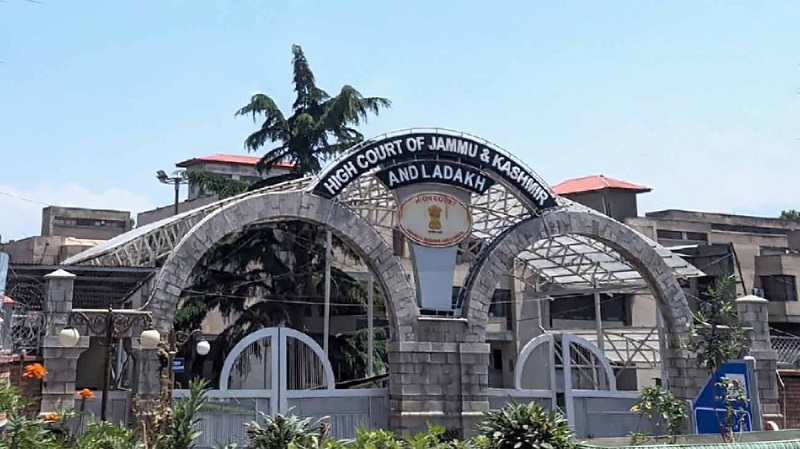
Srinagar: The High Court of Jammu & Kashmir and Ladakh has ruled that similarity in duties or funding from a common source does not, by itself, entitle employees of different institutions to parity in service conditions, including post-retirement pension benefits.
“……merely because the duties performed by two sets of employees may be similar or the two sets of employees pertaining to two different institutions are being funded from a single source would not be in itself a ground to claim parity in service conditions between the two sets of employees,” said a Bench of Justice Sanjay Dhar while dismissing two petitions filed by 60 serving and retired employees of J&K Sainik School Mansbal who has sought a direction upon the authorities to grant pensionary benefits to them on attaining the age of superannuation in accordance with the scheme as was in vogue before 2010 and also to provide arrears of pension on superannuation to those who have already retired from service. They also sought direction to the authorities to treat and adjust the CP Fund of them as General Provident Fund as was applicable to the Government employees.
“…the petitioners cannot claim parity in service conditions pertaining to post-retirement pension either with the employees of other Sainik schools of the Country or with other institutions which are funded by the Government of Union Territory of Jammu and Kashmir,” the court said, rejecting the contention of the petitioners as being without any merit.
In their plea, the employees contended that while they receive pay and retiral benefits such as gratuity and leave salary, they are not entitled to pension on superannuation.
The petitioners submitted that the Government of India had extended pensionary benefits to Sainik School employees across the country in 1988, but the scheme was not made applicable to J&K Sainik School as it was established by the erstwhile State Government. They pointed out that the issue of extending pension was repeatedly discussed and approved in principle by the School’s Executive Committee and Board of Governors over the years, including an approval by the then Chief Minister in 2005, but the scheme remained unimplemented due to lack of financial and administrative concurrence.
They alleged that the delay was the result of bureaucratic wrangles and contended that pension is a form of social security, asserting parity with government employees and staff of other Sainik Schools, particularly for those appointed prior to 2010.
The petitioners further submitted that even after the introduction of the National Pension System (NPS) following the implementation of the 7th Pay Commission, State Government employees appointed prior to 2010 continue to receive pension. On that basis, they claimed that employees of J&K Sainik School, Mansbal appointed before 2010 were entitled to pension on par with Government employees and staff of other Sainik Schools in the country, and that denial of the same amounted to discrimination.
The authorities opposed the plea, stating that J&K Sainik School, Mansbal is run by a separate society and is fully funded by the J&K Government, unlike other Sainik Schools which function under the Ministry of Defence, and therefore its employees cannot claim parity with them.