
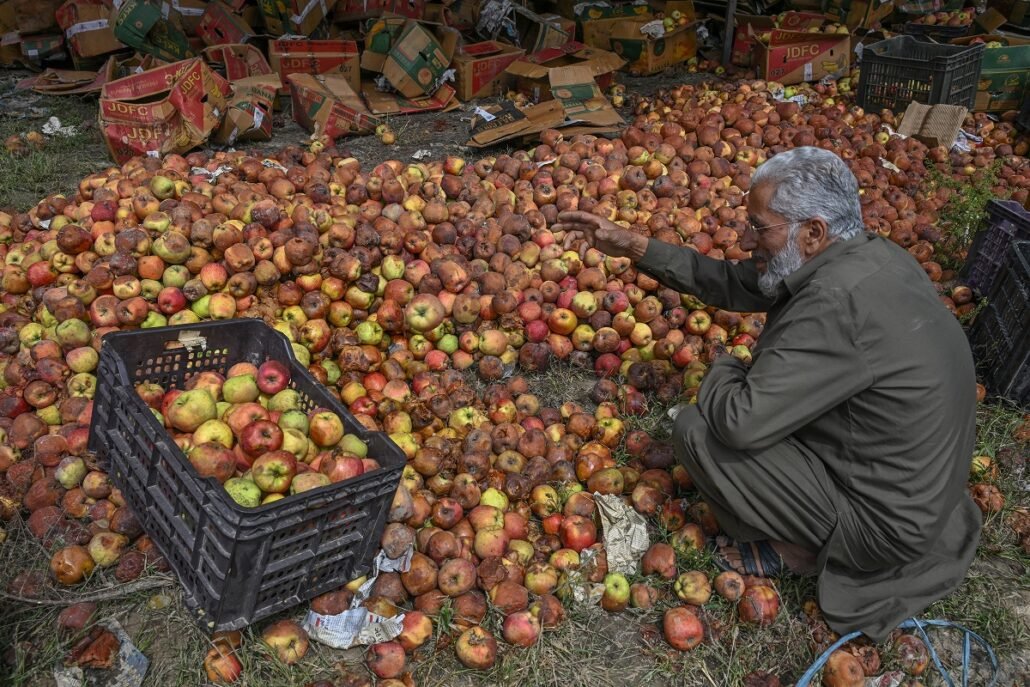
Srinagar- For thousands of fruit growers across Jammu and Kashmir, the 2025 apple season unfolded as a slow-moving disaster. What should have been months of harvest, transport and sales instead turned into a chain of setbacks, leaving orchards stocked with unsold produce, markets flooded at the wrong time and growers staring at mounting losses.
From prolonged highway closures during the peak harvest to erratic weather, soaring freight costs and the absence of any compensation, the season exposed the fragile underpinnings of the Valley’s fruit economy and pushed it closer to collapse. Growers and traders estimate losses at nearly Rs 2,000 crore, calling 2025 the worst year the sector has witnessed in recent memory.
August rains trigger cascading crisis
The crisis began in the last week of August when continuous and heavy rainfall triggered landslides at several locations along the Srinagar–Jammu National Highway, the Valley’s primary all-weather surface link with the rest of the country. The highway remained shut for nearly a month, right at the peak of the apple harvesting season.
Orchards were full and produce was ready for dispatch, but transport came to a standstill. Thousands of trucks carrying fresh fruit were stranded for days and weeks. By the time many consignments reached markets outside Kashmir, a significant portion of the produce had already deteriorated.
Repeated closures and repair work further choked supply lines, causing irregular market arrivals and a sharp crash in prices. Apples continued to pile up in orchards and mandis as growers struggled to move their produce out of the Valley.
“Farmers who invested their life savings, took loans and worked the entire year were left with no option but to sell at throwaway prices,” said Bashir Ahmad Basheer, President of the Kashmir Valley Fruit Growers Cum Dealers Union. “Many could not even recover the cost of harvesting and packaging.”
Mughal Road fails as an alternative.
With the national highway closed, the Mughal Road was pressed into service as an alternative route. However, growers said it proved grossly inadequate for large-scale fruit transportation.
“Only small vehicles were allowed, and even those were cleared after long delays,” Basheer said. “Large trucks could not pass, making bulk transportation impossible.”
Freight charges on the Mughal Road shot up three to four times higher than normal, further squeezing already thin margins. In desperation, some growers transported fruit in small load carriers up to Rajouri, where it was reloaded onto trucks for onward movement. The process increased costs, delayed deliveries and damaged fruit quality.
Structural weaknesses laid bare
Growers say that while the sector has endured disruptions in the past, 2025 was different in scale and intensity.
“Even during earlier political turmoil or disruptions, the losses were never this severe,” they said. “This year, everything failed at once – weather, roads, markets and policy support.”
The crisis also highlighted deeper structural problems. Growers pointed to the rise of orchard diseases, the unchecked sale of fake pesticides and substandard fertilisers, and consistently low apple prices as long-standing issues that worsened the situation.
“Instead of protecting crops, poor-quality inputs are damaging them,” growers said, adding that the lack of effective regulation has further weakened confidence in the system.
Cold storages offer relief, but remain insufficient
Controlled atmosphere and cold storage facilities emerged as one of the few safeguards during the crisis, allowing some growers to store produce and avoid distress sales. However, growers said existing capacity is far below the Valley’s production needs.
“Cold storages are a boon, but they are too few,” growers said. “Many units operate on their own terms rather than following guidelines.”
They demanded strict regulation of storage facilities and the establishment of 200 to 300 additional CA and cold storage units across the Valley. Growers also urged authorities to ensure that storage operators adhere to the decision allowing farmers to use their own packaging material if they choose.
Expansion continues amid growing risk
Despite the crisis, horticulture continues to expand in Jammu and Kashmir. Officials say around 1,000 hectares have already been brought under high-density orchards, with plans to add another 5,500 hectares in the coming years.
Growers, however, warn that without strong infrastructure, insurance cover and reliable market support, this expansion could expose farmers to even greater risks.
The fruit economy employs lakhs of people directly and indirectly and forms the backbone of rural livelihoods in the region. Growers say it is now at a breaking point.
“If urgent corrective measures are not taken now, the damage will not be limited to one season,” they warned. “It could permanently weaken the horticulture sector and the lives dependent on it.” (inputs from KNO)