By Tawheed Parvaiz Bhat
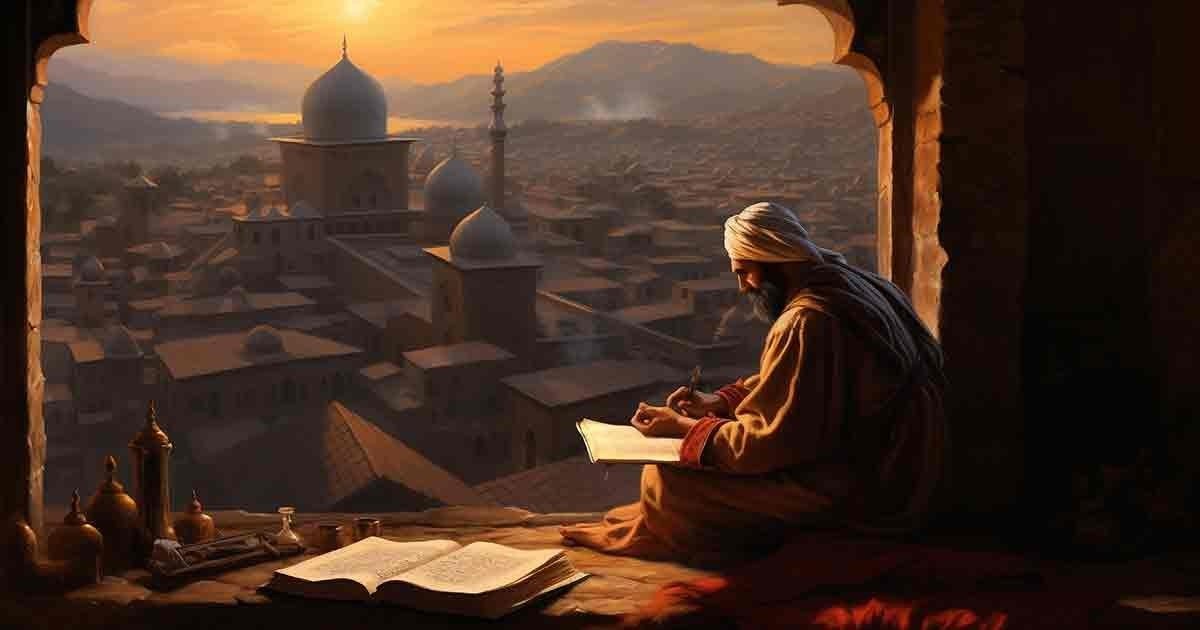
There was a time when the Muslim world stood at the centre of global knowledge.
Between the 8th and 14th centuries, cities like Baghdad, Cordoba and Cairo shaped the intellectual direction of humanity. Science, philosophy, medicine, astronomy and mathematics flourished together.
This period, often called the Golden Age of Islam, was the result of a culture that valued reason, inquiry and learning as acts of faith.
At a time when much of Europe struggled with intellectual stagnation, Muslim scholars were translating, testing and expanding knowledge from Greek, Persian, Indian and Roman sources. Institutions like the Bayt al Hikmah, the House of Wisdom in Baghdad, became magnets for thinkers from across the world. Knowledge was questioned, refined and pushed forward.
This spirit produced towering figures.
Al Khwarizmi laid the foundations of algebra. Ibn Sina reshaped medicine through Al Qanun, a text that guided doctors for centuries. Al Biruni made major advances in astronomy and geography. Ibn al Haytham pioneered experimental physics and optics by insisting on observation and evidence.
Their methods were strikingly modern. They relied on reason, experimentation and careful study of the natural world.
Religion was a fuel to this work.
The Qur’an repeatedly urges people to observe nature and reflect on creation. “Indeed, in the creation of the heavens and the earth and the alternation of night and day are signs for people of understanding.”
For early Muslim scholars, studying the universe was a way of understanding divine order. Science was tied to ethics and human welfare.
But this remarkable civilisation did not sustain its momentum.
The decline of Muslim scientific leadership was slow and complex, but it was real. One major reason was the weakening of critical thinking.
Independent reasoning, known as ijtihad, gradually gave way to blind imitation or taqlid. Questioning, once celebrated, began to be viewed with suspicion.
Political turmoil deepened the damage. Continuous internal conflicts drained resources and stability.
The Mongol invasion of Baghdad in 1258 was especially devastating. Libraries were destroyed, scholars killed and institutions reduced to ruins. Knowledge transmission was broken, and with it, intellectual confidence.
Another turning point came when science drifted away from everyday religious and social life.
Scientific inquiry began to be seen as secondary to ritual practice. At the same time, Europe absorbed Muslim scientific texts, translated them into Latin and built upon them.
This process helped spark the Renaissance and the Scientific Revolution, while the Muslim world largely stood still.
In losing this balance, Muslims also lost sight of their own scripture’s vision.
Early Muslims were not limited to ritual worship alone. They explored the Qur’an as a guide to understanding the world. The Prophet Muhammad [PBUH] did not offer a rigid, verse by verse explanation of the Qur’an.
This left space for reflection, research and discovery across generations. “Do they not reflect upon the Qur’an?” asks the text itself.
When the Qur’an spoke of the heavens, scholars studied astronomy. When it spoke of life, they advanced medicine and biology. When it spoke of balance, they examined nature and agriculture.
Over time, however, the Qur’an became confined largely to ritual recitation. The deeper practice of reflection, or tadabbur, weakened.
The connection between revelation and reason faded.
The Qur’an repeatedly calls on humanity to explore the world. “Travel throughout the land and see how He originated the creation.” It points to stages of human development, the balance of nature and signs spread across the universe.
Today, modern science confirms many of these realities through its own methods. This should not create conflict, but responsibility.
That responsibility lies heavily on Muslim societies today.
Religious schools must engage with modern science. Universities should become centres of research and innovation. Doctors should contribute to medical research. Engineers, environmental scientists and technologists should study nature ethically, guided by moral values. “In this are signs for people who reflect,” the Qur’an reminds us.
The lesson of history is simple. Civilisations rise through knowledge and decline through ignorance.
Islam never opposed science. It encouraged curiosity, learning and discovery. Decline began when these principles were abandoned.
In an age of rapid technological change, revisiting this legacy is about survival and relevance. Educational reform, scientific temper and ethical innovation are the need of the hour.
The story of Muslim scientific brilliance is a mirror for the present and a map for the future.
As works like Kitab al Urooj remind us, nations grow through intellect and fall through its neglect.
The Qur’an remains a guiding book, but it guides only those who reflect, explore and apply its wisdom.
Recovering that spirit may yet help rebuild what was once lost.
- The author is a teacher and columnist focused on education, ethics, environment and emerging social challenges in the digital age.