Electric mobility is often sold through flashy launches and big-city promises. But in Kashmir, it is showing up in a very different way.
Power cuts are common, petrol is expensive, winters are harsh, and roads are tough on both people and machines.
Here, electric transport is about saving money and getting through the day.
That is why Switch Electric matters right now.
Founded by Aqid Farooq Shah, this startup is building electric mobility and energy solutions from Kashmir itself.
While much of India’s EV push focuses on premium scooters and urban buyers, this team started with bicycles.
Milkmen, students, daily workers, and shopkeepers depend on them every day.
The thinking is simple: if electric mobility can work for people who cannot afford delays or breakdowns, it can work anywhere.
In this interview, Kashmir Observer speaks with Aamir Riyaz, who leads deployment and design at Switch Electric. He speaks plainly about cold mornings, broken roads, battery costs, and the hard choices people make before spending a single rupee. There is no startup hype here, only real questions of cost, reliability, and trust.
You’re building Switch Electric in Kashmir, where power cuts are normal and jugaad is often the default solution. What made you feel this was the right place to start an electric mobility company? Was there a moment when it all clicked?
Honestly, it was not some big “startup dream” moment. It just felt practical. Electricity goes off often in the valley, petrol is expensive, roads are rough, but life still goes on. People still have to reach work, school, markets. We grow up learning how to manage with limited resources. That way of thinking shaped us.
Our founder likes experimenting with things. One day, he ordered a small electric kit online and fitted it onto his bicycle. When he rode it around, people kept stopping him. They wanted to know what it was, how much it cost, and whether they could get one.
That reaction said a lot. It showed us there was a real demand for simple, affordable electric cycles.
So we started with bicycles because that’s what people here already use. Milkmen, students, daily workers depend on them.
Jugaad gave us the first idea, but our aim was never to make something weak or temporary. We want to build products that are reliable and actually help people.
Kashmir has its own character: long winters, uneven terrain, and limited infrastructure. How do you design for these realities? Can your kits survive a Srinagar winter or a steep climb towards Gulmarg?
Kashmir is not an easy place for machines. Winters are cold, roads have potholes, there’s water, mud, sometimes snow. We designed our kits with all of this in mind. The motor is sealed so water doesn’t enter. The battery is protected. Components are chosen to handle cold and damp conditions.
We haven’t done a full Gulmarg climb yet, but in Srinagar, the kits work daily, even on bad roads and during light snow. For people who carry heavy loads or ride steeper routes, like milkmen, we offer more powerful options.
The idea is simple: whether someone rides short distances in the city or tougher routes with weight, the kit should work safely and consistently.
You often mention milkmen, students, daily wage workers, farmers. Did you actually speak to them, or was this based on research papers and reports? What did they tell you?
We spoke directly to people. Reports don’t tell you everything. We focused on people who ride cycles because they have no choice. Milkmen with heavy cans, workers going to job sites, students riding long distances, shopkeepers, farmers.
We spoke to more than a hundred people. Some on the road, some who contacted us after seeing our posts. Almost everyone said the same thing. Ready-made electric cycles are either too expensive or not built for local conditions. Many didn’t even know that legal, license-free conversion kits exist.
Price was the biggest concern. At around ₹11,000, our kit is still expensive for many. So we are constantly working on better design and sourcing to bring the cost down.
My own milkman laughed when I told him about it. He said it wouldn’t work here. But a shopkeeper who rides every day got excited and said if the price comes down to ₹8,000, he would buy it immediately. Conversations like these keep us grounded.
Where does your kit sit financially between a normal bicycle and a ready-made electric cycle? Why should someone trust it’s worth the money?
A regular bicycle costs anywhere between ₹3,000 and ₹10,000. A decent electric cycle usually starts from ₹25,000 and can go up to ₹50,000. Cheaper electric cycles often don’t last long, especially the batteries.
Our kit starts at around ₹11,000. You keep your existing cycle, one you already trust, and convert it into an electric one. Performance-wise, it’s similar to an entry-level electric cycle.
It also allows flexibility. You can add a carrier, transport groceries, milk cans, or tools. For many users, it can replace a petrol scooter for daily needs.
We keep costs down by making our own batteries, designing specifically for local use, and avoiding unnecessary features. We also provide a one-year warranty on batteries and key components. That reassurance matters here.
You describe the kit as “plug and play.” If I bring you an old Hero cycle, what actually happens? How does the ride change?
Right now, it’s not something you can install yourself in minutes, but we are working towards that. At the moment, you bring your cycle to us or we pick it up. The installation takes about a week.
We replace the rear wheel with a 250-watt motor, add a throttle, motor-cutoff brakes, lights, a horn, and a pedal-assist sensor. The controller and battery are fitted securely.
You still pedal, but the motor assists you. Riding becomes much easier, especially on slopes or with weight. The typical range is 20 to 35 kilometres, and with a bigger battery, up to 60 kilometres.
Each battery is tested thoroughly and includes a safety system that cuts power if something goes wrong. Our long-term goal is true plug-and-play kits that people can install themselves at home.
Running a hardware startup in Kashmir isn’t easy. What has been the biggest operational challenge so far?
The hardest part was logistics: delays, transport, and power cuts. Our first model worked, but we kept refining it.
We found a middle path. Some parts come from outside Kashmir, but we try to build and assemble as much as possible locally. We trained local people and planned our work assuming that power or internet might go off anytime.
We don’t design for ideal conditions. We design for real Kashmir conditions. That slows things down, but it also makes the product stronger.
You’re now talking about batteries, solar, and a broader energy ecosystem. Why not focus on just one thing and perfect it first?
We actually started with just one thing: bicycles. But we quickly realised that batteries make up more than 70 percent of the cost of any electric vehicle. Relying on outside suppliers forever didn’t make sense.
So we began making our own lithium batteries here. That opened doors to other uses: load carts, scooters, backup power, even drones.
Still, we are careful. Right now, our focus is mainly on cycle kits and batteries. We want to get really good at these before expanding further. The bigger goal is to build strong technical skills in Kashmir.
Who’s behind Switch Electric? What kind of team is building this?
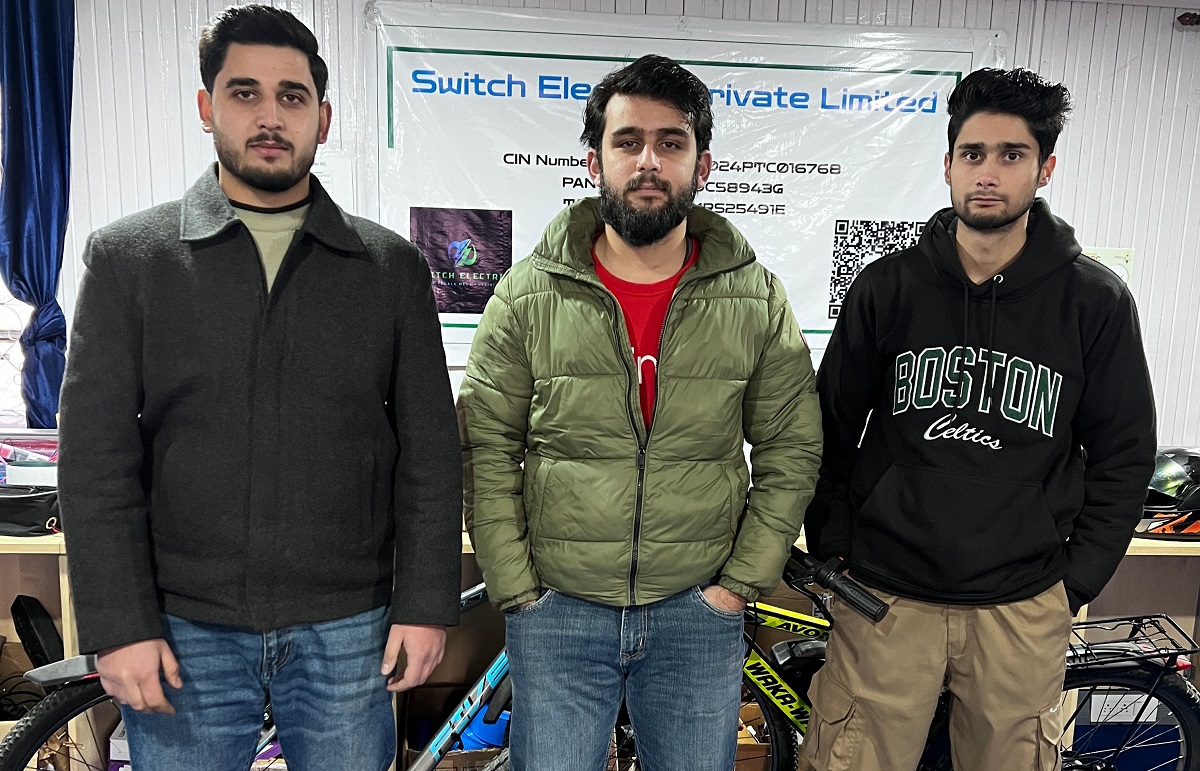
We’re four friends from Kashmir, all studying B.Tech at the University of Kashmir. We work on the startup during evenings and weekends.
Aqid Farooq Shah handles engineering and technical development. Ruman Sajad manages operations, finances, and quality checks. Danish Imtiyaz looks after branding and communication. I work on planning, product design, and overall coordination.
There’s no strict hierarchy. We test ideas together and decide together. What binds us is the belief that meaningful innovation can come from here.
E-cycle kits are available online. Why shouldn’t someone in Sopore just order one of those?
Online kits often look cheaper, but installing them properly requires good mechanical and electrical knowledge. If done wrong, they can be unsafe or fail quickly.
We provide complete, tested systems. We install them ourselves, adjust them for local roads, and offer real after-sales support. We use our own batteries, and there’s accountability if something goes wrong.
We don’t just ship a box. We deliver a working solution with local support.
People in Kashmir are cautious about new technology. How are you building trust?
Trust takes time here. We focus on reliability and staying accessible. We offer a one-year warranty and quick repair support.
More than 20 people are already using our kits. They tell us it saves fuel money and reduces physical strain. One user, Karim, converted his load cart and now travels daily between Srinagar and Lar with less effort and better earnings.
When people see real results and consistent service, trust spreads naturally.
Looking ahead, where do you see Switch Electric in two or three years? Do you stay local or expand?
Kashmir is home, and starting here matters. But if we solve real problems well, growth will come naturally.
For now, our focus is Srinagar and nearby areas. The tough terrain, cold weather, and careful buyers make it the best testing ground. Support for startups is also slowly improving through families, local networks, and schemes.
In a few years, we want strong products and deep trust here. Expansion can come later. We’re not chasing fast growth. We’re chasing solid work.
We want Kashmir to be seen as a place where serious innovation happens, not just where ideas are consumed.
You could have built this elsewhere. Why stay and build in Kashmir? What drives you personally?
Big cities offer easier setups and more funding, but building here feels more meaningful. This is home. Our families are here. We understand these problems deeply.
If we can solve them in a place as challenging as Kashmir, we can solve them anywhere. For me, it’s about responsibility. Instead of asking what Kashmir can give us, we ask what we can give back.
This work is bigger than electric cycles. It’s about showing that places like Kashmir can create valuable, practical solutions when people choose to stay and build with care.