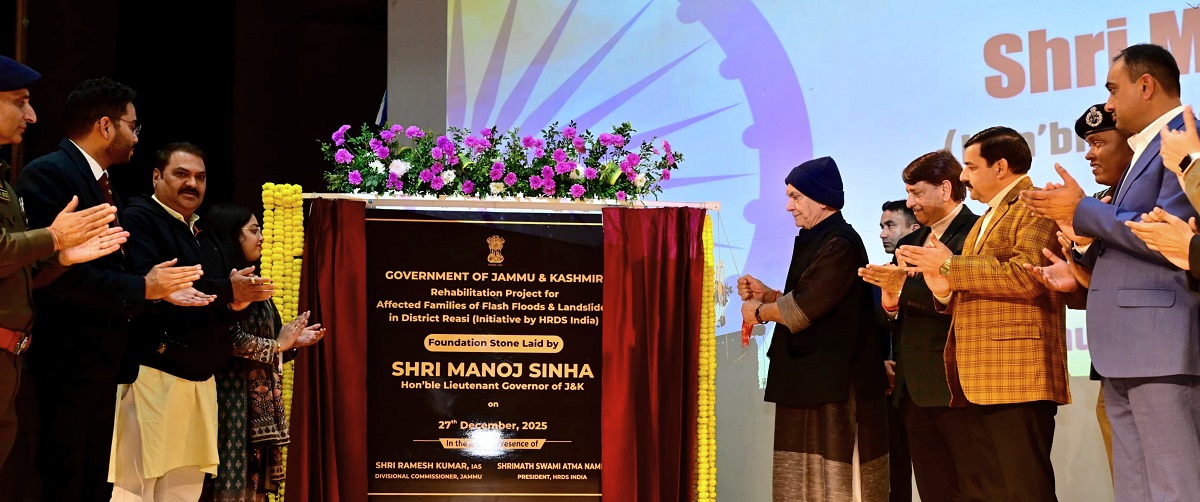
Jammu- Lieutenant Governor Manoj Sinha on Saturday laid the foundation stone for the construction of 320 houses that were completely damaged during recent flash floods and landslides in Reasi district, reiterating the administration’s commitment to ensuring dignity and security for disaster-affected families.
The housing project, to be executed at an estimated cost of Rs 32 crore, is being fully funded by HRDS India. The initiative will provide 320 affected families in Reasi with modern, prefabricated three-bedroom “Smart Houses” without any burden on the government exchequer.
Earlier, the Lieutenant Governor had laid foundation stones for 1,869 houses for families affected by Pakistani shelling during Operation Sindoor and recent natural calamities across eight districts, including Kishtwar, Rajouri, Poonch, Udhampur, Ramban, Jammu, Kathua and Samba.
The Lieutenant Governor praised Swami Atma Nambi, President of HRDS India, and the members of the organisation for their selfless contribution. He said that with the support of HRDS India, the administration’s vision is to ensure that no family affected by natural calamity remains weak or disadvantaged.
“Houses for affected families are not just walls and roofs but they are the embodiment of dreams and aspirations and the foundation for quality living and personal growth for family members,” the Lieutenant Governor said.
Describing the initiative as a replicable development model, he said, “I see this movement as a new revolution and a new model for the country where needy families are being taken care of without involving government money. It gives us a powerful mantra that all should work together for the common good of the UT of J&K and its people.”
The project features state-of-the-art, efficient, resilient and technologically advanced Smart Houses, which are scheduled to be completed within six months of the start of construction. Each house will include a dedicated cowshed to support rural livelihoods.
In addition, HRDS India will provide an extensive social security package to beneficiary families, including 15 years of free life insurance and annual health check-ups for all family members. To ensure long-term sustainability, the organisation will also maintain the houses for the next five years.
Reiterating his broader development vision, the Lieutenant Governor said it has been his sincere effort to ensure speedy and all-round development of the entire Jammu and Kashmir Union Territory. “In the past five years, we had integrated physical, social and digital components to create the best infrastructure while prioritizing a people-first approach to provide dynamism to the development of the UT of Jammu and Kashmir,” he said.
LG also highlighted several infrastructure projects initiated in recent years to enhance connectivity and improve the ease of living for people in Reasi district. Addressing long-pending demands, he announced that work on the underground sewerage system for Katra town would commence within the next six months. He said the Master Plan for Katra is in its final stages and efforts are being intensified for the establishment of an inter-modal station.
He lauded the Chief Executive Officer and the entire team of the Shri Mata Vaishno Devi Shrine Board for their effective response during rescue and relief operations, and outlined several initiatives undertaken by the Board.
The LG said the Board is constructing the Shankaracharya Temple in Katra at a cost of Rs 30 crore to enhance the spiritual landscape and boost local economic opportunities. He said the Board had completed five temples in Reasi last year and is working on another five. Promotion of Sanskrit and Vedic education remains a priority, reflected in a Rs 1.5 crore grant to Kathua’s Chudamani Sanskrit Santhan Nyas and continued support to Sanskrit and Ved Pathshalas and Gurukuls.
He added that the Shrine Board has procured products worth Rs 22 crore from local self-help groups in Reasi and surrounding areas and plans to scale this up to Rs 50 crore. The Board has also reconstructed 15 schools damaged in floods and spent Rs 12 crore over the past seven years on the development of villages around the Holy Shrine.
The LG informed that helipads at Katra and Shiv Khori, built at a cost of Rs 27 crore, are in the final stages of construction and will soon be dedicated to pilgrims, along with the redevelopment of Shiv Khori. An International Museum of the Goddess is also coming up in Katra.
Highlighting pilgrim welfare measures, he said the insurance cover for pilgrims has been increased from Rs 5 lakh to Rs 10 lakh, while around Rs 4 crore is spent annually on medical treatment of devotees. He also underscored the Shrine Board’s commitment to the welfare of Baridar families, noting that assistance has been provided to 777 families for the marriages of their daughters. Under the Kanjak Samriddhi Yojana, 565 girls have been given long-term financial security amounting to Rs 9.49 crore, while 154 girls benefited under the Girl Child Adoption Scheme with an outlay of Rs 3.2 crore.