Manzoor Zargar stands behind a low wooden counter in Srinagar’s downtown, turning a dented silver plate slowly in his hands.
Faded floral patterns catch the light, recalling years when the plate appeared at weddings and family gatherings before spending long stretches wrapped away.
The shop carries the smell of metal dust and polish. Shelves behind him hold bowls, trays, glasses, and utensils that once signaled comfort and standing inside Kashmiri homes.
Zargar has worked here for more than thirty years, long enough to watch silver drift out of everyday life and long enough to see it return with an attention he never expected.
“There was a time when people stopped coming,” Zargar said, placing the plate on a scale and writing down its weight. “Many of us thought this work would end with our generation.”
That fear has eased as the metal begins to matter again.
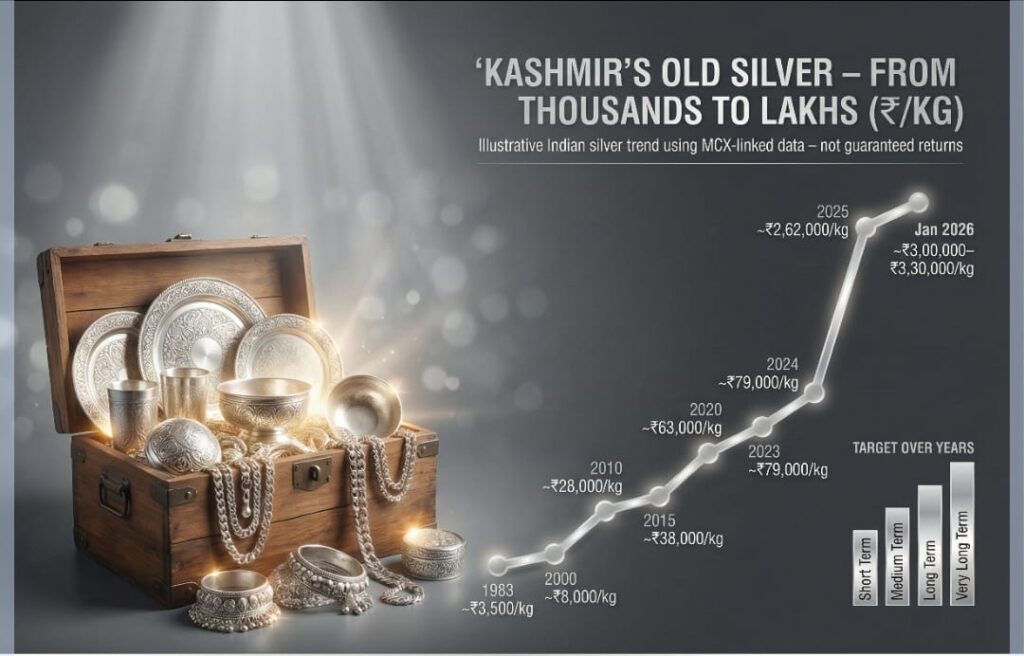
Silver in India, which sold for about ₹17,000 to ₹20,000 per kilogram in the mid 2000s, now trades well above ₹3,00,000 per kilogram in early 2026.
The rise has brought a regular flow of customers back into Zargar’s shop, changing how people talk about silver as they weigh memories against numbers.
Customers arrive with inherited utensils wrapped in cloth, others ask about buying bullion for the first time, and many begin by asking for the rate that now determines the value of a metal once taken for granted.
The path to this moment unfolded over years.
Around 2011, silver climbed toward ₹55,000 to ₹57,000 per kilogram before cooling between 2015 and 2018 to roughly ₹37,000 to ₹41,000.
After 2020, prices crossed ₹60,000, moved toward ₹80,000, and then accelerated into what analysts describe as a super cycle, shaped by industry and investment.
“This rise rests on fundamentals,” said Anil Mehta, a Mumbai based commodities analyst who tracks industrial metals. “Silver now sits at the center of energy, electronics, and finance at the same time.”
What appears on rate boards in Srinagar reflects forces far beyond the city.
Industry now accounts for more than half of global silver demand, according to data from international commodity research firms.
Electronics rely on silver for connectors and circuit boards used in phones, appliances, and communication equipment. Solar energy depends on silver paste applied to photovoltaic cells, tying demand directly to renewable expansion.
Electric vehicles and modern power systems consume more silver per unit than earlier technologies, while medical applications continue to expand through coatings and hygiene products.
“Silver moved from display shelves to supply chains,” Mehta added. “That shift tightened demand in ways traditional markets were never built to absorb.”
Supply has struggled to keep up because most silver comes as a byproduct of mining copper, lead, zinc, or gold, so production cannot rise quickly when prices climb.
New mining projects take years to start, and as industrial use grows alongside investor demand, shortages continue, pushing rupee prices higher after currency conversion and duties.
“Silver reflects how economies change,” said Renu Khanna, an economist who studies commodities and energy systems. “It links household savings, manufacturing pressure, renewable targets, and investor behavior into one price.”
Back in Srinagar, those global forces reach kitchen tables and family discussions.
Farah Tariq, a homemaker from the old city, recently brought a pair of thick silver bangles to a local dealer after hearing daily updates on rates. The bangles came from her mother and sat untouched for years.
“I never thought of them as something valuable,” she said. “Now everyone looks at silver with new eyes.”
Households across the city share that realization.
Scrap payouts remain lower than headline prices because buyers account for refining costs, impurities, margins, and risk.
Plain, heavy items such as solid bangles or utensils fetch stronger rates than ornate pieces with stones or mixed materials.
Even so, the amounts involved have shifted how families think about what they own.
“Our elders always said silver would help the household,” Farah said. “For a long time, that sounded like an old belief. Today the numbers explain it clearly.”
Silver holds deep roots in Kashmiri life.
Families once displayed silver bowls, trays, samovars, and utensils during weddings and gatherings. Women wore silver jewellery to achieve richness without the cost of gold. Artisans engraved chinar leaves, floral motifs, and calligraphy, turning everyday objects into heirlooms.
That culture weakened as tastes changed and gold gained attention.
Many silversmiths survived on repairs and small commissions. The recent price surge has reopened conversations about foresight.
“People talk about what their grandparents saved,” said Farooq Bhat, a jeweller who works in Saraf Kadal. “Those choices look thoughtful today.”
Rising prices have also reshaped daily use. Solid silver utensils have given way to copper, brass, and stainless steel. Jewellery buyers often choose plated designs that offer shine while limiting exposure to price swings.
“Silver has moved from daily use to ceremony and long-term holding,” Bhat said. “It is becoming the new gold.”
Financial markets have added speed, with silver-linked funds and exchange-traded products letting people invest without worrying about storage or purity.
These options have drawn younger buyers who might never step into a traditional shop. They now take part in the rising silver market alongside longtime customers and families bringing inherited pieces.
“Digital access changed who enters the market,” said Mehta. “That participation supports liquidity and confidence.”
Economists describe silver as a signal metal.
“It reflects how energy systems, manufacturing costs, and savings behaviour align,” Khanna said. “Few commodities connect personal choices and national priorities so directly.”
Inside Zargar’s shop, the global story narrows to individual moments. He weighs another bundle, records the figure, and watches as a customer decides whether to sell or hold.
“Some sell because they have to,” he said. “Others decide to keep what they own.”
As evening settles, Zargar arranges the remaining pieces on shelves that have seen years of neglect and revival.
“Silver came back after a long time,” he said. “This time, it came back with purpose.”