
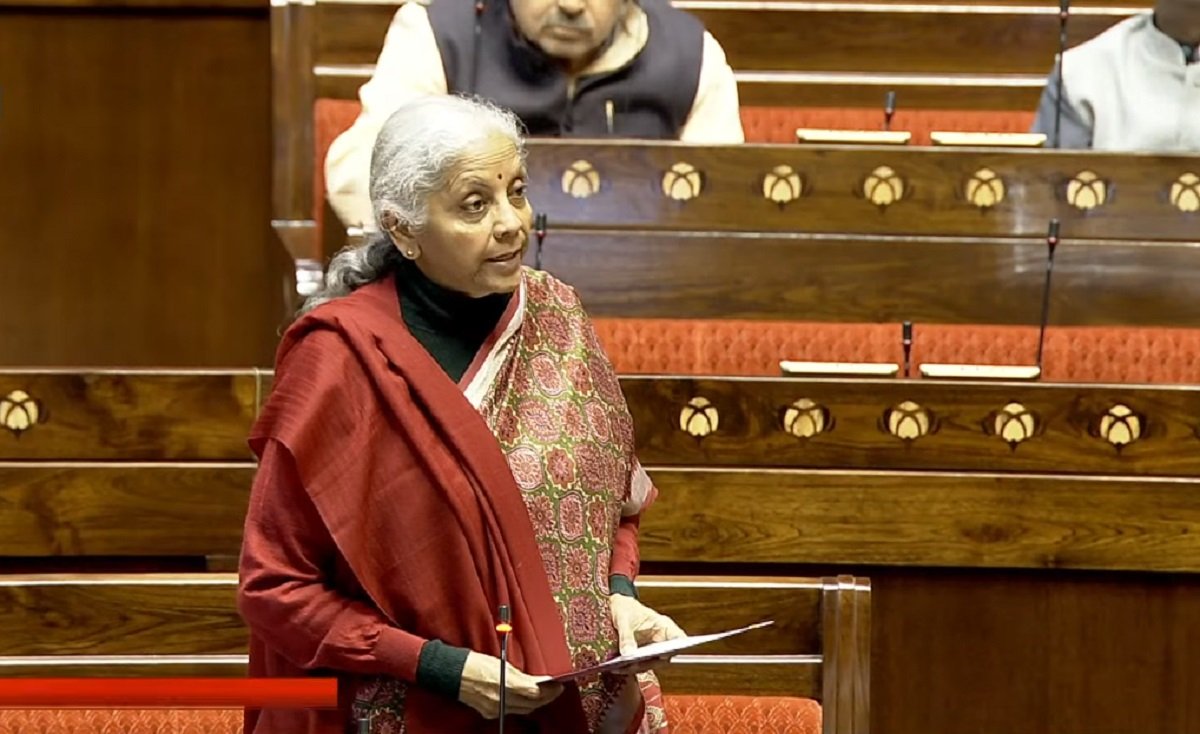
Srinagar- Finance Minister Nirmala Sitharaman on Thursday tabled the Economic Survey 2025–26 in Parliament, projecting GDP growth for the next financial year in the range of 6.8 to 7.2 percent and flagging global uncertainties while maintaining that India’s economy remains on a steady expansion path.
The Survey estimated medium-term growth potential at around 7 percent and said the economy is adapting to structural reforms, including changes in the Goods and Services Tax. It described FY27 as a year of adjustment, noting that growth projections for the next fiscal are lower than the 7.4 percent expansion estimated for the current year.
Prepared by the Economic Division of the Department of Economic Affairs under the supervision of the Chief Economic Adviser, the Economic Survey is presented annually ahead of the Union Budget to assess economic performance and outline short- to medium-term prospects. The first Survey was presented in 1950–51 and was separated from the Budget documents in the 1960s.
On fiscal management, the Survey said the government remains on track to achieve its fiscal consolidation roadmap and aims to meet the fiscal deficit target of 4.4 percent of GDP in FY26. Inflation in FY27 is expected to be higher than the current year but is unlikely to pose a major concern, it said.
The Survey called for caution amid an uncertain global environment but said there was no reason for pessimism about India’s economic trajectory. It also noted that the rupee’s valuation does not accurately reflect the country’s strong economic fundamentals.
Raising concerns over social and digital challenges, the Survey called for reducing reliance on online teaching tools that expanded during the Covid-19 pandemic and promoting offline engagement. It recommended age-based access limits for social media platforms and said companies should be made responsible for enforcing age verification and age-appropriate default settings. The Survey also suggested promoting simpler devices for children, such as basic phones or education-only tablets with content filters.
On public health and nutrition, the Survey advocated restrictions on the marketing of ultra-processed foods, including a proposed ban on their advertising between 6 am and 11 pm. It also recommended introducing a nutrient-based tax on ultra-processed foods, with the highest GST rates and surcharges on products exceeding thresholds for sugar, salt, or fat.
The Survey pitched for reforms to improve working conditions for gig workers and called for a National Input Cost Reduction strategy to enhance competitiveness. It said a free trade agreement with Europe could strengthen India’s manufacturing capacity, export resilience, and strategic positioning.
On trade and industrial policy, the Survey said a disciplined approach to Swadeshi was necessary in the context of export controls and technology denials by developed countries, while cautioning that not all import substitution is feasible or desirable. It proposed a transition from Swadeshi to what it termed “strategic indispensability,” where Indian products become a default global choice.
The Survey also warned of the risk of financial contagion if the global artificial intelligence boom fails to deliver expected productivity gains, potentially triggering corrections in asset valuations. It added that prices of gold and silver are likely to continue rising due to sustained demand as safe-haven assets amid global uncertainty.
US tariffs ‘most disruptive’
India must focus on building enduring national capabilities and economic sovereignty in the face of shrinking space for rules-based trading, anti-immigrant stance, weaponization of energy sources and growing use of export controls in critical sectors, the Economic Survey said.
It said the global economy has been subjected to “multiple upheavals” and the “most disruptive” amongst these disturbances was the imposition of tariffs by the US on imports from its trade partners.
In a world where economic relationships are increasingly strategic and contested, the ability to learn becomes a core element of “statecraft”, it said, noting that India must build enduring national capabilities to deal with the challenging geopolitical scenario.
The assessment comes against the backdrop of growing concerns over the Trump administration’s policies on trade, tariffs and immigration, China’s export control measures relating to critical minerals and increasing disquiet in the West over India’s energy ties with Russia.
The Survey also said that the telecom sector has seen an increase in exports, a decline in imports, with locally-produced gears under production linked incentive scheme clocking sales of Rs 1 lakh crore.
“The telecom sector has achieved notable success, with exports rising by 1.5 per cent (average annual growth rate), while imports have concurrently declined by 18.5 per cent (AAGR),” the Survey said.
The Union Budget for 2026–27 will be presented by Sitharaman on Sunday, marking her ninth consecutive Budget, a first for a woman finance minister in the country.