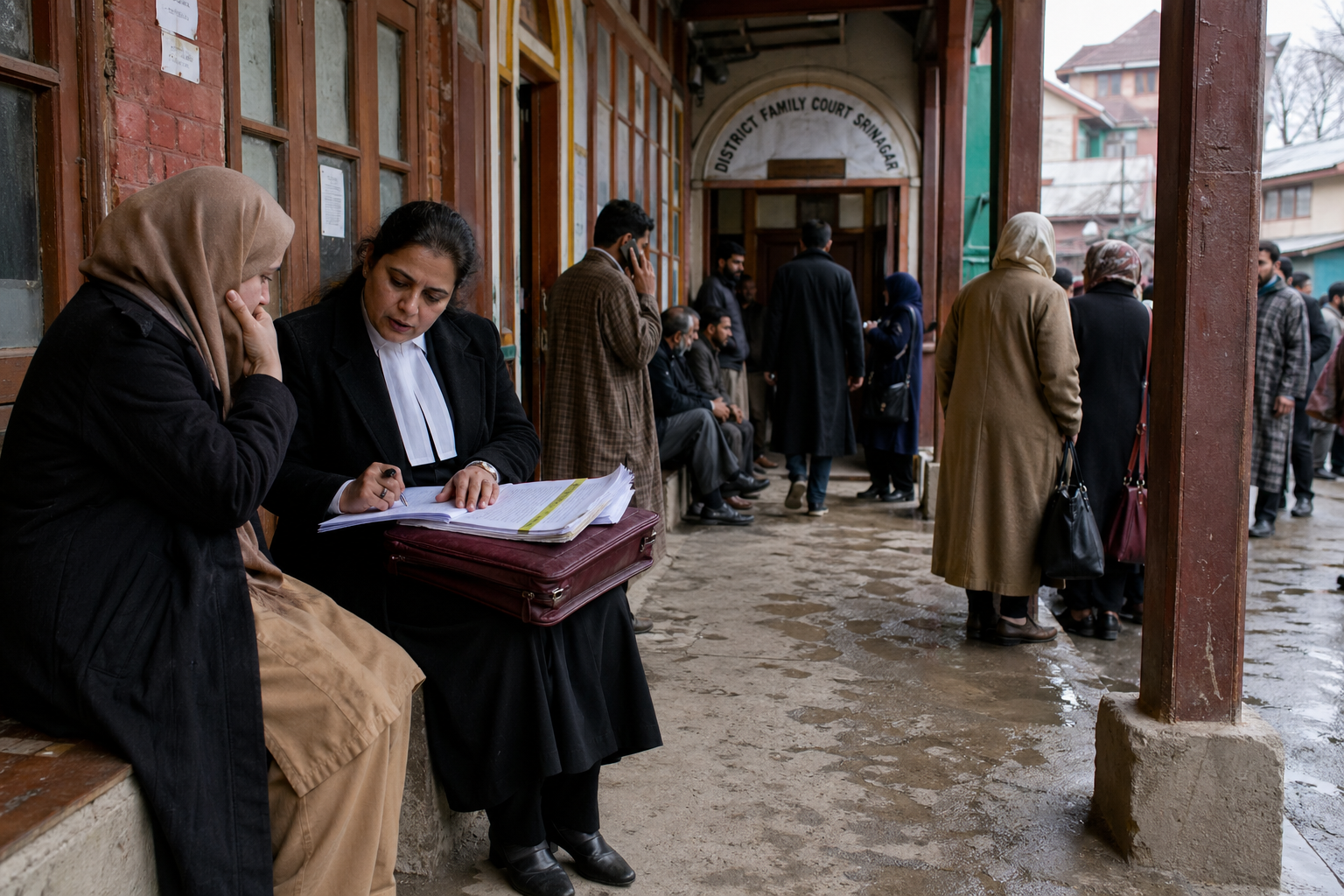

The corridor outside Srinagar’s family court smells of damp wool and stale tea. On a cold March morning, Rehana adjusts her dupatta while her lawyer, Haseena Akhtar, arranges papers inside a worn leather briefcase.
Rehana spent six years inside a marriage that demanded everything and gave slim comfort. She cooked, cleaned, earned a salary, and raised two children. Her husband’s family always wanted more.
“Household chores are easy,” they said. “She should adjust further.”
Rehana finally walked out. Her case joins a flood of matrimonial petitions swamping Kashmiri courts.
Advocate Akhtar sees this discord daily. “Couples arrive with egos larger than their commitment,” she tells me inside a cramped chamber near the courthouse. “Wives file domestic violence complaints over small disputes. Husbands hurl suspicion and abuse over equally minor issues. Both sides focus on ego while marriage demands coexistence plus cooperation.”
She points to a nearby stack of files. Each folder represents a home where love surrendered to demands.
Nasirul Islam, grand mufti of Jammu and Kashmir, estimates divorce cases jumped roughly thirty percent since 2012. Courts that handled five or six divorces monthly now see ten, with reconciliation efforts succeeding rarely.
By 2025, Kashmir posted three to five divorce filings every single day. The 2011 census recorded Jammu and Kashmir’s divorce incidence at a mere 0.34 percent. That figure now belongs to another era entirely.
I travel to downtown Srinagar to meet Ghulam Qadir, a matchmaker who has arranged marriages for three decades. His room sits adjacent to a bakery on Nawhatta Road. His diary pages are filled with names, occupations, and demands.
Qadir sips kehwa from a cracked cup and explains the shift.
“Parents used to seek character and compatibility,” he says. “Today they bring endless list. The groom must earn a specific salary. The bride must possess a particular degree. Both families want immediate nuclear households, separate kitchens, limited interference. They expect paradise on a government salary.”
His observation aligns with broader research.
A 2024 study on evolving marriage traditions among Muslims in Jammu and Kashmir documents how education and employment aspirations now delay unions significantly.
The average marriage age reached 31.5 years for men and 27.8 years for women, far exceeding national averages.
Another study identifies three primary drivers behind this delay: completion of education, unemployment, and financial preparation.
Young Kashmiris spend years building careers, but enter matrimony with expectations that money alone satisfies poorly.
At a city police station, an inspector scrolls through complaint logs on a computer screen. Domestic dispute calls consume an increasing share of police time.
“We receive allegations that range from genuine cruelty to trivial disagreements,” the station incharge says. “A mother-in-law’s sharp comment becomes a police case. A husband’s late return from work triggers a harassment complaint.”
The cop cites Supreme Court rulings that cautioned against automatic arrests in matrimonial disputes, including the 2014 Arnesh Kumar judgment, which demanded proper investigation before detention.
The court recognized that laws designed for protection sometimes transform into tools for harassment.
The SHO opens a file on his desk. A local teacher married a businessman last year. The wedding cost her family eighteen lakh rupees. Within two months, she returned to her parents’ home citing emotional distance.
The husband counters that she demanded a separate house immediately after marriage while he faced business losses.
Both parties now exchange criminal complaints. The file grows thicker. The marriage itself ended within weeks.
This economic dimension haunts every marital discussion.
Kashmir Observer previously reported how families routinely spend between ten and thirty lakh rupees on ceremonies, gold, and furniture. Parents view these expenses as investments in stability. When marriages end within days or weeks, the financial devastation compounds the emotional pain.
I meet Abrar Hussain, another lawyer, in the canteen of Srinagar’s district court. He traces much of the crisis to what he calls “emotional illiteracy.”
“People plan weddings with precision,” Abrar says. “They select photographers, venues, and menus. They omit planning the actual marriage. Communication skills elude them, apology remains a foreign concept, and listening becomes a lost art.”
He points to a 2026 study on social media and marital dynamics among Kashmiri couples, which found that excessive online usage creates “technoference,” trust erosion, and addiction patterns when couples establish few boundaries.
Another recent study links social networking sites directly to infidelity behaviours among young Kashmiri couples.
Abrar’s analysis echoes through the coffee shops of Srinagar.
One evening, I sit with Tariq, a 32-year-old accountant who married his college sweetheart. Dark circles shadow his eyes. He works fourteen-hour days to cover EMIs, grocery bills, and school fees. His wife complains about his absence.
“She sees me as a machine built for earning,” he says. “My exhaustion holds small value for her. I feel like a donkey running a race that continues forever.”
His voice wavers. Men throughout Kashmir absorb similar pressures. Society teaches them to provide and protect, while emotional breakdowns earn only ridicule.
The burden falls on both partners. Inside his Bemina home, mediator Rouf Bhat spends six days each week attempting to salvage faltering unions. His waiting room stays full.
“Women arrive expecting constant attention and grand romantic gestures learned from Instagram,” Bhat explains. “Men arrive expecting obedience and silent management of household labour. Both want the role while understanding the responsibility poorly.”
He describes a case last month where a bride demanded her husband delete every female contact from his phone. He declined.
She filed a domestic violence complaint. The marriage ended before their first anniversary.
Bhat’s mediation records reveal a notable thread: family interference.
“Marriages here involve entire households trying to control the relationship,” he says. “Parents interfere, siblings influence decisions, and personal conflicts become family wars.”
This matches Advocate Abrar’s observation about extended family members pursuing vested interests ahead of solutions.
The systemic picture extends beyond individual actions. Mudasir Ahmad, a social activist, notes that poverty and unemployment in Kashmir place enormous strain on households.
“Poor families face enormous financial burdens after marriage,” he says. “Husbands appear overwhelmed at managing expenses. Wives demand more than the budget allows. The pressure explodes.”
Youth often grasp marriage’s gravity poorly, he adds, letting ego end partnerships before they mature.
Back at the family court, Rehana signs her final papers. Her children wait outside with an aunt. She tells me she feels lighter, though the future remains uncertain.
“I gave everything,” she says. “Everything always proved smaller than my effort.”
Her words capture the central tragedy.
Marriage in Kashmir once rested on patience, compromise, and mutual growth. But today, many couples approach the institution with demands above understanding, checklists above compassion, and ego above emotional maturity.
Rehana steps into the afternoon light. Behind her, another couple enters the courthouse, holding hands, still believing their love will beat the odds.
The corridor smells the same, the tea grows colder, and the cycle continues.