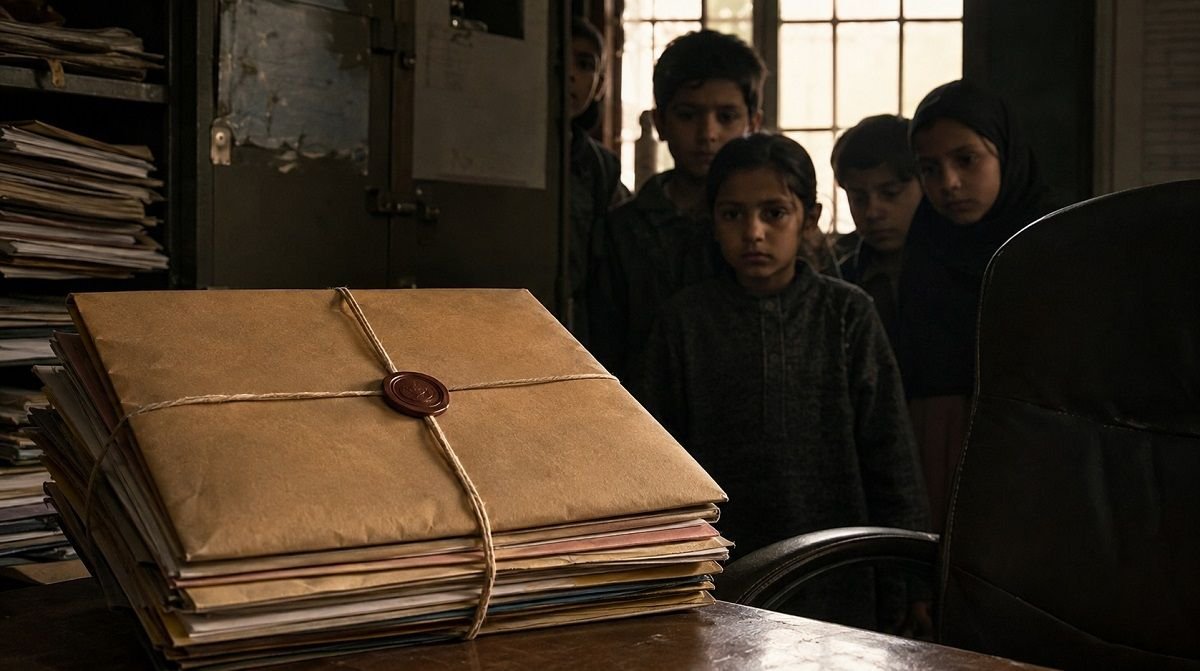

Srinagar’s Social Welfare Department keeps a sealed cover in a government office, and inside it sits the answer to a question that has consumed courtrooms, careers, and the lives of children who have no lawyer to speak for them.
The cover holds interview results for the chairperson and six members of the Jammu and Kashmir Commission for Protection of Child Rights, a body Parliament ordered into existence in 2005 and that still, twenty-one years later, does not legally exist.
A 42-year-old academic in Srinagar knows exactly what he thinks belongs in that cover, and what does not.
He holds a Ph.D. in law from the University of Kashmir, a doctoral thesis on human rights, and a Master of Laws with Distinction from a university in the United Kingdom. He cleared the UGC-NET and JRF examinations in both law and sociology.
Since April 2023, he has served as a member of the Child Welfare Committee in Srinagar, under the same department now running this selection.
Under the government’s own published scoring formula, he would score maximum academic marks before an interviewer asked him a single question. He was not shortlisted.
And no one told him why.
His experience traces back to a citizen named Musab Omer, who filed a Public Interest Litigation before the Jammu and Kashmir High Court in 2020 after noticing that the Commission required by the Commissions for Protection of Child Rights Act simply did not exist in the region.
The Act had passed Parliament in 2005, obligating every state and union territory to build a body to monitor child welfare and investigate violations of children’s rights.
Jammu and Kashmir let seventeen years pass before it even notified its own rules, in 2022, and did that only after the High Court ordered it to move.
The Social Welfare Department finally advertised the posts on 15 June 2023, listing six qualifying disciplines lifted directly from Section 17(2)(b) of the Act: education, child health and welfare, juvenile justice, elimination of child labour, child psychology or sociology, and laws relating to children.
Applications closed on 30 June 2023.
Then, on 30 May 2024, the government withdrew that advertisement from its very beginning, canceling every application it had received, without a public explanation on record anywhere.
Five months passed, and on 18 October 2024, a new advertisement appeared under the same file number, and it contained something no version before it had: a qualifying field called Management, which does not appear anywhere in the statute Parliament wrote.
The scoring system shifted with it.
The interview’s weight dropped from thirty points to twenty, while the pre-interview academic component, now open to management graduates alongside child-welfare specialists, climbed to eighty.
That single addition became the fault line running through everything that followed.
Four of the five listed disciplines trace directly to Section 17(2)(b). Management does not, and legal observers have struggled to find any reading of the statute that would justify it.
The government has offered no noting, press statement, or legal argument for its inclusion, and that silence has raised an uncomfortable possibility: that the field was written into the advertisement to open a door for candidates who hold business degrees but lack grounding in child protection.
The advertisement also promised a hundred-point merit formula, sixty for academic qualifications, twenty for experience, twenty for the interview, that would have ranked all 548 applicants before anyone sat for an interview.
The department never used it.
On 25 October 2025, a shortlist appeared instead: twenty-one names for chairperson, twenty-eight for member, with no published marks, no disclosed criteria, and no account of why candidates who would have topped the advertised formula never made the list.
The Supreme Court’s 2025 Constitution Bench ruling in Tej Prakash Pathak v. Rajasthan High Court settled this exact question, holding that once an authority advertises a merit formula, it must apply it rather than discard it when the results become inconvenient.
Candidates who were excluded went to court, as citizens in a functioning democracy do.
Shalini Sharma filed a writ petition on 7 November 2025, three days before interviews were set to begin, and won a stay on the results.
Interviews proceeded anyway on 10 and 11 November, with results sealed and handed to the court.
On 20 November, Dr. Shahid Ahmad Ronga filed a broader challenge, contesting the legality of the entire process, from the Management qualification to the missing merit list to the department’s failure to meet the fairness standard written into Rule 4(3) of the 2022 rules.
On 1 July 2026, a Division Bench dismissed Sharma’s petition as settled, since she had gotten her interview, and lifted the stay.
Appointments could proceed, the court said, though any appointments made would remain subject to whatever the court decides in Ronga’s still-pending case, a case the government has yet to answer eight months after it was filed.
That leaves Jammu and Kashmir’s child rights watchdog suspended in a strange legal condition, cleared to name a chairperson and members while a case challenging the legitimacy of their selection sits unresolved before the same bench.
The High Court will take up that question on 29 August 2026, and it comes down to a plain reading of statute: did Parliament ever authorize a management degree as a qualifying field for a child rights commission.
The text says it did not.
Between now and that hearing lies the real test. The government can wait for the court’s answer, or it can open the sealed cover and make appointments while the challenge still stands, building a commission whose founding act defies the law that created it.
Twenty-one years after Parliament first ordered this body into being, Jammu and Kashmir’s children remain without the one institution built to answer for their welfare, and the government now holds the choice of whether to hand them a commission the law can trust, or one it can still tear down.