
By Dr. Fiaz Maqbool Fazili
Official power ends in small subtractions. The office is vacated, the nameplate comes down, the files are closed and the corridors of authority fill with other people.
The chair disappears, but the voice acquired beside it survives, and for some retired officials it grows into a second career in representation.
Yesterday they exercised authority through an institution, but today they claim legitimacy through a letterhead.
The method is common.
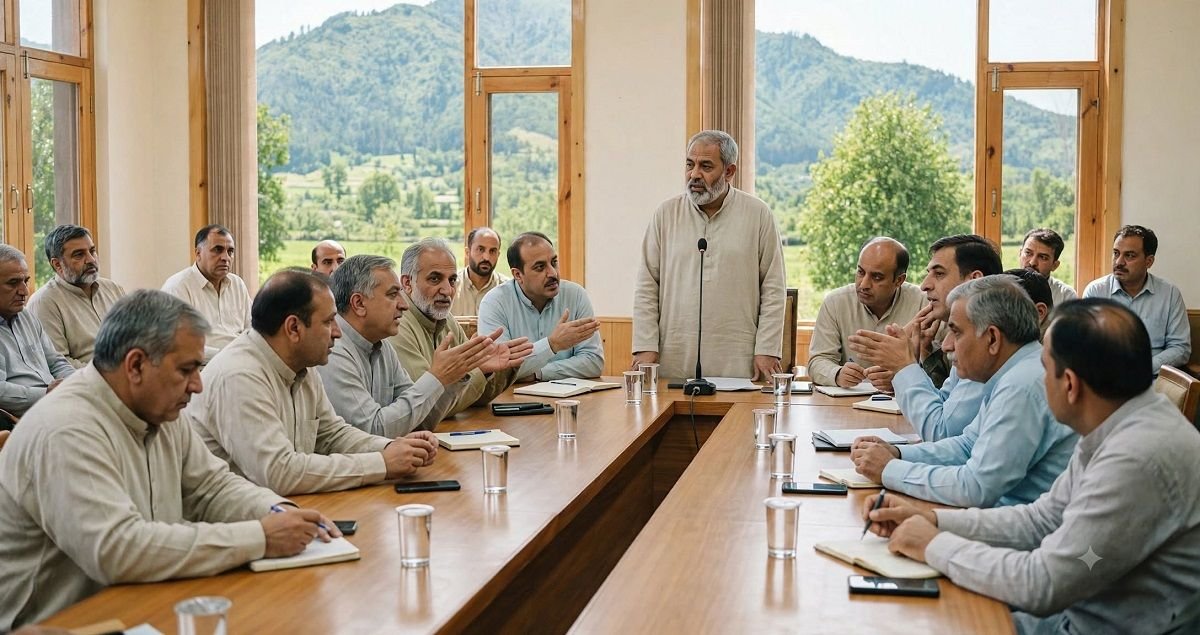
A few known faces gather, an organisation is formed and a grand designation is coined. A handful of agreeable voices become a forum, the forum becomes civil society, and civil society, rendered as concerned, conscious or sensitive citizens, becomes the voice of the people by some curious alchemy.
Someone starts a WhatsApp group. The discussion runs on without result and ends by fixing the date of the next general body meeting.
Where, in all of this, did the public hand over its voice?
A press release is easy, a memorandum is easier, and a photograph is easiest of all.
Titles make relevance visible, and they open doors to people in power and to the press. The harder work is harder to show: staying engaged, asking tough questions, following up with institutions and demanding accountability after the story has moved on.
The result is a politics of the one-day concern, an issue born in a press release, sustained by a headline and forgotten before the ink dries.
The chronology of conviction tells more.
Some questions become public causes only after the people raising them have left office. Positions surface in retirement that were missing, or even resisted, while the same individuals held institutional authority.
People may change their minds, and intellectual honesty sometimes demands it. The difficulty begins when a person pretends never to have held the earlier view.
A society that values public memory should be able to ask such questions without being accused of disrespect. Experience earns regard but no immunity from scrutiny. Retirement confers no second, invisible office of Permanent Representative of the Public Conscience.
Having something to say is a right all citizens share, but a mandate to speak for others has to be earned.
An NGO cannot manufacture a constituency, a designation cannot manufacture legitimacy, and a newspaper headline cannot manufacture consent. Proximity to former power cannot manufacture democratic authority either.
Public life has begun to mistake visibility for legitimacy, publicity for advocacy, association for representation and repetition for public opinion.
The danger is subtle. Institutions do not have to collapse for the public voice to grow weaker. It happens when those most comfortable speaking for the public slowly take over that space, leaving citizens as spectators instead of participants.
Former officials can bring their experience to public life, and citizens can organise, criticise, advocate and dissent. Any claim of representation still meets one elementary democratic question: where is the mandate?
A city is a community of citizens who all hold a voice, and none of them holds the right to confiscate the voices of the rest. The most democratic sentence a self-appointed public leader can learn is also the simplest: “I speak for myself, unless the people have asked me to speak for them.”
Holding up this mirror accuses no one. It helps all of us see ourselves more honestly.
- The author is a senior consultant surgeon, who writes frequently on healthcare reforms. He can be reached at [email protected].