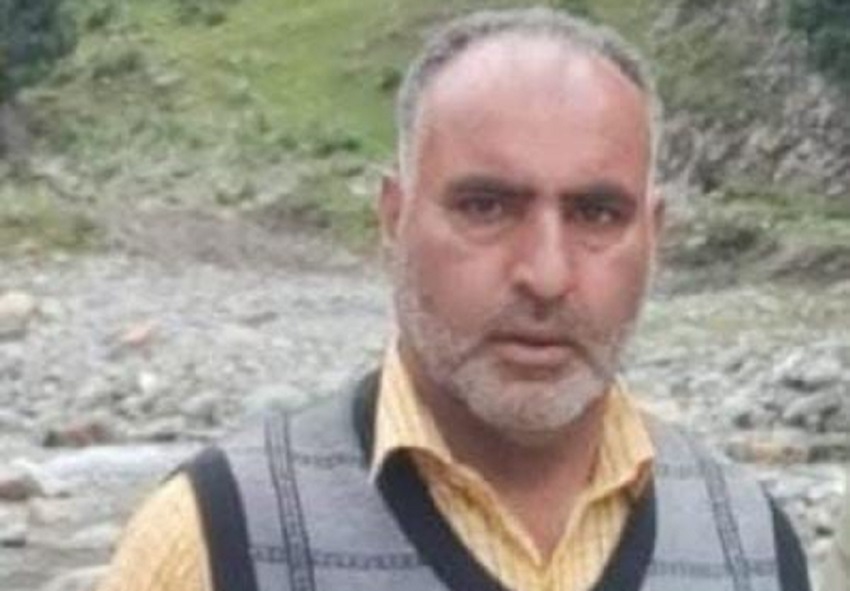

On the morning of December 7, 2025, the streets of Changoo lay still. Most government employees stayed home for Sunday, while Gull Mohammad Shah, 54, a forest guard with the Jammu & Kashmir Forest Department, set out into the predawn cold.
The temperature hovered around minus five degrees as Shah made his way toward Hengipora, a dense forest in the Verinag range of Anantnag district, where a fire had been smoldering since December 5.
The elderly forest guard and a handful of colleagues had spent the previous two days trying to contain the blaze. They acted without protective clothing, fire beaters, helmets, and breathing equipment. Their only tools were bare hands, muck, and sheer determination.
In compartment 48 of the forest, as they tried to move away from advancing flames, Shah slipped down a steep slope of more than 50 meters. His injuries were grave, and he died while being transported to the Government Medical College Hospital in Anantnag.
His death exposes a long-standing neglect in forest protection and the vulnerability of those assigned to protect it.
Reports from local media indicate that this is not a single tragic incident but part of a pattern of systemic failure in the region.
Forest guards risk their lives every day, particularly during peak fire seasons, without the proper tools or training to manage such hazards.
Jammu and Kashmir is recognized by the Ministry of Environment, Forest and Climate Change as a major forest fire hotspot in India.
Between November 2023 and June 2024, fires affected over 438 square kilometers of land. In the 2024-25 financial year, authorities reported 1,243 forest fires, which destroyed more than 3,550 hectares of forest cover, representing a massive environmental and economic loss.
In February and March 2025 alone, 91 fires damaged 136 hectares, followed by 127 fires in April that affected 174 hectares.
While fires temporarily decreased between May and September, they surged again in autumn, coinciding with dry conditions and rising temperatures that heighten wildfire vulnerability.
Satellite monitoring by the Forest Survey of India provides real-time alerts and large fire updates, but the effectiveness of this technology depends on timely action from local authorities.
Despite a nationwide remote monitoring system and financial support under the Centrally Sponsored Scheme for Forest Fire Prevention and Management, ranging from Rs 28 crore to Rs 39 crore annually over the last five years, frontline officials still operate with minimal resources.
During a recent visit to the Pir Panjal mountains near Tatakoti, layers of black carbon coated the snow. This fine particulate matter results from incomplete combustion during wildfires and poses serious health risks, contributing to climate warming and respiratory illnesses.
In Srinagar, air quality frequently crosses an AQI of 175 during dry spells. Forest fires, local experts emphasize, exacerbate air pollution, compounding public health challenges.
The creation of charcoal and burning of plastic waste inside forests, often by visitors or local communities, further fuels these fires.
Over the past five years, tourists and locals have discarded large amounts of plastic inside forests, sometimes intentionally burning it, inadvertently setting fires.
While the Compensatory Afforestation Fund Management and Planning Authority has approved nearly Rs 950 crore for Jammu and Kashmir over the last three financial years, much of it remains unutilized.
Forest officials continue to rely on improvised methods, fighting blazes with sticks, muck, and sand. Proper gloves, fire-resistant clothing, breathing equipment, and vehicles capable of reaching remote forest blocks are largely absent.
The department’s small workforce, 10 to 15 officials in forest blocks spanning 50 to 60 square kilometers, struggles to monitor and protect these vast areas.
Technology offers solutions that remain largely untapped. Drones, capable of surveying fires and carrying water or fire retardants, could provide early detection and rapid response.
Solar-powered water tanks in remote forest areas could aid both irrigation and firefighting. Helicopters equipped for aerial water drops would dramatically increase containment capabilities.
Each year that these resources remain unimplemented, forests shrink and lives are put at risk.
Frontline workers deserve recognition and protection comparable to that of police or healthcare staff, who operate under risk allowances and overtime policies.
Forest guards, like Gull Mohammad, face threats that are immediate and lethal, but their compensation and support structures lag far behind.
They work long hours, often in extreme weather, without basic firefighting gear. Fire extinguishers, protective suits, and standard safety equipment are rare, leaving them exposed in life-threatening situations.
The forest guard’s death shows that protecting Kashmir’s forests means protecting the people who guard them.
These forests sustain air, water, and communities. Fires destroy both land and lives. Technology and training exist, but without political will, more lives will be lost and forests destroyed.
Shah’s sacrifice calls for swift action, reform, and accountability.