By Syed Sammar Mehdi
Shabir Sultan, a schoolteacher from South Qamarwari, walked into the local community hall one cold December morning with a thin folder under his arm. Inside were papers he had carried from one office to another for months, trying to update his ration card.
This time, he hoped things might be different.
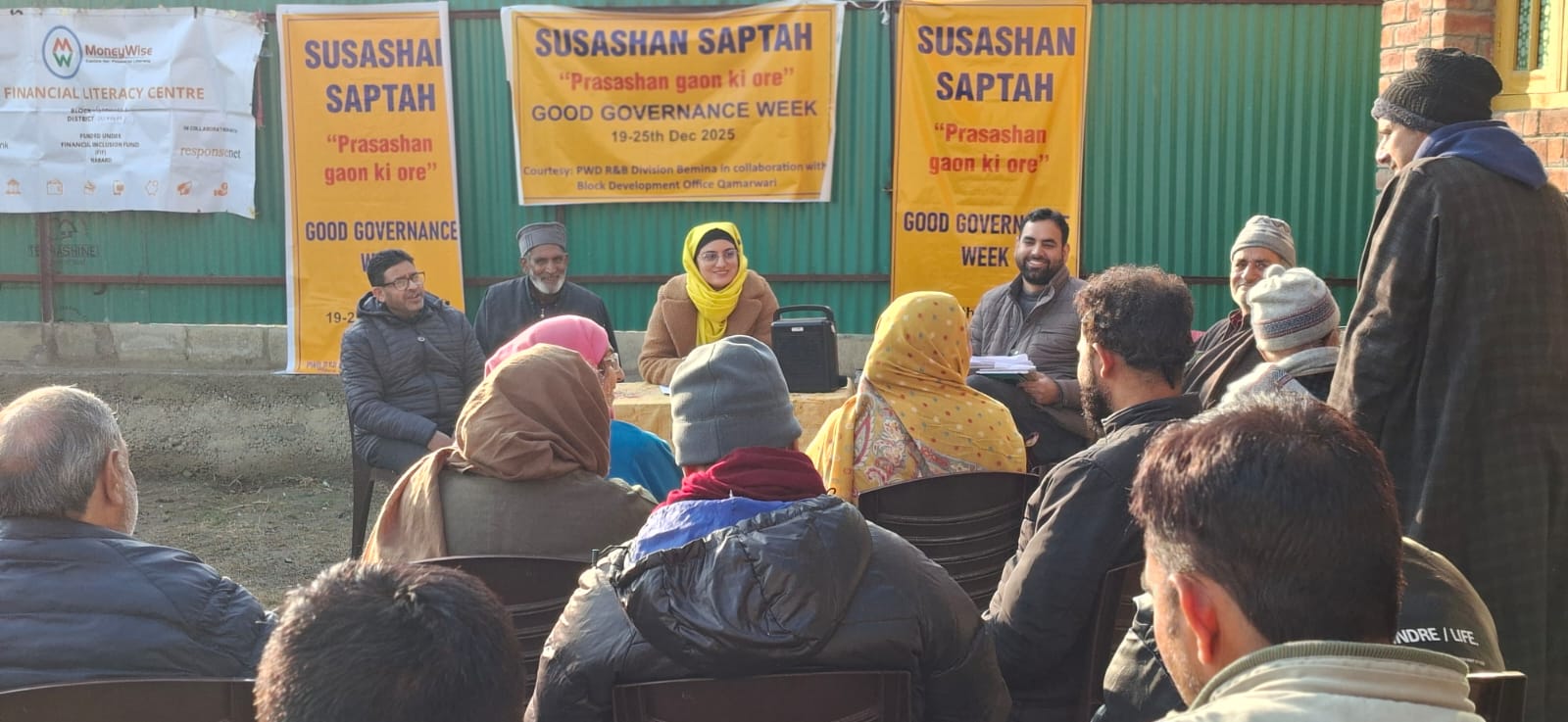
From December 19 to 25, South Qamarwari hosted a grievance redressal camp under Prashasan Gaon Ki Ore, part of Sushasan Saptah, a week-long initiative focused on good governance.
Organized by the Block Development Office of Qamarwari, the camp brought government officials directly into the neighbourhood, away from distant offices and into everyday life.
Inside the lawn, long tables were lined with officials from different departments of District Srinagar. Residents came in steady streams. Some carried written complaints. Others came with questions about welfare schemes they had heard of but never fully understood.
Officials listened carefully, took notes, and in many cases, offered solutions on the spot.
“The idea is simple,” said an official at the camp, requesting not to be named as he was not authorized to speak formally. “People should not have to run from office to office. Administration must reach them, especially in winter when movement becomes difficult.”
Farida Mushtaq, a mother of three, had been struggling to find support for her children’s school expenses. “I kept asking where to go, but no one explained it clearly,” she said.
At the camp, officials guided her through the process and registered her under a suitable welfare scheme. She left with information she had been seeking for months.
Nearby, Bilal Khan, a local shopkeeper, raised concerns about sanitation delays in his area. “Usually, you file a complaint and hear nothing back,” he said. “Here, someone listened.”
Such camps are part of a larger push by governments across India to improve last-mile delivery.
During Sushasan Saptah, administrations review grievances, speed up approvals, and try to ensure welfare schemes reach eligible citizens.
Officials say thousands of applications and complaints are addressed each year during these outreach efforts, especially in districts with dense populations and high service demand.
In cities like Srinagar, the need is sharp.
Rapid urban growth, rising costs, and limited job opportunities have strained families. Many residents face urban poverty, insecure livelihoods, and poor access to government offices.
For them, even small delays can push households deeper into financial stress.
“These camps matter because they lower the barrier between people and power,” said Nighat Dar, a Srinagar-based social activist who works on urban welfare issues.
“When systems are hard to access, the poorest suffer the most. Bringing officials into neighbourhoods restores some balance.”
As the days passed, the mood at the camp changed.
What began with hesitation slowly turned into conversation. Neighbours exchanged advice. Officials stepped out from behind tables to explain procedures and clear doubts.
For a brief moment, the distance between citizens and administration narrowed.
When Shabir’s turn finally came, he placed his folder on the table and explained his problem.
The official checked the records and assured him the issue would be resolved within days.
“That’s all I wanted,” Shabir said softly. “Someone to listen.”