By Dr. Mushtaq Rather
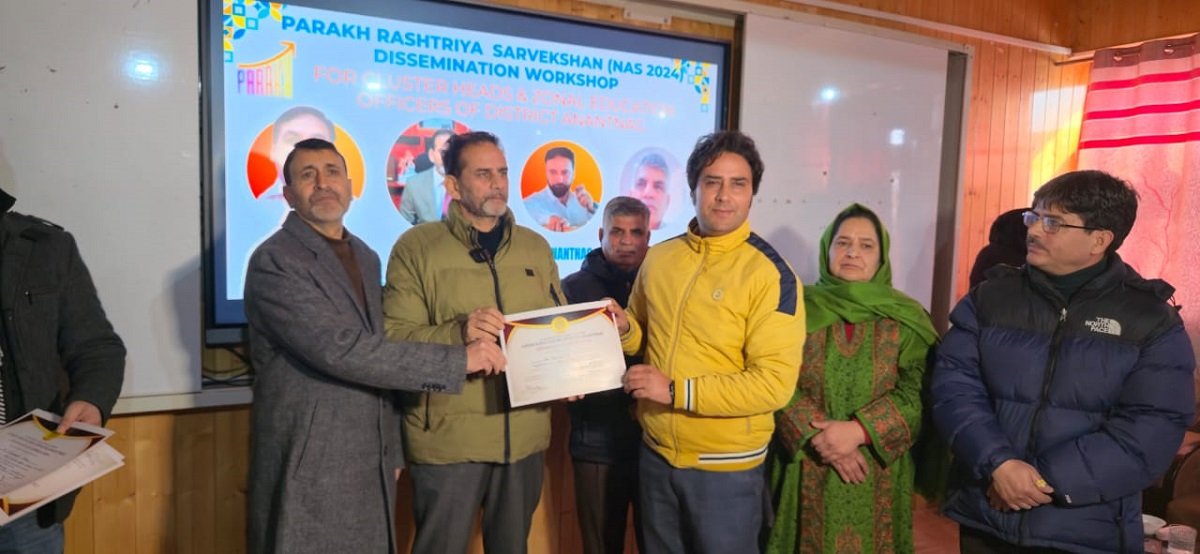
Naveed Gull’s science classroom at Model Higher Secondary School Kokernag in Anantnag buzzes with creative energy.
He moves among his students, guiding them through experiments using simple, everyday materials.
A pulley swings, chemicals bubble, and a small stream outside turns into a living lab. Students watch, touch, ask questions, and test their ideas.
They think about what happens, talk about the results, and try again.
The classroom feels alive because learning happens through curiosity, and every student is part of it.
Gull has changed what it means to be a teacher. He works as a guide, a mentor, and a partner in learning. Science in his classroom grows through discovery and hands-on work, where students learn by exploring ideas together.
The National Education Policy 2020 supports this way of teaching and encourages classrooms that focus on experience, curiosity, and active learning.
The National Curriculum Framework for School Education highlights the same idea.
Students observe the world around them, design experiments, and use their local environment as a laboratory.
A garden, a pond, or even a classroom corner can spark experiments. Learning connects to real life. Concepts become meaningful and memorable.
Kolb’s Experiential Learning Cycle shows why this works.
It starts with doing. Students perform an experiment and feel the process in action. Reflection follows. They think about what happened and compare it to what they already know.
Abstract thinking comes next.
Students form ideas and connect observations to scientific principles. Then they test these ideas in new situations.
The cycle continues, and every hands-on activity strengthens understanding.
In Gull’s classroom, students collaborate naturally. They share results, challenge ideas, and solve problems together.
They develop skills beyond science, like communication, teamwork, and critical thinking. These skills prepare them for life and work.
Low-cost materials make experiments accessible to every student. Curiosity drives the day, and engagement shapes learning.
The benefits appear in how students understand and remember concepts.
Learning through experience strengthens memory and creativity. Students gain skills that go beyond grades. They test ideas, adapt, and solve problems. Different learning styles are supported, and every student finds a way to participate.
This method makes science accessible and exciting in Kashmir, where resources are limited.
But despite this deligent classroom conduct, challenges exist.
Hands-on teaching requires energy, preparation, and imagination. Field trips, experiments, and projects need planning. Teachers used to lectures must adjust their methods. Standard exams rarely show what students learn through experience.
However, Gull overcomes these challenges with focus, creativity, and dedication. His classroom shows that meaningful learning thrives when curiosity leads the way.
This approach addresses bigger needs in Kashmir’s education system.
Students develop scientific thinking, problem-solving, and curiosity. They become capable of handling challenges with practical skills and creative ideas. Education becomes more than exams. Classrooms become spaces for exploring, experimenting, and growing. Students experience learning instead of memorizing it.
By the end of the day, students leave Gull’s classroom with excitement.
A chemical reaction sparks discussion. A stick bridge stands under testing. Tiny organisms in a pond invite wonder and conversation.
Each experience leads to reflection, new questions, and another round of experiments.
Learning flows continuously. Students think, test, and explore ideas actively. The classroom becomes a laboratory for understanding and imagination.
Naveed Gull’s work shows how education can transform a student’s world. Science becomes accessible, meaningful, and exciting.
His classroom connects to a larger reality: Kashmir’s students face many challenges, but education can turn curiosity into skill, ideas into action, and learning into opportunity.
Gull’s classroom proves that change begins when students explore, reflect, and create.
- The author is an educator and columnist based in Mattan, Kashmir. He writes on education, social equity, and public policy.