By Girdhari Lal Raina
This winter marks the seventh straight year of snow scarcity in the valley.
Overall precipitation has dropped 65 percent below normal, and February alone fell short by a staggering 89 percent. The mountains that should be draped in white lie bare and brown.
It is like watching a bank robbery in slow motion.
Snow here functions as our primary reservoir. Winter accumulation melts through spring and summer, feeding rivers, irrigation channels, drinking water systems, hydropower stations, and apple orchards. When the snow fails, every system suffers.
We measured 100.6 millimeters of precipitation this season against a normal of 284.9 millimeters. The numbers tell a stark story.
This recurring shift signals more than a single bad season.
Over three consecutive winters, precipitation deficits reached 54 percent in 2023-24, 45 percent in 2024-25, and 65 percent in 2025-26. The pattern points to a structural change rather than simple bad luck.
Climate research now confirms what the valley’s changing winters have been silently signaling for years.
Glaciers across Jammu, Kashmir, and Ladakh are retreating faster with each passing decade. Scientists estimate that 25 to 30 percent of glacier mass has been lost since the 1960s, and current warming trajectories suggest up to 70 percent could disappear by 2100. That future lies within the lifetimes of children born today.
The consequences ripple across the entire system. Reduced snowfall weakens the meltwater buffer that sustains summer river flows. Warmer winters trigger premature blooming in apple orchards, exposing crops to damaging late frosts. Hydropower generation becomes less predictable as reservoir inflows fluctuate, while groundwater recharge slows.
Climate change operates globally, but its local consequences deepen under human pressure.
Kashmir’s population has grown at striking speed. Between 1981 and 2011, it more than doubled from 5.99 million to 12.54 million.
The 2001-2011 decade alone recorded 23.6 percent growth, far above India’s national average of 17.6 percent.
But while much of India experienced demographic transition through rising education and family planning, Kashmir moved in the opposite direction.
More people require more resources: housing, roads, schools, hospitals, water systems, even burial grounds. Each demand takes a slice of land.
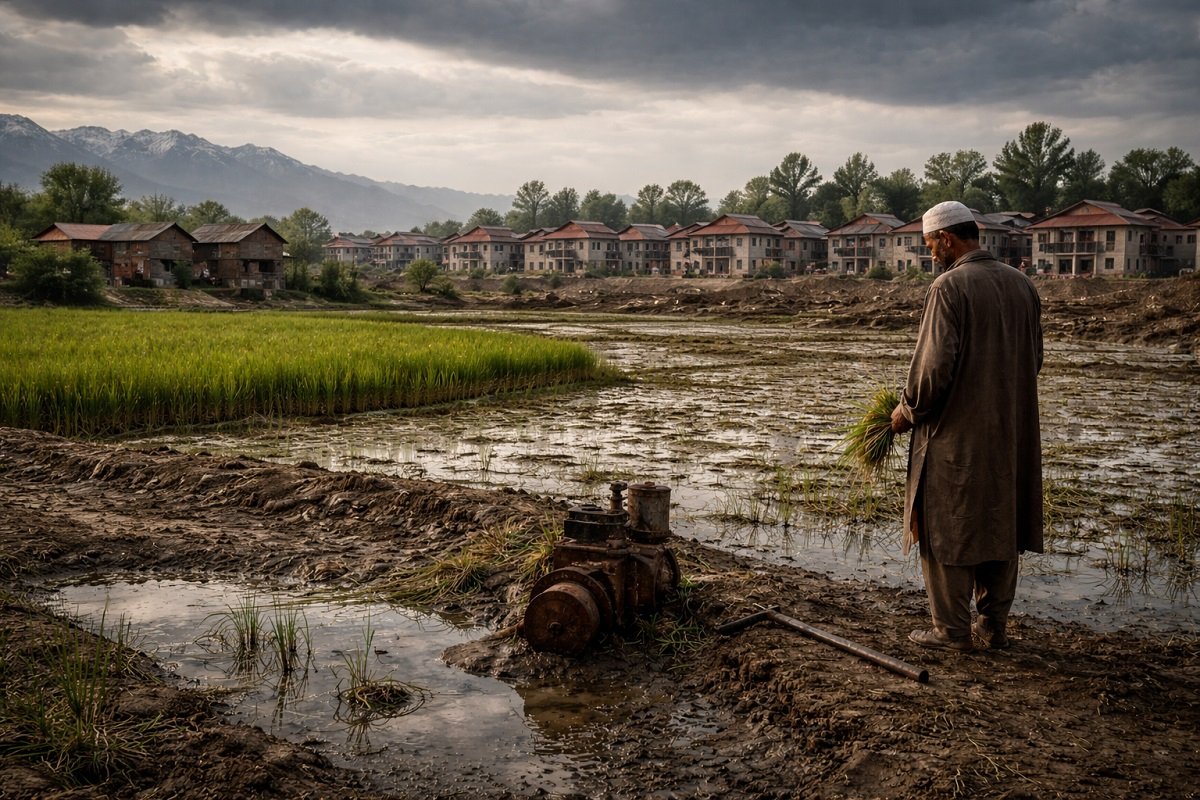
The change is already visible across the valley. Prime paddy fields are turning into residential colonies, fertile soil disappears beneath commercial complexes, and agricultural land becomes highway corridors.
The transformation unfolds gradually, year by year, so no single moment sparks outrage. But the cumulative loss is devastating.
An MLA from Tral recently raised this issue in the J&K Assembly, warning that paddy fields are shrinking and fertile land is disappearing. His concern deserves amplification, but the problem reaches far beyond a single constituency.
Kashmir’s rice paddies formed the backbone of local food security and the rural economy for centuries. Agriculture sustained livelihoods, supported markets, and shaped cultural life. The gradual loss of cultivable land signals a structural economic shift, rather than an agricultural adjustment.
The shift exposes a deeper governance failure. Land-use regulation has remained fragmented and weakly enforced. Urban master plans often exist only on paper and trail far behind real expansion. Agricultural zoning is limited, while farmland conversion proceeds through administrative discretion rather than strategic planning. Weak oversight creates room for abuse.
Population pressure fuels demand for development. Weak institutions allow that demand to fall on the easiest target: flat, fertile farmland. Rising land prices encourage speculative construction, and regulatory gaps make quick profits possible.
The consequences ripple outward. Local food production declines, dependence on imported grain increases, and price volatility hits household budgets. Supply disruptions threaten nutrition security, while fiscal pressure grows as the region imports what it once produced.
Solutions demand sustained attention across multiple fronts.
Family planning awareness needs stronger support through public health initiatives. Women’s education and reproductive choice offer proven paths toward demographic stabilization. These tools have worked across India, but they remain underutilized here.
Prime agricultural zones need clear identification and legal protection. High-value paddy belts should receive protected status, and any conversion should require exceptional justification, rigorous review, and public transparency.
Urban expansion must become more efficient. Vertical housing, mixed-use redevelopment, and higher-density development within existing boundaries can accommodate growth while sparing farmland. Other regions have already demonstrated that such approaches work.
Agriculture must remain economically viable. Assured procurement at fair prices, targeted subsidies, and direct support to farmers can ease the pressure to sell land for real estate profit. When livelihoods weaken, desperate farmers make desperate choices.
Land governance demands modernization. Digitized records, satellite monitoring of land-use change, and transparent approval systems can strengthen oversight and reduce arbitrary conversion. Accountability begins with visibility.
Kashmir now stands at a decisive moment. Demographic trends, development pressures, and environmental change are converging here. These forces can overwhelm weak institutions, but with foresight and discipline they can still be managed.
The current trajectory leads toward a paved valley, dependent on external food supplies, watching water sources dwindle, wondering what happened to its agricultural heritage.
Land once buried under concrete rarely returns to production. The loss is permanent.
The legislator from Tral has sounded the alarm, others must now join him. The moment for action is shrinking as quickly as the farmland itself.
- The author is a former member of the Legislative Council of Jammu and Kashmir and spokesperson of BJP JK-UT.