
By Rayees Ahmad Kumar
When Mukhtar Ahmad Bhat lifted a length of Pashmina under the winter sun at Sher-e-Kashmir Park in Srinagar, the threads seemed to hum with history.
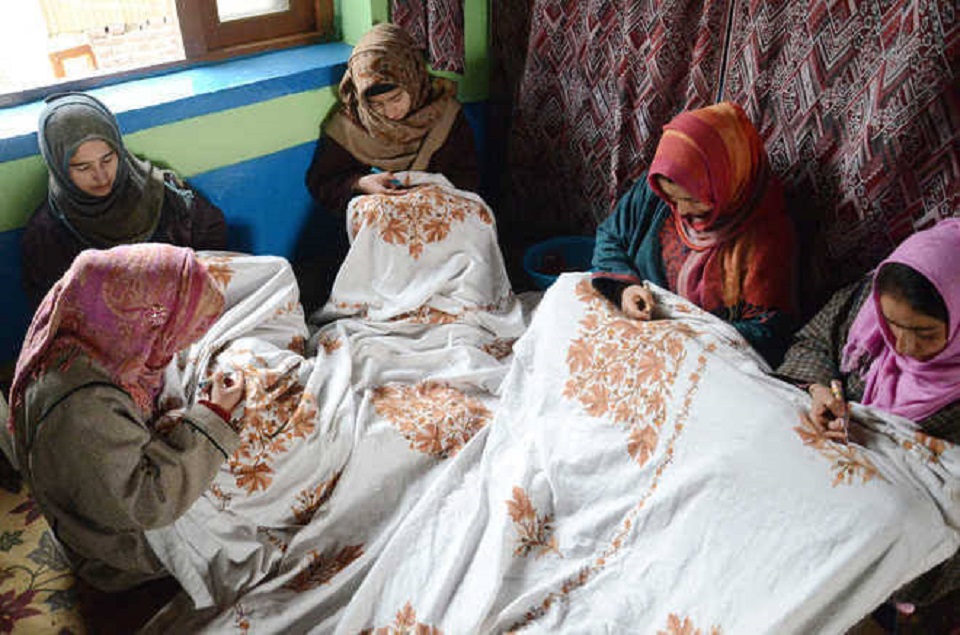
Bhat has stitched thousands of Sozni patterns in his life. This season, he sat surrounded by students, showing them the careful movements that have defined his craft for decades.
“This craft can give you a way to earn a living,” he said, guiding a young student’s hand. “It connects you to our past and shapes your future.”
Bhat was one of thirty master artisans invited to the Know Your Artisan festival, a three-day initiative by the Department of Handicrafts and Handloom, Kashmir. The festival brought artisans from across the valley to demonstrate their skills to students, visitors, and potential buyers.
“The aim is to revive a craft ecosystem that once supported thousands of households,” said a senior handicrafts official.
Sozni and Crewel embroidery, Pashmina and Kani weaving, copperware Kandkari, willow work, tweed, and Papier-mâché were all on display. Each demonstration taught patience, skill, and identity.
Across the park, willow baskets came to life under the hands of Bashir Ahmad Dar. At another stall, Nazir Ahmad Malik embroidered a pheran with Tilla work, metallic threads sparkling as students leaned in to watch.
“This isn’t decoration,” Dar said, watching a group of schoolchildren try their first weaving loops. “These are skills that can sustain a life.”
The importance of such efforts is hard to miss.
Jammu and Kashmir faces a severe employment crisis. As of late 2025, more than 3.6 lakh educated young people are registered as unemployed. Graduates, postgraduates, engineers, and researchers often take informal jobs just to survive.
“Crafts offer a different path, combining tradition, storytelling, and earning potential,” said the official.
Government data shows Kashmir’s handicraft and handloom exports reached an estimated ₹2,567 crore over the past two financial years and three quarters of the current fiscal.
Pashmina shawls alone accounted for over ₹1,100 crore, and hand-knotted carpets contributed ₹728 crore.
That economic promise was visible at the festival.
Students from Government Boys High School Anderwan in Ganderbal watched master artisans demonstrate Sozni, Willow Work, and Tilla embroidery. Officials explained government schemes that support artisans with tools, training, and access to markets.
Students asked questions about careers, earnings, and opportunities abroad.
“I never thought I could make art and earn from it,” said one student, her voice carrying excitement through the crisp winter air.
Experts say Know Your Artisan is part of a larger revival movement. Dr. Parvez Ahmad, a heritage scholar, said these skills once formed the backbone of Kashmir’s culture and economy.
“Crafts are not museum pieces,” he said. “They are living threads of community survival and identity. When artisans connect with buyers and young learners, they see futures they might otherwise miss.”
Kashmir’s craft tradition stretches back centuries. Sufi saint Mir Syed Ali Hamadani brought 700 disciples to the valley long ago. Alongside spiritual teachings, they introduced local communities to arts and crafts from their homelands, creating a culture of skill and resilience that still runs through everyday life.
At Know Your Artisan, that legacy was visible everywhere.
Students tried their first Sozni and Crewel stitches. They laughed over willow work, asked questions about copperware Kandkari, and marveled at Papier-mâché.
Artisans say these interactions change how people see craft.
Mukhtar Ahmad Bhat, who used to travel far for exhibitions in big cities, saw children realize they could learn and earn in their own valley. Dar spoke of how willow work meets modern eco-friendly demand. Malik highlighted the opportunities Tilla embroidery offers young women.
“The government is backing these efforts with training, support, and market linkages,” Malik said. “Handicraft exports have surged in recent years and are expected to rise further by the end of this year.”
As the festival closed, artisans packed their tools, but their stories stayed. Aarif Mir, a shy student, walked home with a notebook full of sketches.
“I came here without a clue,” he said. “Now I see a way to use my hands and my mind.”