By Arshina Aslam
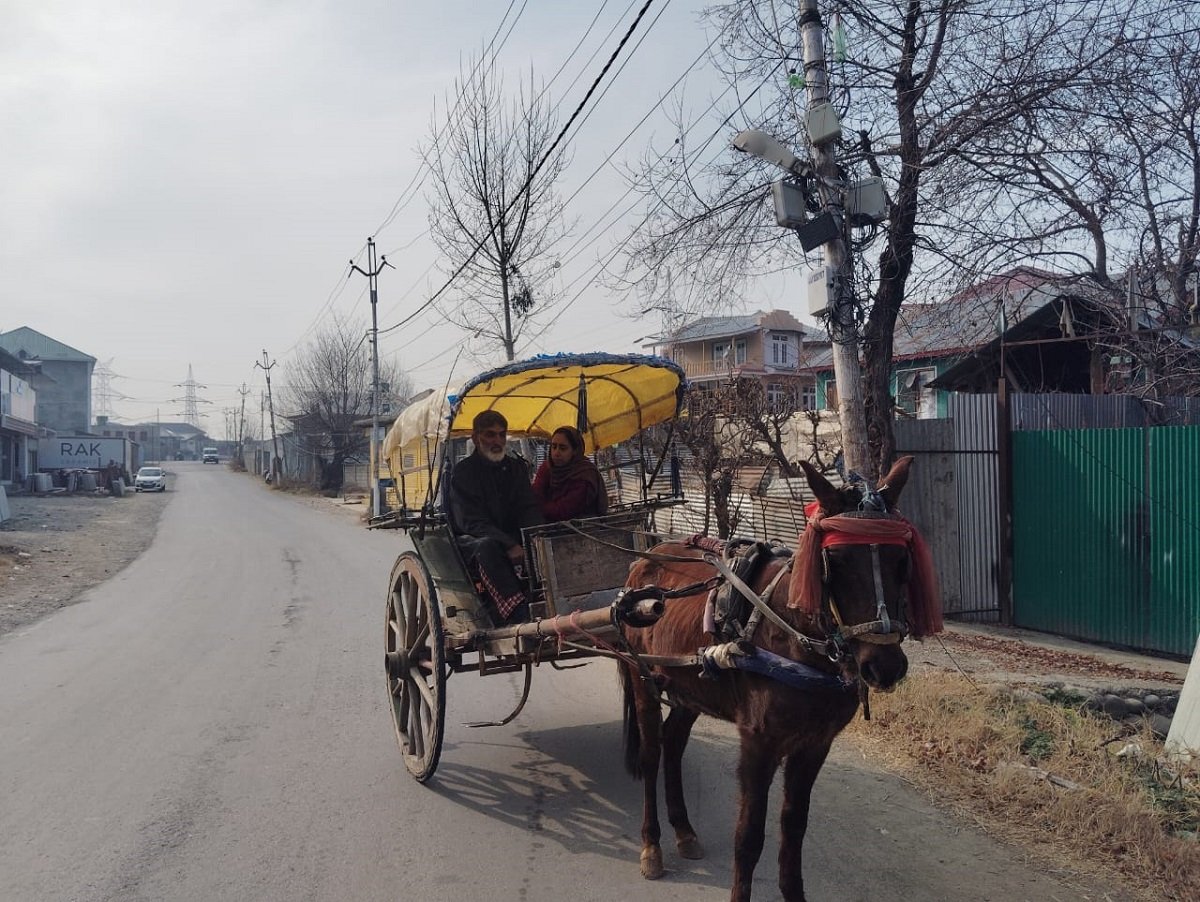
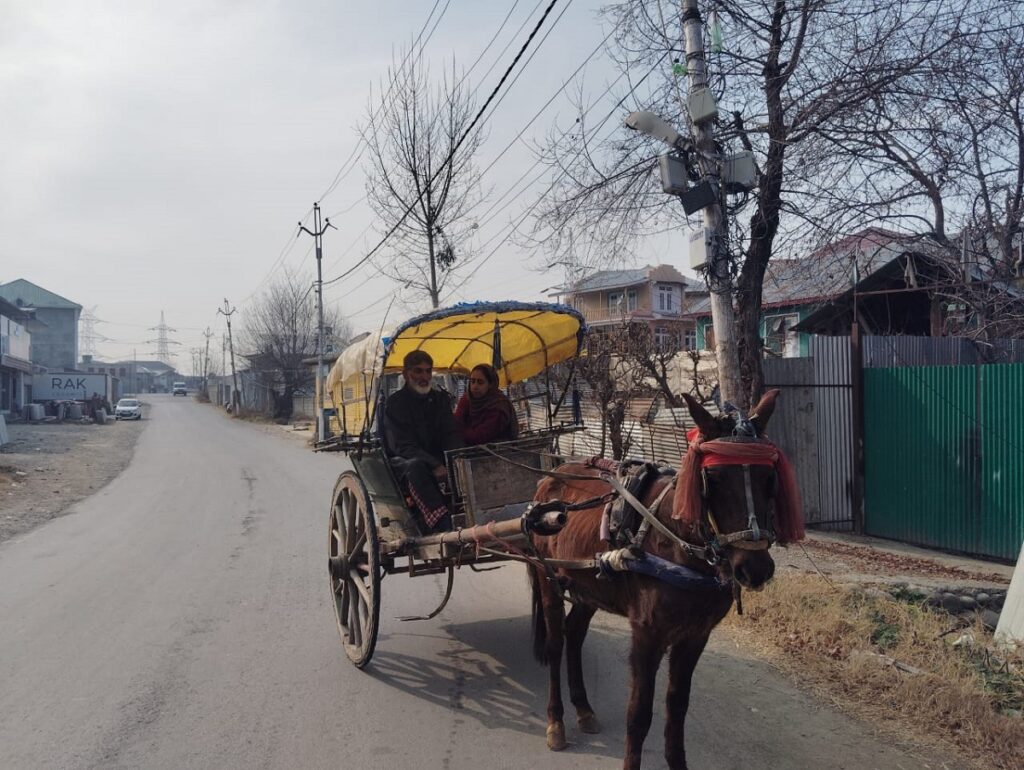
Srinagar- The sharp clatter of iron-shod hooves cuts through the constant honking at Murran Chowk in Pulwama. As buses, autos and sumos rush past, Manzoor Ahmed adjusts the leather reins of his horse and waits.
“I still get my customers. That is why I haven’t left this work,” he says, scanning the road for a familiar face.
For the past 35 years, Manzoor has earned his livelihood riding a horse-drawn tonga, a mode of transport that once defined Pulwama’s roads but now survives at the margins of a rapidly modernising transport system that includes free public transport services for women.
When tongas ruled the roads
Recalling earlier days, Manzoor says tongas were once the backbone of local transport.
He says that buses began appearing only in the late 1990s, followed gradually by sumos and later battery-operated autos, steadily shrinking the space for tongas.
“Earlier, only tonga services were running on routes like Sirnoo–Tahab–Murran, Rajpura to Tikken,” he says. “There were no buses. Even autos were rare. Only a few Bajaj scooters came from Srinagar, mostly used by businessmen.”
At the Murran adda, where he now waits for passengers, mornings once resembled today’s busy transport hubs. “There used to be around fifty tongas standing here early in the morning,” he recalls. “The adda was always crowded.”
Surviving in a modern transport system
Despite the drastic changes, Manzoor has managed to hold on.
“Today, tongas are limited, but there are still enthusiasts,” he says. “Some people ride for the experience, especially children, while others are regular passengers who have stayed loyal over the years.”
He usually carries three to four passengers at a time, charging ₹10 per passenger. On a good day, he earns just enough to take care of daily household expenses and fodder for the horse. Some days pass slowly, with long hours of waiting at the chowk.
When autos and sumos are overcrowded or delayed, commuters from nearby villages like Sirnoo and Manghama sometimes turn to him.
“Sometimes they even call me,” he says with a faint smile. “I tighten the reins and go to pick them up.”
Apart from passengers, Manzoor occasionally carries light goods such as cement bags or shop supplies. He is careful not to overload the tonga.
“Too much load damages it,” he explains, patting the wooden frame. “I have an emotional attachment with this tonga and with my horse.”
The horse is fed before Manzoor eats his own meal. “If the horse is not well, I do not work,” he says simply.
A livelihood built on patience
The tonga, Manzoor says, has sustained his family through decades of change.
“I have one son and two daughters. I got them married from this income only,” he says, thanking Allah. “I have also bought some land with this earning.”
In his early years, he frequently travelled as far as Nowgam, carrying oilseeds and other goods for shopkeepers in Pulwama. With little traffic on the roads, journeys were long but calm.
“Sometimes it would be dark when I returned home,” he recalls. “There was no traffic disturbance. I would sit comfortably on the tonga and sing.”
Softly, he hums a line from a Kashmiri folk song he used to sing on those quiet roads:
Haa shear sawaro kour gasakh, akher chei marun chui
“Whatever Kashmiri song comes to my mind, I sing it,” he adds. “It keeps me company and keeps the horse calm.”
Traffic today has slowed his work considerably. “A ride that took five minutes earlier sometimes takes fifteen minutes now,” he says, pointing towards the congested stretch ahead.
Seasonal challenges remain another reality. “During heavy snowfall, when roads get blocked, I sit at home for some days,” he explains. “But when things resume, my work resumes too.”
Even now, Manzoor’s tonga plays a role beyond routine transport.
If someone is very serious, or a pregnant woman needs help during winters, or goods have to be carried when transport is not easily available, they call me,” he says with quiet pride. Living nearby, he is often able to respond faster than vehicles stuck in traffic.
At other times, he is asked to take children for a short ride. “The new generation has not seen tongas much,” he says. “I tell them stories as we move.”
Some passengers even hire him for long-distance rides from Pulwama to Srinagar, purely for the experience.
Most of Manzoor’s passengers today are elderly people who prefer the slower, familiar rhythm of a tonga.
“Even with so many transport options today, including free services for women, I am satisfied,” he says. “I am still running my household with this income.”
Asked about the future, he pauses. “I do not know how long tongas will remain,” he says.
“As long as my horse can walk and people still call me, I will continue.”
As another stream of vehicles rushes past Murran Chowk, Manzoor waits patiently, reins in hand, content that even in a fast-paced world, his tonga still finds its moment on the road.