- Inaugurates Two-day Anti-Terror Conference Organised By NIA
- ‘Security Forces Gave A Befitting Reply To Pak’s Terror Masters’
Srinagar- Union Home Minister Amit Shah on Friday said the investigation into the Pahalgam terror attack was a complete and successful probe that would be studied by agencies across the world, asserting that it set a global benchmark in counter-terror investigations.
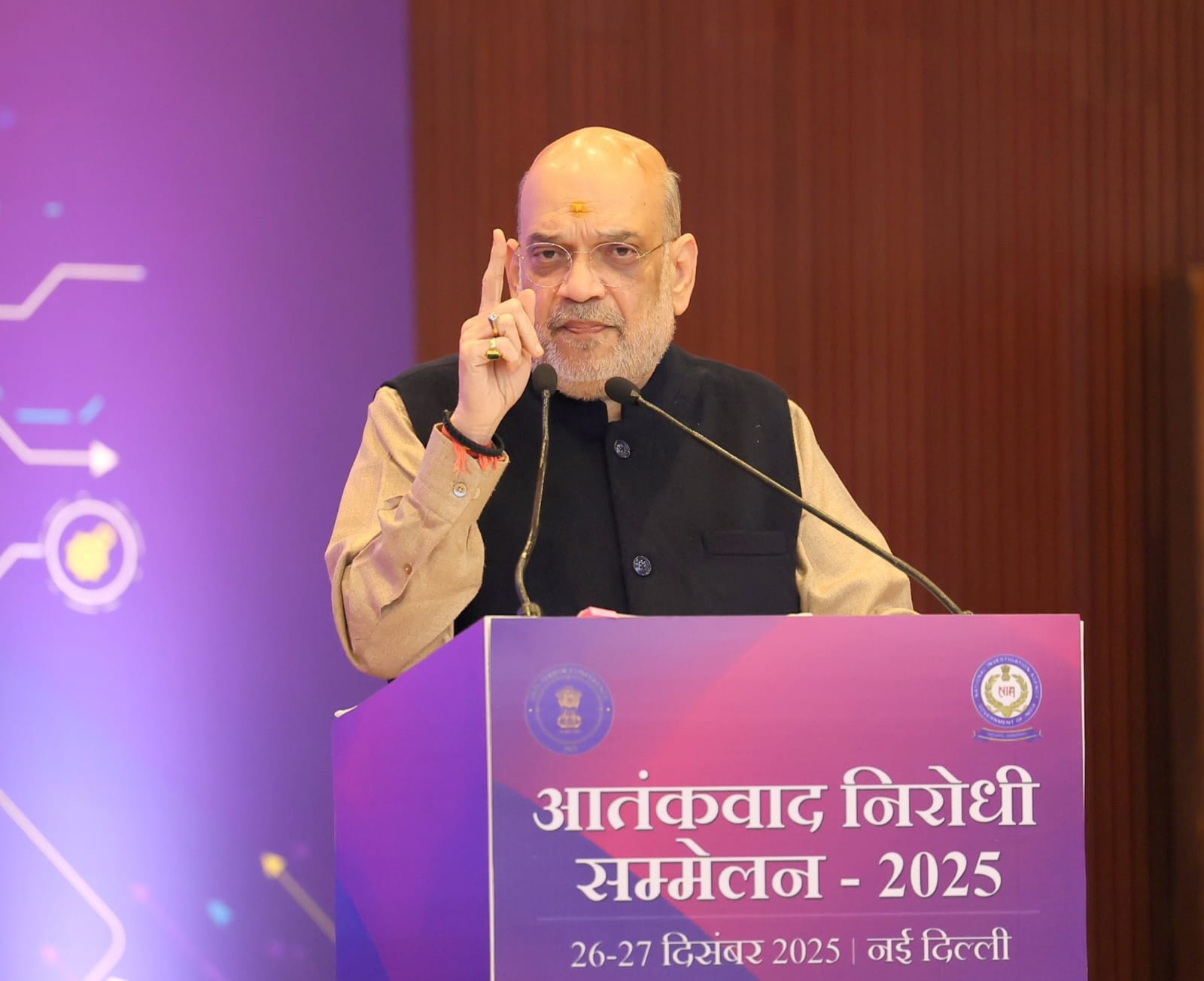
Inaugurating a two-day Anti-Terror Conference organised by the National Investigation Agency, Shah praised the security forces and investigating agencies for their coordinated response, stating that the case was not an example of routine policing but of watertight investigation.
Lauding the neutralisation of the terrorists involved in the Baisaran Valley attack, the home minister said the perpetrators aimed to disrupt communal harmony and derail the new phase of development and tourism in Kashmir. He said the security forces, acting on precise intelligence, eliminated all three terrorists and sent a strong message to Pakistan.
“This is the first terrorist incident where those who planned the attack were punished through Operation Sindoor, and those who executed it were neutralised through Operation Mahadev,” Shah said, adding that India had responded firmly at both ends through its security forces and intelligence agencies.
Shah said the results of the investigation would put Pakistan in the dock on international platforms, asserting that the evidence gathered exposed the full chain behind the attack. He said agencies worldwide would study the probe for its precision, coordination and outcomes.
The home minister also praised the investigations conducted by the Jammu and Kashmir Police and the Delhi Police in the Red Fort area blast case, saying they exposed the entire network involved. “Investigations into the Pahalgam and Delhi blast cases are not ordinary policing but outstanding examples of watertight investigation,” he said.
Highlighting evolving security challenges, Shah said the global landscape of terrorism was changing due to increasing use of technology by terror outfits. He stressed the need to anticipate invisible future threats and prepare to counter them proactively.
Calling it a national responsibility, Shah urged all central agencies and state police forces to function as a ‘Team India’ to strengthen national security and prevent emerging terror challenges.
‘Databases Would Form Core Asset Of Zero-terror Policy’
Shah said a common ATS structure for the police force across the country and an impenetrable and strong anti-terrorism grid — vigilant and capable of swift, result-orientated action — are essential for “uniform preparation at every level” to counter terror attacks.
The home minister also said a new plan to launch “a 360-degree assault on organised crime” would be brought in the coming days, and that these databases would form a “core asset of the zero-terror policy”.
Inaugurating the two-day Anti-Terrorism Conference-2025 organised by the National Investigation Agency (NIA), Shah launched two databases — the Organised Crime Network Database and the Weapons Database for lost, looted and recovered arms — hosted by the NIA
Under Prime Minister Narendra Modi’s vision of zero-tolerance against terrorism, the annual conference has become a platform to deal with the emerging threats, Shah said.
Actionable points emerge from this conference, and the NIA, along with all related agencies from the states, works throughout the year to implement them, Shah said, according to an official statement.
“Organised crime networks initially operate for the purpose of ransom and extortion, but when their leaders flee abroad and settle there, they automatically come into contact with terrorist organisations and then use the proceeds from ransom and extortion to spread terrorism within the country,” Shah said.
Under the guidance of the NIA and CBI and with the cooperation of the Intelligence Bureau and by utilising this database, every state must eliminate these threats within their jurisdiction, Shah said.
The home minister also said the database of terrorists and criminals should be made a core asset of the zero-terror policy, the statement said.
A new standard of coordination, cooperation and communication among the DGP Conference, Security Strategy Conference, N-CORD meetings, and the Anti-Terror Conference has been developed, he said.
These four pillars cannot be seen in isolation, and running through them as a common thread is the Anti-Terrorism Conference, the statement quoted Shah as saying.
“When we establish a common ATS structure across the entire country, it provides us with an opportunity for uniform preparation at every level,” Shah said.
“A common ATS structure for the police forces across the country is extremely important, and the DGPs from all the states should implement it as soon as possible,” he added.
The home minister also said the ATS units of all the states should get into the habit of using intelligence sharing platforms — NIDAAN and NATGRID — to ensure that cases are not investigated in isolation, and the invisible links among them are brought to light.
Shah said the use of NATGRID should be made mandatory in certain investigations, and the use of NIDAAN should be made mandatory in certain cases, the statement said.
The home minister also emphasised ensuring active participation in the Multi Agency Centre and the National Memory Bank.
“The common ATS structure and operational uniformity give us an advantage in prosecuting terrorists. Unless we achieve operational uniformity, we cannot make an accurate assessment of threats, make proper use of intelligence sharing, or carry out coordinated counter-actions,” Shah said.
He also emphasised ensuring uniformity — from investigation to prosecution.
Asserting that as India’s economic prowess grows, threats will also increase, Shah said the preparations to ensure the country’s internal security do not begin on the borders; rather, they must start many miles away.
Shah also gave a call to develop a national grid — vigilant and capable of swift, result-oriented action — to counter cyber and information warfare, the misuse of economic networks, and the hybrid format of terrorism.
He said that building a multi-layer security model and working with a ruthless approach against terrorism can keep us secure in the coming days, the statement said.
Everyone should move forward with the principle of ‘Duty to Share’ instead of ‘Need to Know’, the home minister said.
The central agencies and state police have made good use of technology at their levels, but technology developed in silos and data collected in silos are like a gun without bullets, the statement quoted Shah as saying.
He said it is better if all data can communicate with each other and are created using the same technology.
Shah also asked the Ministry of Home Affairs, the NIA and the IB to hold discussions to develop a seamless national-level framework for technology and data.
The database of terrorists and criminals should be made a core asset of the zero-terror policy, he said.
Shah also said he expects the director generals of police to implement the database framework in letter and spirit.
“In coming days, the country would bring a plan to launch a 360-degree assault on organised crime,” Shah said. (PTI)