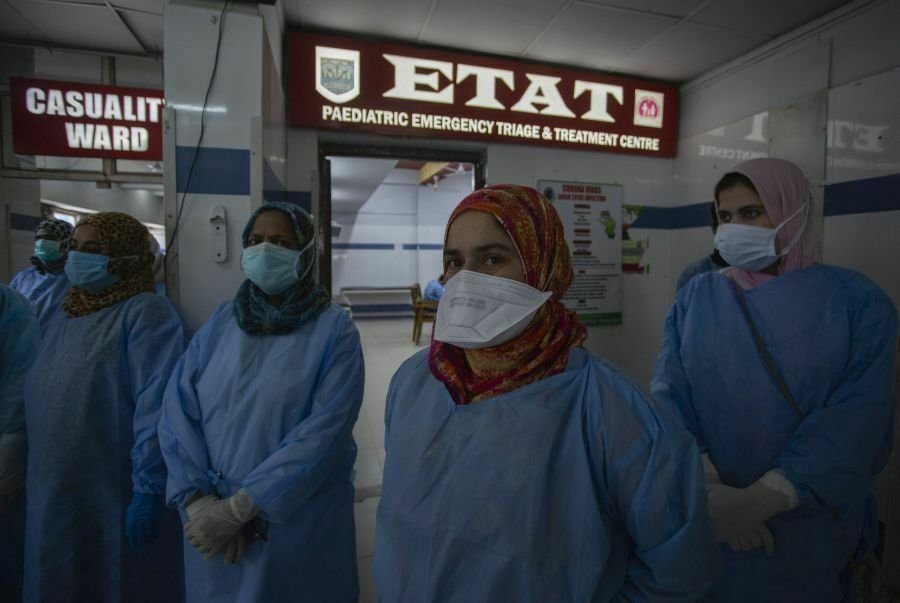
Healthcare workers here and across India watched closely as the Government of Jammu and Kashmir issued a formal order in December 2023 to revise pay and working conditions for nurses in private hospitals.
This was meant to align local practice with a decade‑old judicial mandate and service rules developed by the Union Ministry of Health and Family Welfare.
The committee formed under that order was to offer guidance within thirty days.
But many months later, its findings and recommendations have not appeared in any public record. And this absence has amplified a long‑standing issue that deserves sustained public focus.
Nurses are the frontline of patient care. They respond to emergencies, calm anxious family members, and perform critical procedures through long shifts.
In large private facilities nationwide, the average nurse earns between ₹20,000 and ₹50,000 per month depending on experience and hospital type.
But in Jammu and Kashmir, reported average pay for a nurse is approximately ₹22,000 per month. Some private duty nurses here are documented at similar rates.
Even those figures tell only part of the story.
Independent salary surveys across India show private hospital pay widely varies by city, bed strength, and ownership. Smaller clinics and nursing homes often maintain much lower wages.
In many such facilities the baseline can sit well below ₹20,000, creating a stark contrast with government hospital scales that often start above ₹30,000 for comparable roles.
This contrast was at the heart of a landmark judicial step taken on 29 January 2016, when the Supreme Court acknowledged widespread wage disparities and work‑condition issues among nurses in private healthcare institutions.
The Court directed the Health Ministry to form a High‑Level Committee to study these conditions and propose solutions.
Acting on that order, the Ministry convened a panel in February 2016. Its mandate was to gather data from states and union territories to advise on fair pay scales and standardised service terms that would protect nurses working in private settings.
After deliberation, the committee reached firm conclusions. It said private hospitals often lacked structured pay scales for nurses, a reality that failed to reflect their critical role in patient care. Bed strength formed the basis for proposed pay frameworks. For hospitals with more than 200 beds, the panel recommended salaries equivalent to those of state government nurses holding the same grade.
Facilities with 100-199 beds were to offer pay within 10 percent of government rates, while those with 50-99 beds were to stay within a 25 percent margin.
All establishments, including those with fewer than 50 beds, were to provide at least ₹20,000 per month, with working conditions, leave entitlements, and ancillary benefits aligned with government standards.
The committee’s recommendations also explicitly covered working conditions. Hospitals were to ensure duty hours, leave provisions, medical care, and transportation support that matched or approached the standards enjoyed by government nurses.
Those well‑considered suggestions formed a roadmap designed to make private healthcare systems more equitable and professionally sustainable for nurses and by extension for patients.
However, implementation has not followed with corresponding vigour or reach.
Kashmir’s private health sector runs on informal pay and fragile contracts, a system that strips nurses of bargaining power and leaves them taking whatever wages hospitals decide to offer.
Many young professionals join the workforce with degrees, diplomas, and specialised training only to find earnings lower than the national estimates of ₹20,000 and far below government scales for equivalent jobs.
These trends matter beyond paychecks.
Numerous peer‑reviewed studies from within Indian hospitals show that work‑life quality among nurses directly correlates with staffing levels, pay, and employer support.
In one hospital survey, private hospital nurses with wages between ₹5,000 and ₹20,000 per month reported significantly lower job satisfaction and higher burnout compared with those with structured support and clearer remuneration.
A pervasive outcome of this differential is workforce instability. High turnover, frequent job hopping, and the loss of experienced nurses to either government service or opportunities abroad weaken the overall quality of care.
Facilities that claim high “nursing charges” in patient bills often fail to link those charges transparently with compensation for nursing staff.
Reports from larger Indian cities show examples where total daily rates billed under nursing categories far exceed the monthly salaries nurses actually receive, indicating financial flows that bypass direct remuneration for caregivers.
Private hospitals in Jammu and Kashmir, like many across India, operate in competitive, high‑cost environments that demand rapid service turnover.
When this market pressure is combined with weak regulatory action on wages and work conditions, the system puts upward pressure on patient bills while offering downward pressure on employment terms.
The government order of late 2023 was a step toward recognition of these imbalances and a move to align local practice with national commitments.
The delay in producing actionable guidelines and transparent enforcement structures deprives nurses of predictable career pathways, reinforces wage gaps, and sustains a model that undervalues essential caregiving skills.
A sustained commitment to implementing existing frameworks, including transparent monitoring and periodic review of pay scales tied to cost of living and professional growth, would reflect both policy coherence and practical respect for those who serve at the heart of health systems.