By Mohammad Hanief
Morning comes early in Pandach, and Shahid Farooq knows it by the sounds before he sees the light.
He hears footsteps in the house, his mother calling from the kitchen, and the village waking up around him.
At eleven, Shahid already understands his world through what he remembers and pays attention to, living his days with patience and care he has learned from experience rather than being told.
Shahid was born on May 7, 2011, in this village in Ganderbal district. He is in Class 5 at Government High School Pandach, where he learns by listening, remembering, and putting in steady effort.
A government medical assessment shows that Shahid has a seventy-five percent visual disability, classified as low vision. His condition comes from encephalomalacia with gliosis in both occipital regions of the brain, along with damage to the optic nerves, which affects how his eyes process sight.
Doctors say the condition is progressive, which means Shahid’s experience of the world will continue to change as he grows.
The boy’s daily life reflects this reality in small but clear ways.
Reading a page takes time and close focus. Writing on the blackboard is hard to see without help. He recognizes familiar faces more by their voices than by how they look. Moving through new spaces calls for careful steps and attention.
Even so, Shahid goes to school every day, holding on to education as a door to possibility instead of a barrier set by his circumstances.
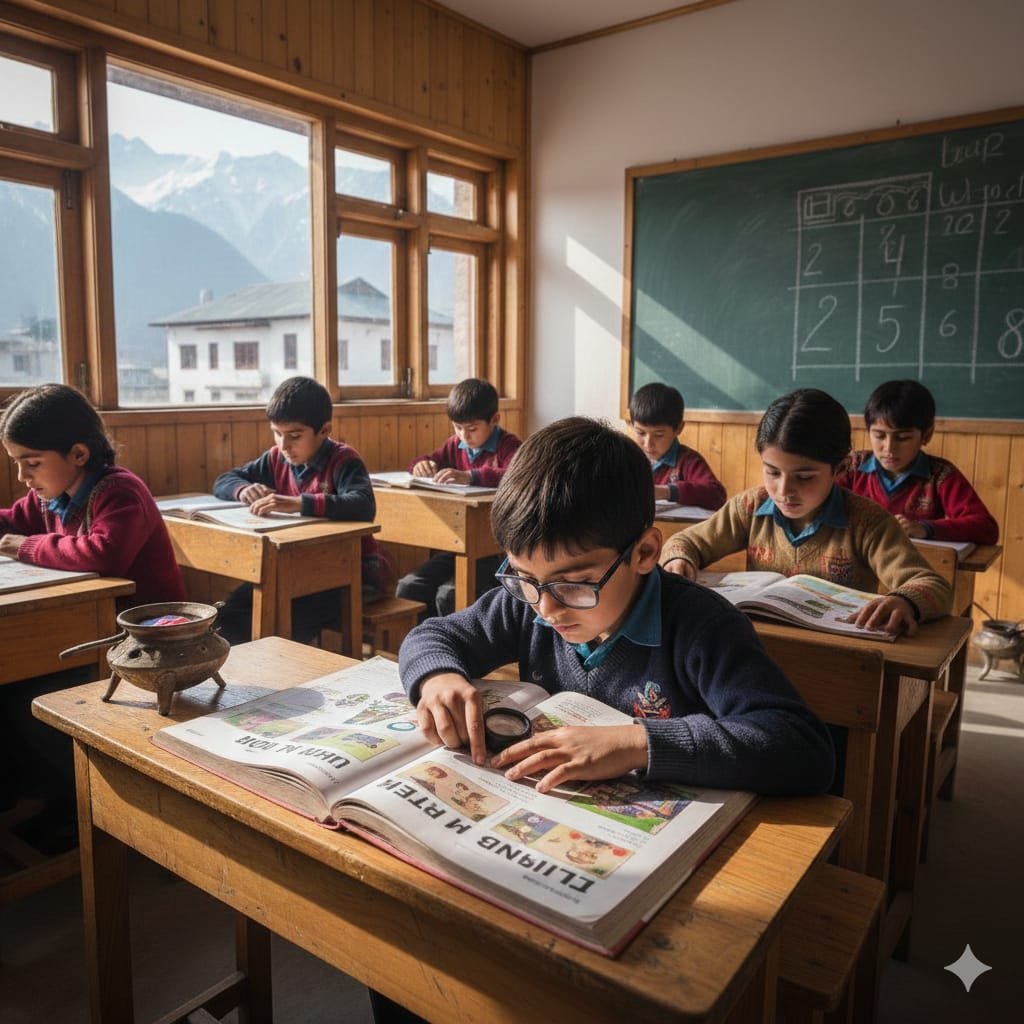
Inside the classroom, Shahid listens with full concentration, absorbing lessons through sound and repetition while classmates follow chalk and print.
Teachers describe him as engaged, curious, and committed to keeping pace, even when the classroom offers limited tools designed for students with visual challenges.
His experience mirrors that of many children in mainstream schools, where inclusion often rests more on intention than on practical design.
Life beyond school centers around family and faith, which give Shahid structure and assurance.
Five times each day, he walks to the mosque with his father and younger brother, following paths shaped by routine and familiarity.
His father stays close, attentive to each step, while his brother moves beside him with the ease of shared understanding.
Prayer offers Shahid a sense of grounding and belonging, a place where his presence feels complete and whole.
From the doorway of their home, Shahid’s mother watches these moments with layered emotion. Pride rises as her son moves through the world with determination. Hope stays constant as she imagines a future shaped by medical progress and supportive care.
Her days revolve around that belief, strengthened by faith and the certainty that her child’s life holds meaning and promise.
The family’s finances add another dimension to their journey.
Medical evaluations, follow up visits, visual therapy, assistive tools, and specialized educational support demand resources that stretch the household budget.
Each decision requires planning and adjustment, as care remains essential rather than optional.
Families like Shahid’s often balance these demands silently, guided by responsibility and love.
Beyond the household, social attitudes continue to influence how children with disabilities experience community life. Understanding grows slowly, and inclusion takes time.
Shahid’s constant presence in school, prayer, and daily routines gently challenges old assumptions, offering a living example of capability shaped through support rather than limitation.
India’s legal framework recognizes this principle.
The Rights of Persons with Disabilities Act of 2016 places low vision within benchmark disabilities, opening access to educational support, healthcare benefits, and social welfare measures. Shahid’s certification confirms his eligibility, while practical access depends on awareness, coordination, and local systems prepared to respond.
Medical professionals emphasize that early and ongoing rehabilitation strengthens independence and learning outcomes for children with visual impairments.
Therapy, adaptive technology, and learning environments designed with care allow children like Shahid to thrive and grow with confidence. Support at the right time shapes futures in lasting ways.
Shahid Farooq’s story highlights the importance of turning recognition into action and policy into practice.
His life raises a shared responsibility, asking whether society chooses to meet children like him with meaningful support and sustained commitment.
Each day, Shahid moves forward with purpose. He learns through listening and memory, finds grounding in his prayers, and draws strength and guidance from his family.
His hopes are simple, shaped by the dreams of childhood: to learn, grow, and become independent.
As his life moves between faith and education, Shahid walks with care and confidence, supported by his family, and ready for a future defined by opportunity and inclusion rather than the limits of his sight.