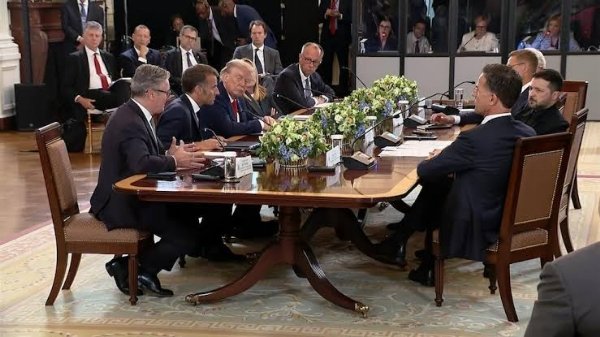
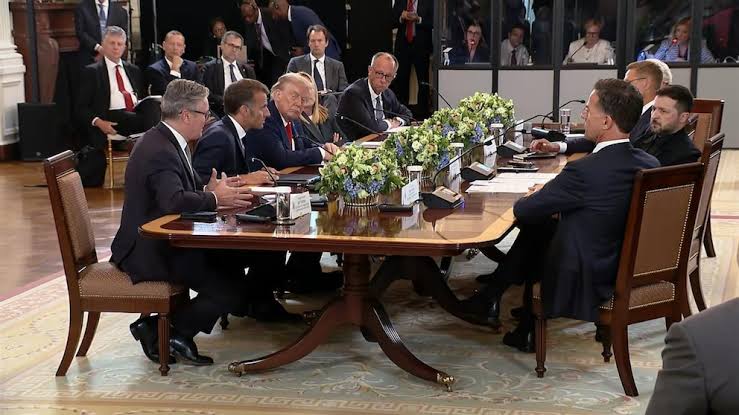
Washington, August 19 (H.S.): In a landmark meeting at the White House on Monday, US President Donald Trump, Ukrainian President Volodymyr Zelensky, and top European leaders came together to discuss urgent steps toward ending the devastating war in Ukraine. The summit follows Trump’s recent talks with Russian President Vladimir Putin in Alaska and marks a renewed push for high-stakes diplomacy aimed at forging peace.
President Trump made a striking announcement shortly after the meetings, revealing he had personally called Putin to initiate arrangements for a direct face-to-face meeting between the Russian and Ukrainian presidents. “At the conclusion of the meetings, I called President Putin, and began the arrangements for a meeting, at a location to be determined, between President Putin and President Zelensky,” Trump stated. He added that this bilateral meeting would be followed by a trilateral summit including himself, emphasizing his commitment to playing a direct role in ending the conflict.
On the issue of security guarantees for Ukraine, Trump reiterated that multiple European countries would take primary responsibility, with the United States coordinating these efforts. “They are a first line of defense because they’re there, but we’ll assist them,” he said, underscoring the collaborative approach envisioned for Ukraine’s protection moving forward. Despite calls from some European leaders for a ceasefire as a precondition, Trump expressed skepticism about its necessity for successful negotiations. “I don’t think you need a ceasefire,” he remarked, explaining that hostilities could continue while talks progress.
U.S. President Donald Trump emphasized that the issue of missing and abducted children is very important to his wife, Melania Trump, who has been actively involved in peace talks and wrote a personal letter to Russian President Putin urging him to protect children. During his visit, Ukrainian President Zelensky gave Trump a letter from his wife to pass on to Melania. Trump expressed hope that the world will work together to resolve the issue and bring the children back to their families
President Zelensky spoke with cautious optimism following the high-profile meeting. Describing the talks as “very good” and noticeably warmer than past encounters, he expressed a readiness to engage directly with Putin. “I confirmed — and all European leaders supported me — that we are ready for a bilateral meeting with Putin,” Zelensky declared, emphasizing that Ukraine remains steadfast in seeking peace “on our terms.” He stressed the significance of concrete security guarantees as a “starting point for ending the war,” welcoming the US and European support pledged during the talks.
European leaders, present in force alongside Zelensky and Trump, voiced both support and caution. German Chancellor Friedrich Merz likened Russia’s demand for Ukraine to cede parts of the Donbas to an unthinkable scenario: “The Russian demand that Kyiv give up the free parts of Donbas is, to put it in perspective, equivalent to the US having to give up Florida.” He insisted on a broad European role in any security guarantees, signaling the continent’s unified stance.
French President Emmanuel Macron previewed a future where European military support could take the form of peacekeeping missions on Ukrainian soil. “We are going to need a strong Ukrainian army and will need to help Ukraine with boots on the ground,” Macron said, indicating the seriousness of Europe’s commitment to upholding Ukraine’s sovereignty.
UK Prime Minister Sir Keir Starmer expressed satisfaction with the progress made, highlighting breakthroughs on security guarantees and the movement toward bilateral and trilateral talks. “That’s what I wanted to happen today and I’m really pleased we got to that point,” he told the BBC, while cautioning that no decisions should be imposed on Ukraine without its full agreement.
US Senator Marco Rubio addressed the difficult reality of the negotiations, predicting that both Russia and Ukraine will have to make territorial concessions for peace to be achievable. “It’s not easy and maybe it’s not even fair, but it’s what it takes to end a war,” he said bluntly, stressing America’s role as a facilitator to keep the dialogue open.
The Finnish President said on Monday in Washington that his Russian counterpart was not trustworthy, after meeting at the White House with the US President, Ukrainian head of state and European leaders.
Putin is rarely to be trusted. So now it remains to be seen whether he has the courage to come to this type of meeting. Does he have the courage to come to a trilateral meeting, or is he once again playing for time? the Finnish President Alexander Stubb told Finnish reporters.
Meanwhile, NATO Secretary-General Mark Rutte characterized Trump as a pragmatic figure in the quest for peace, praising his efforts to open communication channels with Moscow. Rutte called the day’s meetings “very successful” and emphasized ongoing work toward finalizing security guarantees for Ukraine in the coming days.
European Commission President Ursula von der Leyen reiterated her calls for Russia to return all abducted Ukrainian children to their families, emphasizing that “the human cost of this war must end.” Her statement followed a tweet from U.S. President Donald Trump, who highlighted the global issue of missing and abducted children, noting it is particularly important to former First Lady Melania Trump.
Recently, the White House released a letter written by Melania Trump addressed to Russian President Vladimir Putin, urging him to protect children and restore “their melodic laughter,” further underscoring the international concern over the fate of Ukrainian children taken during the conflict.
As the world watches closely, this unprecedented gathering of leaders marks a hopeful but complex milestone. The proposed Putin-Zelensky meeting — and potential trilateral summit with the US — offer a new diplomatic pathway to resolving Europe’s deadliest conflict since World War II. Yet deep divisions over territory, trust, and the timing of ceasefire conditions remain formidable barriers as talks continue.
President Trump closed Monday’s events with an optimistic vow: “We are going to have a meeting. I think if everything works out well today, we’ll have a trilat and I think there will be a reasonable chance of ending the war when we do that.” The coming weeks will test whether these bold diplomatic efforts can transform into lasting peace.
Hindusthan Samachar / Jun Sarkar