
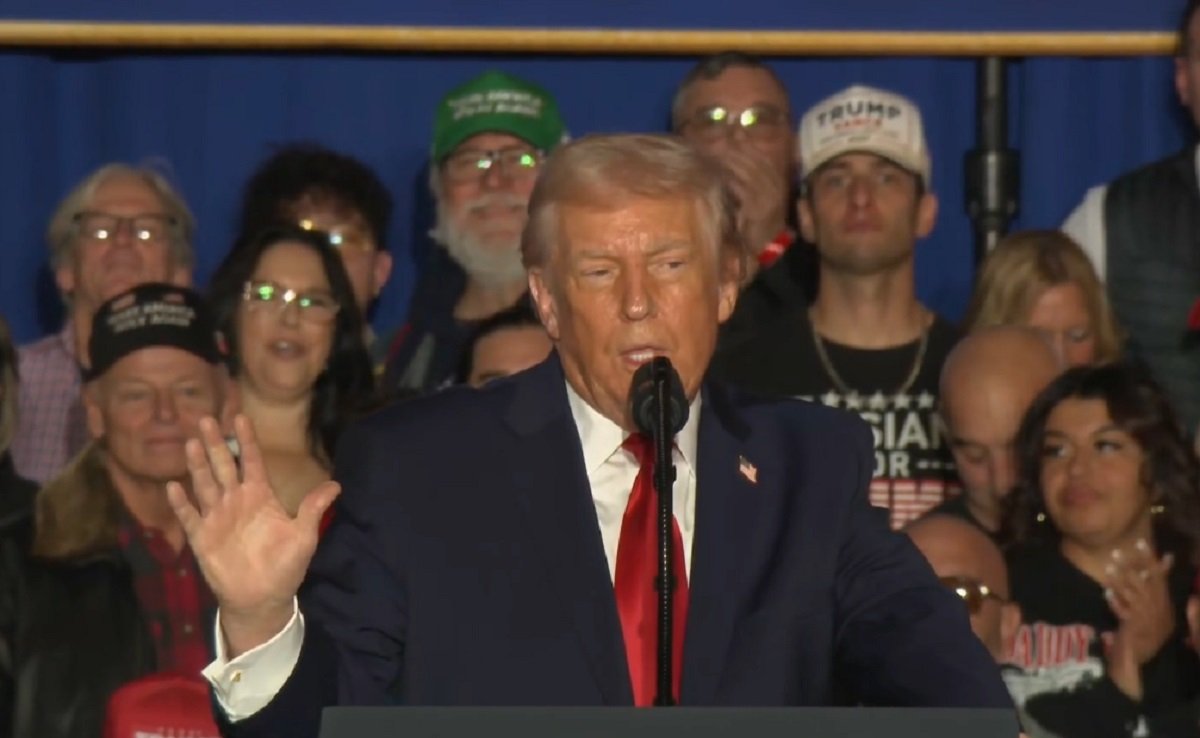
Dubai— President Donald Trump on Saturday threatened that the United States would “obliterate” Iranian power plants if Iran does not fully open the Strait of Hormuz within 48 hours.
Trump issued the ultimatum in a social media post while spending the weekend in Florida. He said he is giving Iran exactly 48 hours to open the vital waterway or face a new round of attacks. He added that the US would destroy “various POWER PLANTS, STARTING WITH THE BIGGEST ONE FIRST!”
Trump faces increasing pressure to secure the strait as oil prices soar.
Iran Responds to Trump’s Threat
Minutes after Trump’s warning, Iran’s military declared that US-linked infrastructure would be targeted.
“Following previous warnings, if Iran’s fuel and energy infrastructure is violated by the enemy, all energy, information technology, and desalination infrastructure linked to the US and the regime in the region will be targeted,” Iran’s military operational command, Khatam al-Anbiya, said in a statement carried by the Fars News Agency.
Difficult evening
Earlier, in retaliation for an attack on the Natanz nuclear facility, Iran struck the Dimona nuclear site in Israel. At least 47 people were injured on Saturday evening after an Iranian missile hit the southern Israeli town—famous for the dome-shaped structure atop its nuclear centre—rescue services said.
The Israel Defence Forces (IDF) said it is investigating the failure to intercept the Iranian ballistic missile. The Israeli army stated that air defences engaged the missile, but the interceptors failed to bring it down.
The UN nuclear watchdog, the IAEA, called for “maximum military restraint” following the attack.
“The IAEA is aware of reports of an incident in the city of Dimona, Israel, involving a missile impact and has not received any indication of damage to the Negev nuclear research centre,” the agency said in a post on X.
Iran said it targeted Dimona in response to an earlier strike on the Natanz nuclear enrichment site. However, the IDF said it was not responsible for striking Natanz earlier in the day.
Following Iranian strikes, Prime Minister Benjamin Netanyahu called it a “very difficult evening”, as two direct missile hits in southern Israel left scores wounded. His office also shared an image of him in which he is receiving an update on the rocket incident in Arad at the situation room. “This is a very difficult evening in the battle for our future,” Netanyahu said in a statement. “We are determined to continue striking our enemies on all fronts,” he added.
No leakage at Natanz
Iran’s official news agency, Mizan, reported no leakage following the strike on the Natanz facility, located nearly 220 kilometres southeast of Tehran.
The UN nuclear watchdog has stated that the bulk of Iran’s estimated 970 pounds (440 kilograms) of enriched uranium is stored elsewhere, beneath the rubble at its Isfahan facility, with a smaller amount at Natanz.
Israel’s military said it was “not aware” of any strike it conducted there.
Reacting to the Israeli strike, Russian Foreign Ministry spokesperson Maria Zakharova said such actions pose a “real risk of catastrophic disaster throughout the Middle East”.
The Natanz facility was first hit in the opening week of the war, with several buildings appearing damaged in satellite images. It was also targeted during the 12-day conflict last June.
Iran Targets Diego Garcia
Iran’s attack on the Diego Garcia US airbase—approximately 4,000 kilometres away—suggests that Tehran possesses missiles with a longer range than previously acknowledged or that it may have used its space programme for an improvised launch.
UK officials have not provided details about the strike that targeted the Diego Garcia base on Friday.
Iran has previously maintained that it limited its missile range to below 2,000 kilometres.
Britain has not participated in US-Israeli attacks on Iran but has allowed US bombers to use UK bases to target Iran’s missile sites.