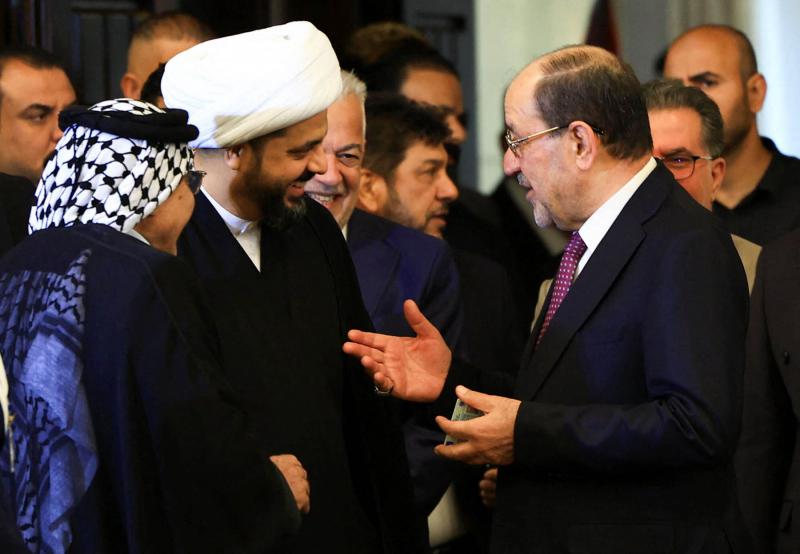
Baghdad — Iraq’s Coordination Framework, the Arab country’s largest parliamentary bloc, announced on Saturday that it has nominated former prime minister Nouri al-Maliki as its candidate for prime minister, in a move widely expected to face opposition from the United States and heighten tensions around the formation of the country’s next government.
The nomination came after caretaker Prime Minister Mohammed Shia al-Sudani, whose bloc won the largest share of seats in November’s parliamentary elections, stepped aside earlier this month, clearing the way for al-Maliki following a contest between the two for the backing of the Coordination Framework, a coalition of major pro-Iran parties.
In a statement carried by the Iraqi News Agency, the Coordination Framework said the decision followed an expanded leadership meeting in which current political developments and the next phase of the political process were discussed. The bloc said al-Maliki was selected by majority vote after “in-depth and extensive discussion”, citing his political and administrative experience and his role in managing state affairs.
Under Iraq’s constitution, parliament must first elect a president, who then names a prime minister tasked with forming a new government. The Coordination Framework called on the Council of Representatives to convene a session to elect the president in line with constitutional timelines, describing the move as necessary to complete the remaining constitutional requirements.
Al-Maliki served as Iraq’s prime minister from 2006 to 2014, making him the only Iraqi premier to serve a second term since the 2003 U.S.-led invasion that ended the decades of Baath Party rule. His attempt to secure a third term previously failed amid accusations that he monopolised power and alienated communities who oppose Iran’s growing influence in the Arab country.
The Iraq National Political Council, a coalition of such parties, urged the Coordination Framework to assume “historical responsibility” and warned against recycling leaders “whose past experiences have failed” to achieve stability or restore public trust. However, the influential Sunni Azm Alliance rejected the council’s statement and voiced support for al-Maliki.
The next government is likely to face intensified pressure from both the United States and Iran, particularly over the future of Hashd al Shabi, a major paramilitary formation founded with Iranian help to defeat insurgent groups like Daesh and Al Qaeda. Washington has been pushing Iraq to disarm Hashd, a difficult proposition given its political influence and Tehran’s likely opposition.
Disarming Hashd, which fought the Islamic State group when it swept across Iraq a decade ago, is expected to face internal resistance amid rising fears of a Daesh resurgence, driven in part by instability in neighbouring Syria.
Against that backdrop, the U.S. military said on Wednesday that it has begun transferring some of the roughly 9,000 Islamic State detainees held in more than a dozen detention centres in northeast Syria to detention centres inside Iraq.
The nomination also comes amid reports of U.S. pressure on Iraqi political leaders over the makeup of the next cabinet. Reuters, quoting four sources familiar with the matter, reported that the United States has threatened Iraqi officials with financial sanctions targeting the Iraqi state, including potentially restricting access to vital oil revenues, if certain political factions are included in the next government.
According to Iraqi officials, the warning has been delivered repeatedly over the past two months by U.S. Chargé d’Affaires Joshua Harris to senior Iraqi figures, including Prime Minister al-Sudani, Shia cleric Ammar al-Hakim, Fatah (Conquest) Alliance leader, and Kurdish official Masrour Barzani.
The sources said Washington warned that including a group of 58 MPs targeted by the United States would lead to a suspension of diplomatic engagement and a halt in dollar transfers. Iraq, one of the region’s top oil producers, holds its oil revenues in a Central Bank account at the Federal Reserve Bank of New York.
While U.S. administrations have previously sanctioned individual Iraqi banks, a suspension of dollar transfers from oil revenues would represent a major escalation. One Iraqi official said the U.S. message was clear: “The American line was basically that they would suspend engagement with the new government should any of those 58 MPs be represented in cabinet. They said it meant they wouldn’t deal with that government and would suspend dollar transfers.”