I am writing this from Anand, Gujarat, far from Kashmir, but my mind keeps returning to the landscapes I know.
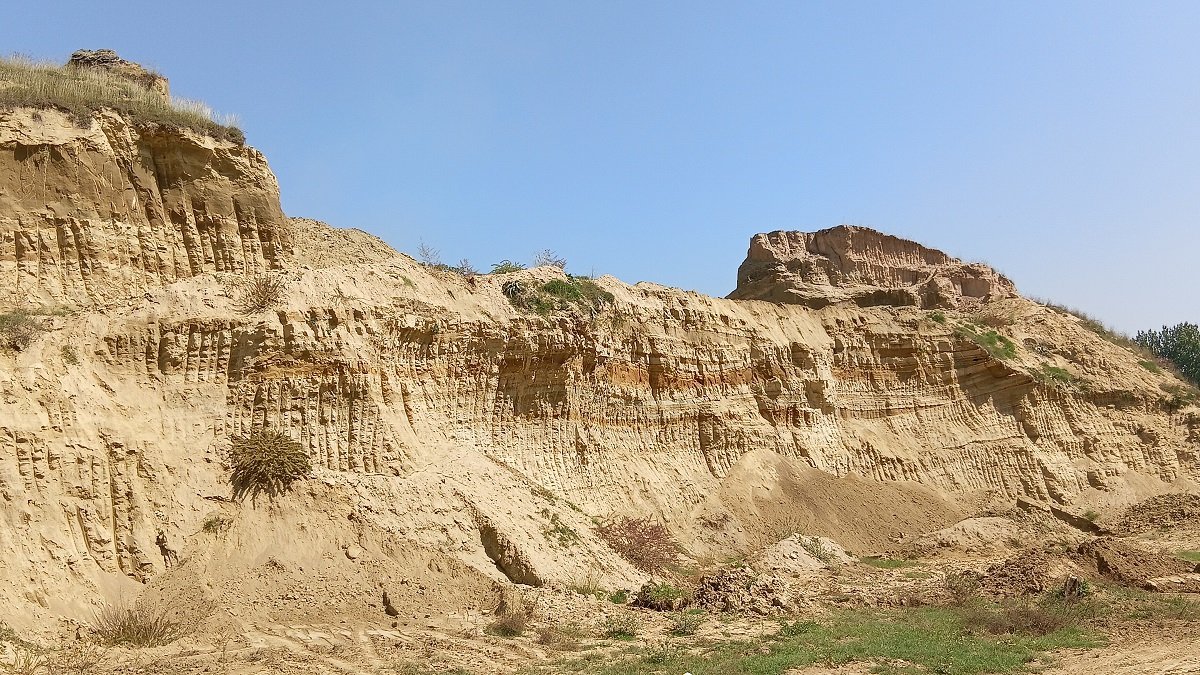
The karewas of Pulwama, Budgam, and other districts are being cut apart.
These plateaus, formed over two million years ago, have shaped the valley’s soil, orchards, and history.
Now they are being stripped of clay, sand, and gravel. The damage is massive and mostly illegal.
In Zadoora, Newa, Tumchi Nowpora, and Parigam villages of Pulwama, and in Pallar, Gowherpora, Kultreh, Nagam, and Hyathpora in Budgam, the land has been carved into pits.
Hundreds of acres of agricultural and horticultural land have been affected. Orchards struggle as the water table drops.
Dust fills the air, covering the soil and the leaves of the trees. The noise of machinery has become constant for local residents.
Mining has become normal in the valley, often without legal clearance.
Some operations run under Disposal Permits issued by the Mining Department, but these permits violate the Mines and Minerals (Development and Regulation) Act of 1957.
Environmental clearance, required for clay and sand extraction, has not been obtained for these sites. No approval from the J&K Environment Impact Assessment Authority exists for the Zadoora mining operations.
The authorities remain silent while the land is destroyed.
The scale of destruction is enormous.
In Zadoora and Tumchi Nowpora, 500 to 700 kanals of land have been excavated. In Gowherpora and Rangeen Kultreh, 400 to 600 kanals show the scars of mining.
Heavy machinery has left the land uneven and prone to erosion. Mining often occurs at night, making enforcement difficult.
Along with clay and sand, gravel is extracted from state land, damaging soil that once supported orchards.
The economic loss is staggering.
The Pulwama Geology and Mining Department has collected 26 lakhs in compensation. Meanwhile, the loss to the state is estimated at 80 to 100 crores.
Environmental damage makes this figure even higher.
Karewas are unique geological formations formed during the Pleistocene period, when Kashmir was a lake. As water drained, clay deposits hardened into these plateaus. They hold geological and archaeological history that is millions of years old. Mining destroys them and erases a part of Kashmir’s identity.
The damage extends beyond public land.
Private farms have been affected. Apple, almond, and plum trees in Zadoora, Kultreh, Gowherpora, and other areas have suffered severe damage. Air and dust pollution have threatened public structures, including the Primary Health Center in Gowherpora.
Local panchayats, whose land has been mined, have not received compensation. The law requires compensation to go to local governance bodies, but this has not happened.
There are also risks to human safety.
Villages located below damaged karewas face potential mudslides and flash floods during heavy rain.
The soil is loose, and heavy rain could wash away orchards and homes.
Restoration of these areas is pressing to prevent disasters similar to those seen in Uttarakhand.
In Budgam, farmers such as Mohammad Maqbool Dar, Riyaz Ahmad Dar, and Asif Aziz report their plum orchards have been affected by dust and soil loss. Hundreds of trees, once thriving, are now struggling.
The land has become uneven and unstable, and air pollution adds to the challenge.
So far, the government has failed to act.
Farmers need compensation for their losses. Environmental compensation should be applied to institutions responsible for illegal mining. Panchayats should receive their rightful share.
The karewas need immediate restoration through proper landscaping. Third-party damage assessments are required to document the full extent of destruction. Mining authorities must enforce the law and prevent further damage.
I have walked these lands. I have seen the scars left by heavy machines. I have spoken to farmers watching their orchards deteriorate.
These are ancient plateaus, the memory of Kashmir’s natural and human history.
If authorities continue to ignore illegal mining, these landscapes, and the communities that depend on them, will be permanently changed.