
By Mudabir Jehan
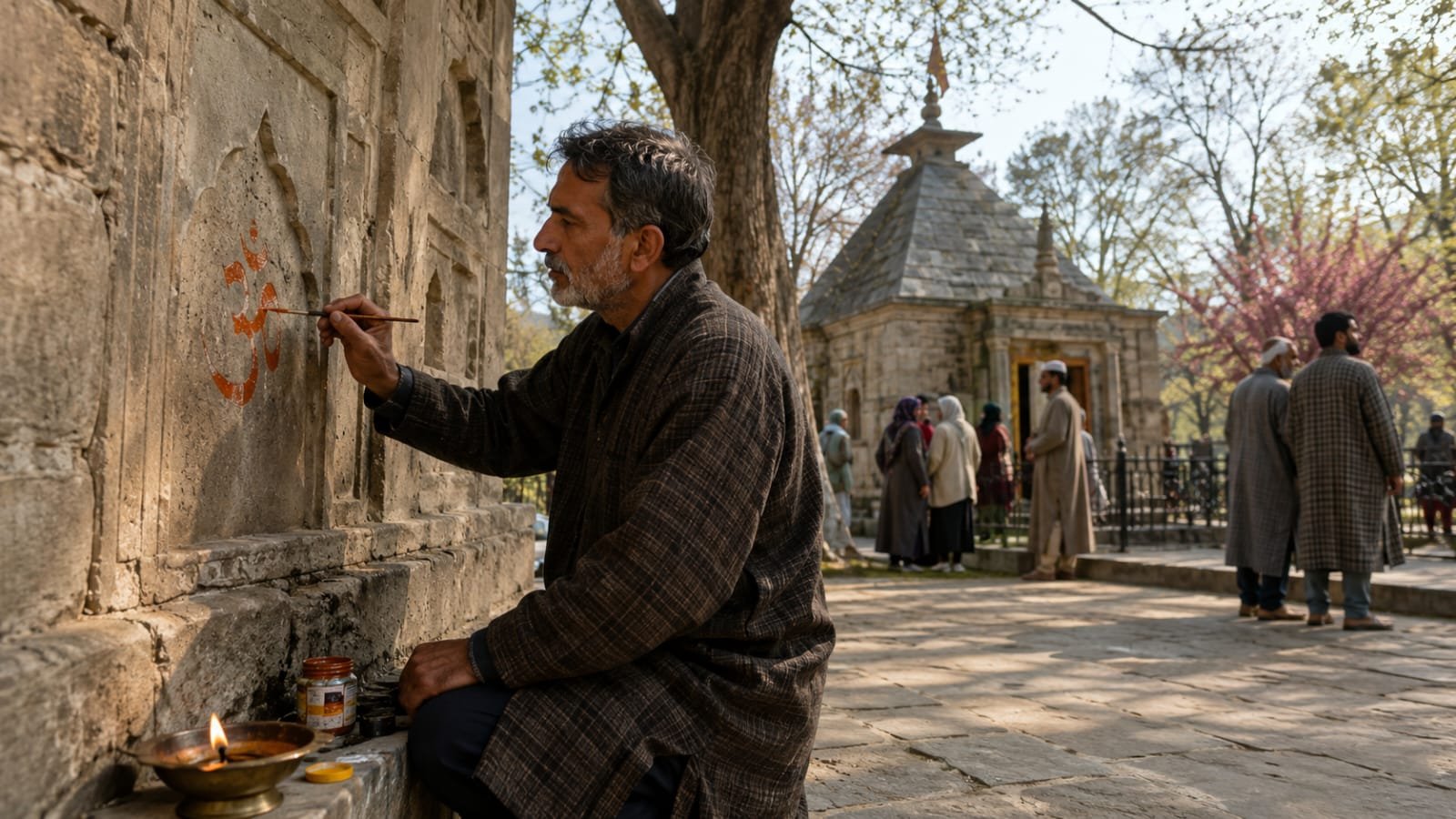
The temple stood under the spring light in South Kashmir’s Shopian district, its walls weathered by time and long winters. Inside the compound, 47-year-old Ghulam Qadir Sheikh dipped a paintbrush carefully into a small container and began tracing the “Om” symbol by hand.
Each stroke moved slowly, almost ceremonially, as if repetition itself had become devotion.
Many Kashmiri Pandit families who once prayed at the Kapalmochan temple left the valley decades ago. The courtyard gradually emptied, footsteps faded, and rituals became infrequent. The structure, however, never slipped into ruin.
Qadir continued arriving there year after year.
He swept the floors, lit diyas and cleaned the premises with a consistency that drew admiration far beyond Shopian.
A recent video showing him painting the temple by hand spread widely online, stirring emotion among Kashmiris who saw in it something larger than maintenance work.
Qadir described his reason in simple terms. He said he did it for humanity.
That image cut through the louder narratives that usually dominate public discussion about Kashmir. Television debates and social media battles often reduce Kashmiri Muslims and Kashmiri Pandits into rigid political identities locked inside the memory of conflict and migration.
But life inside the valley frequently moves through more personal terrain.
Stories of affection, longing and good old bonds continue to surface in neighbourhoods and family gatherings.
A video circulated recently showing two elderly women meeting after years apart. One woman, a Kashmiri Muslim, wrapped her arms tightly around her Kashmiri Pandit friend. Tears filled their eyes as they held each other and spoke about earlier days in the valley.
The scene resonated deeply because many Kashmiris recognized something intimately familiar within it.
Families still recall former neighbours with tenderness. Mothers continue speaking to old friends who migrated years ago. Children hear stories about people who once lived next door, attended weddings together or shared meals during harsh winters.
Distance altered geography, though emotional ties often remained intact.
One Srinagar resident described how his mother still calls a Pandit family that lived in their locality before migration changed the neighborhood.
“There was never any dramatic reason behind it,” he said. “They were people we had known for years. That feeling remained.”
Those bonds survive most visibly in ordinary human moments untouched by political events.
Two women in Srinagar described a friendship that began in 2008, years after migration had already transformed Kashmir’s social landscape. One of them still remembers the first meeting clearly.
“I saw her standing in the corridor of my office,” she recalled. “She looked uncomfortable waiting there alone, so I asked her to sit inside.”
That brief gesture grew naturally into a lasting friendship between a Kashmiri Muslim woman and a Kashmiri Pandit woman. Religion never entered the equation in any defining way, while politics rarely surfaced between them. Shared trust deepened gradually through visits, family gatherings and difficult moments.
“When my father was sick, she helped me immensely,” one of them said. “She guided me through hospitals and doctors. That period brought us even closer.”
Today, their children know each other closely enough to move between homes with ease. Both women speak about their bond with the sense of extended family rather than the caution of symbolic reconciliation.
“We never thought of it as anything extraordinary,” one of them said. “It simply remained part of life.”
Their words reflect a reality often overshadowed by louder public narratives. Many Kashmiris reject the idea that personal relationships must remain permanently trapped inside larger political disputes. They speak instead about individual conduct, shared memories and years of familiarity that existed long before ideological lines hardened.
“We never sat and discussed politics,” the women said. “Friendships do not begin by searching through histories of conflict connected to another person.”
That sentiment echoes through many corners of Kashmir where people continue distinguishing human relationships from collective blame. Politics still casts a long shadow over the valley, while pain and displacement remain deeply embedded in public memory.
Those truths coexist alongside another reality that rarely receives equal attention: many Kashmiris still refuse to see each other solely through religious identity.
Recent remarks by comedian Samay Raina drew attention for similar reasons.
Speaking about difficult years in Kashmir, he recalled how Muslims around his family helped them during periods of uncertainty. His recollection centered on personal kindness rather than communal hostility. Many listeners recognized the sentiment immediately because similar stories exist inside countless Kashmiri households.
But social media frequently amplifies anger, spectacle and division. Television studios reward sharper binaries and louder claims. Human relationships rarely fit neatly into those frameworks.
Old neighbours still ask about each other’s children. Families continue exchanging greetings during festivals and bereavements. Elderly women still cry while remembering shared songs and vanished neighbourhoods.
Kashmir’s public history carries wounds that remain raw and unresolved. Beneath that history, another emotional landscape continues breathing through habit, memory and affection.
Perhaps that explains why Ghulam Qadir Sheikh still walks into the Kapalmochan temple with a paintbrush in his hand, tending carefully to a place many people assume belongs only to someone else’s faith.