
Nusrat stood near a walnut-wood pillar inside Khanqah-e-Moula, her fingers moving slowly over a worn rosary as hundreds of worshippers pressed through the shrine on the banks of the Jhelum River. She remained near that same spot for hours.
Incense smoke hung beneath the sanctum’s sloping ceilings while men recited verses near the entrance. Women sat shoulder to shoulder along the carved interiors, as loudspeakers broadcast collective prayers into the old quarters of Srinagar.
A faded grey shawl covered Nusrat’s head, and her eyes stayed closed through long stretches. Words escaped her lips in fragments of whispered supplication as several women sat behind her in silence, following her lead.
“This day belongs to him,” she said later, referring to Mir Sayyid Ali Hamadani, the beloved Persian saint known in Kashmir as Shah-e-Hamdan or Amir Kabir. “People remember saints through gratitude, and gratitude reaches Allah too.”
This year’s Urs at the shrine drew the usual crowds of devotees, merchants, clerics and families. A separate gathering unfolded within the shrine’s inner spaces, largely hidden from the wider public.
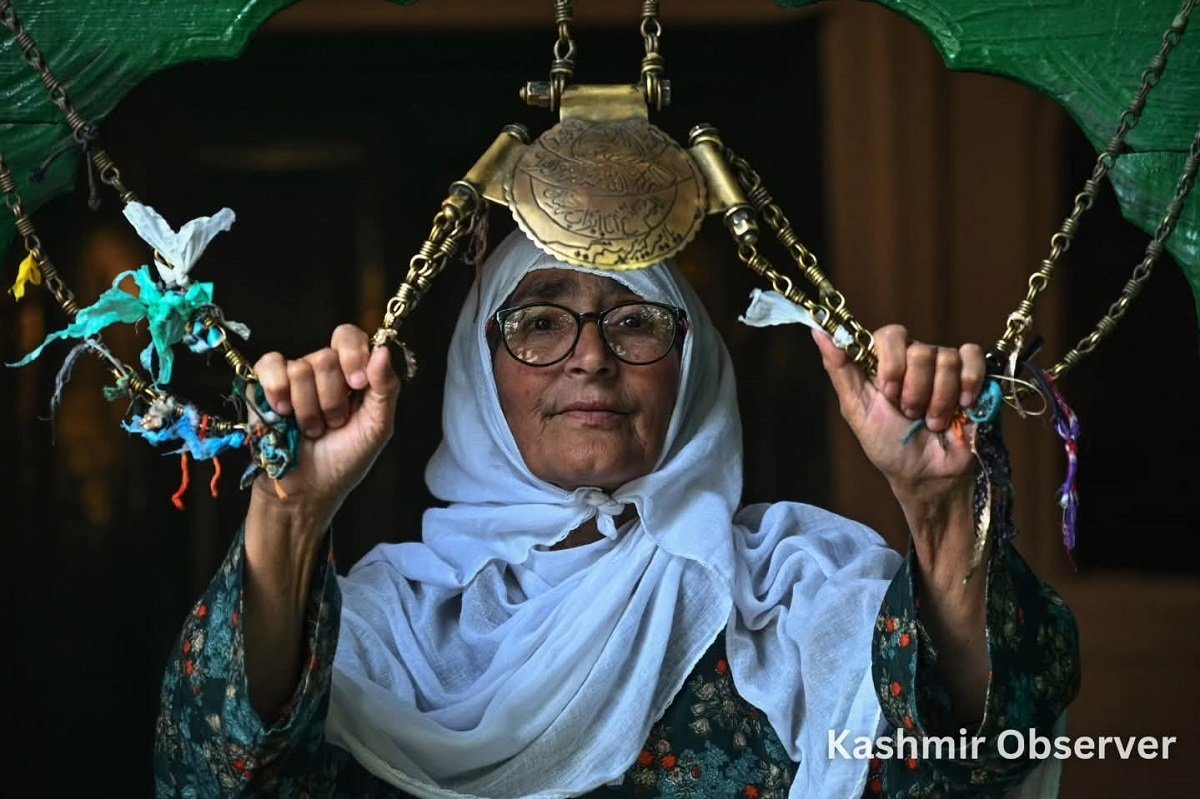
Female faith healers known locally as Pirr Bae had come from villages and towns throughout Kashmir for what many described as a special spiritual assembly tied to Iran, the homeland of Shah-e-Hamdan.
News of war and conflict in Iran had deeply affected many of them. Several women described their prayers as personal acts of devotion linked to the saint whose influence still runs through Kashmir’s religious and cultural life.
Shah-e-Hamdan reached Kashmir in the 14th century with a group of disciples and scholars from Persia and Central Asia. Historical accounts credit him with spreading Islam in the valley while introducing Persian arts, calligraphy, shawl weaving and craft traditions that transformed Kashmiri society.
His shrine, known widely as Khanqah-e-Moula, remains one of the valley’s most important spiritual sites.
Many women at the Urs viewed the conflict in Iran through that historic connection.
Groups of Pirr Bae occupied corners of the shrine through much of the day. Several wore dark robes and held prayer beads wrapped tightly around their wrists. Some stayed seated near lattice windows overlooking the river. Others stood facing the shrine’s interiors with eyes closed and palms raised.
Many of these women maintain small circles of disciples in their home districts. Local residents often seek them for prayers, spiritual guidance and faith healing.
“They prefer solitude over public attention,” says Muzamil Tariq, a regular at Khanqah-e-Moula. “The Urs gatherings here carry deep meaning for many people because of Shah-e-Hamdan and his enduring place in Kashmir’s spiritual tradition.”
Fatima, a faith healer who had travelled with several followers, described the gathering as an emotional response to events unfolding in Amir Kabir’s homeland.
“People help through money and aid when countries suffer,” she said while seated near the shrine’s river side. “Prayer also has its place. We came here because this shrine connects us spiritually to that land.”
Crowds flowed through the khanqah during the day. Vendors sold merchandise outside the shrine complex. Volunteers distributed food to devotees near the riverbank. Cops guided worshippers through narrow lanes leading toward the shrine. Several elderly women recited Persian verses from memory while younger visitors recorded videos on their phones.
The female faithhealers remained detached from much of that movement. Many of them intended to gather this year with Persia in mind. One from Anantnag described the decision as instinctive.
“Shah-e-Hamdan gave Kashmir a spiritual inheritance linked to Iran,” she said. “People feel that connection strongly during difficult times.”
Kashmir’s religious culture has long preserved traces of Persian influence through language, devotional poetry, shrine architecture and ritual practice. Older Srinagar neighbourhoods still refer to Kashmir as Iran-e-Sagheer, Little Iran, a phrase rooted in centuries of cultural exchange between Kashmir and Persia.
That historical memory seemed especially visible inside Khanqah-e-Moula during the Urs.
Persian inscriptions adorned the walls, while the architecture itself reflected Central Asian design traditions brought by the saint’s followers.
The 661st Urs also brought life to the local economy around the shrine. Many families rely on these days to earn seasonal income. Cooks prepared food in huge vessels, cleaners spent the night washing the stone floors, and drivers ferried pilgrims from far-off towns. For traders along the Jhelum River, the Urs often brings the busiest days of the year.
Religious gatherings on this scale sustain an informal social infrastructure alongside official institutions throughout the region. Shrine networks provide employment, food security and spiritual anchoring for communities throughout the valley.
The female faithhealers operate within that ecosystem, guiding women in villages and towns far from Srinagar’s formal institutions.
The spiritual bond with Iran holds political weight within this context.
Shah-e-Hamdan’s legacy created a cultural bridge between Kashmir and Persia that persisted through language, poetry and faith.
That connection now exists within a complex regional landscape where Iran faces international pressure and Kashmir responds with solidarity.
The female faithhealers focused on prayer, though their presence underscored how religious ties continued linking Kashmiri society to wider Islamic civilization.
Late in the afternoon, many worshippers began leaving after congregational prayers ended. The shrine gradually grew calmer. Several female faithhealers stayed seated in small clusters. Some entered prolonged meditative states that fellow devotees described as spiritual absorption. Lips continued moving through whispered invocations. Prayer beads clicked softly through their fingers.
Nusrat stayed near the same pillar where she had spent most of the afternoon.
Women approached her briefly for blessings before stepping away again. A young girl kissed her hand and returned to her family. Older women touched her shoulder and murmured their own prayers. Nusrat acknowledged people with slight nods while maintaining long intervals of silence.
Her thoughts kept returning to Iran.
“Saints build links between places,” she said in a low voice. “People protect those links through prayer.”