
By Er Navaid Runyal
Srinagar- Dawn once brought uncertainty to drivers approaching Panthyal on the Jammu-Srinagar National Highway.
Truckers slowed beneath towering cliffs, watching rain-soaked slopes for falling rocks, while pilgrims, tourists and local families waited for hours as landslides and shooting stones blocked the road.
A journey expected to take minutes often consumed an entire day.
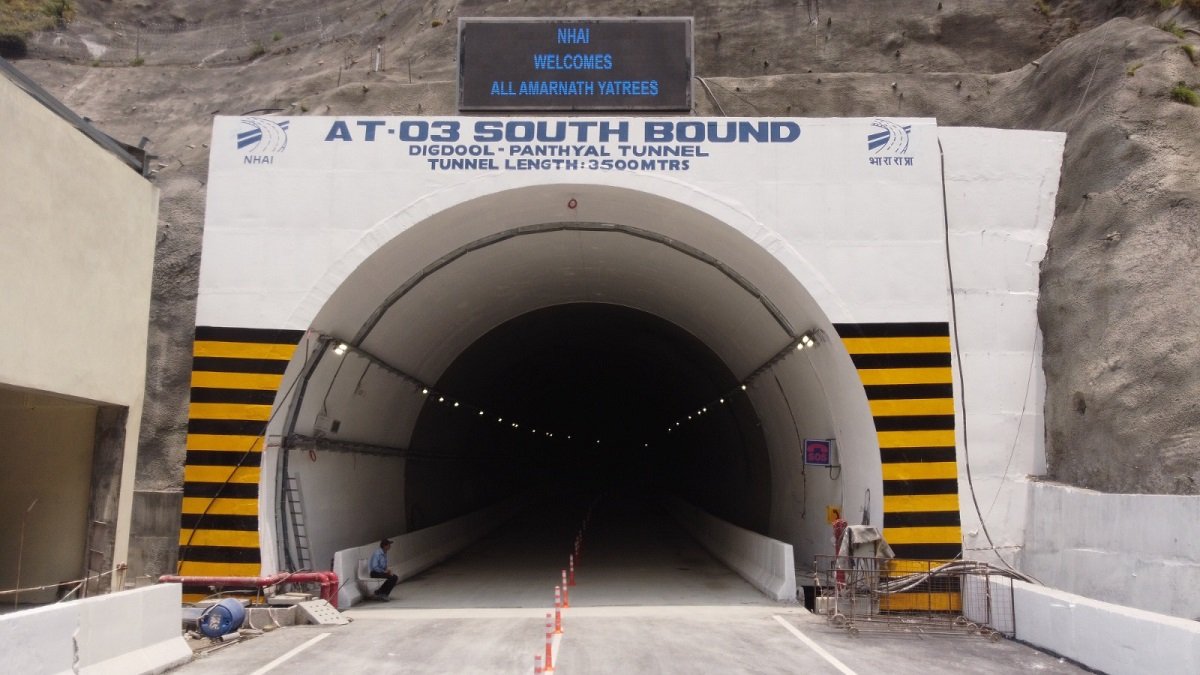
But now, vehicles pass beneath those same cliffs in about five minutes through the newly opened Digdol-Panthyal Twin Tube Tunnels, which bypass one of NH-44’s most hazardous stretches.
Built at a cost of ₹866.37 crore by Ceigall India Private Limited and Patel Engineering for the National Highways Authority of India, the tunnels bypass Khooni Nallah, a narrow corridor that became synonymous with landslides, rockfalls and repeated highway closures.
The southbound tube extends 3.08 kilometres, while the northbound tube measures 2.6 kilometres with an additional 619-metre section.
Both tunnels span 10 metres in width and include ventilation, drainage, LED lighting, emergency exits, communication systems, CCTV surveillance and traffic management equipment designed for continuous operation.
Few roads matter more to Jammu and Kashmir than NH-44.
The highway forms the valley’s primary road link with the rest of India, carrying fruit, fuel, medicines, construction materials and consumer goods while serving millions of tourists each year.
Ramban has long been its most difficult stretch. Steep slopes, fractured rock and intense rainfall regularly triggered landslides that halted traffic for hours, sometimes days.
Those disruptions delayed apple shipments during harvest, interrupted essential supplies and left ambulances, school buses and passenger vehicles waiting alongside stranded trucks.
The twin tunnels shift traffic away from exposed slopes that long disrupted movement through Ramban.
Freight now moves with greater certainty, emergency services gain quicker access during severe weather and residents complete journeys that once depended on the highway’s condition.
“Building the tunnels meant working through one of the world’s youngest mountain ranges, where rock conditions can change within metres,” said a geotechnical instrumentation engineer who worked on the project. “Continuous monitoring helped engineers track ground movement and adjust support systems in real time as excavation progressed.”
That approach, now central to Himalayan tunnelling, allowed construction teams to respond to changing ground conditions while maintaining stability.
Scientific studies explain why tunnelling here is so difficult.
A 2024 study published in Geotechnical and Geological Engineering found that fractured rock in Himalayan tunnels creates about a 20 percent risk of wedge failure while placing the greatest stress near the tunnel crown.
The researchers said those conditions make continuous monitoring and flexible support systems essential during excavation.
“These new tunnels were built using the New Austrian Tunnelling Method, which lets engineers adapt to changing ground conditions,” the engineer quoted above said. “Work advanced in stages, with engineers monitoring stability throughout construction.”
Residents who have watched the highway for decades describe the change through daily experience rather than engineering terms.
Ratan Kumar, who lives in Digdol, remembers rainfall bringing long waits and uncertainty. “Earlier, when rocks used to fall and during heavy rains, many people would be forced to wait for days on either side. Now, we can reach from Digdol to the Ramsoo-Magarkote side in just five minutes,” he said.
Naresh Sharma, another resident, remembers daily traffic jams and frequent accidents that turned routine trips into long delays. “Children often spent hours travelling to and from school,” he said. “Now, we can reach Ramban within no time.”
The Digdol-Panthyal tunnels represent one link in a broader effort to make travel through the Himalayas more reliable.
The 9.28-kilometre Chenani-Nashri Tunnel, opened in 2017, shortened the Jammu-Srinagar journey by about 30 kilometres and reduced travel time by nearly two hours.
The 8.5-kilometre Banihal-Qazigund Tunnel shifted another vulnerable stretch beneath the Pir Panjal range. The Z-Morh Tunnel has already provided year-round access to Sonamarg, while the 14.15-kilometre Zojila Tunnel, which achieved breakthrough in June, is scheduled to open in 2028 as Asia’s longest bi-directional road tunnel.
Work also continues on the 4.38-kilometre Marog-Digdol Tunnel and a 6.02-kilometre viaduct near Banihal, gradually removing bottlenecks along the corridor.
Together, these projects are strengthening Kashmir’s surface communication, and supporting commerce, tourism and emergency access.
Meanwhile, drivers now pass beneath Panthyal in minutes, leaving behind a stretch once defined by landslides and long delays.
That brief journey highlights years of engineering beneath the Himalayas and marks a lasting shift on the valley’s lifeline.