
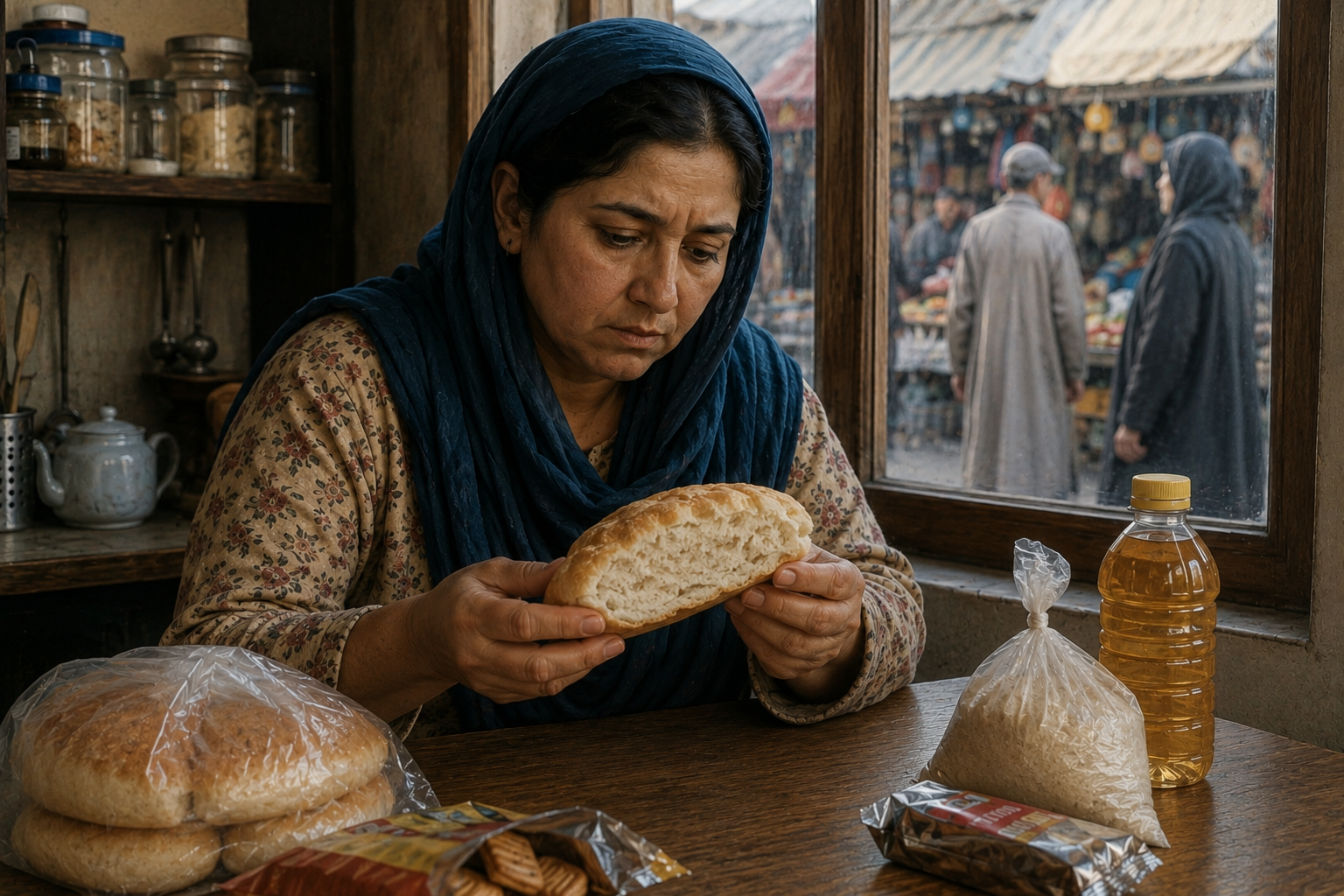

The girda no longer seems enough to get Rukhsana Bhat’s family through breakfast.
Around the table in her downtown Srinagar home, she has started hearing the same request: a little more bread, please.
Girda has long been part of the morning meal in Kashmir, usually eaten with hot tea.
Rukhsana used to buy the same bread from the same local baker, paying 50 rupees for five girdas and dividing it among her family of five.
Lately, one girda finishes faster than it used to.
The price at the bakery remains the same, but the bread in her hand has become smaller.
When Rukhsana asked the baker about the change, he pointed to the rising cost of flour.
His explanation revealed a broader pressure facing bakeries and food businesses, where the cost of basic ingredients has climbed while customers remain sensitive to price increases.
Economists call one response to that pressure shrinkflation: reducing the size, weight or quantity of a product while keeping its price unchanged or moving it only slightly.
The difference from ordinary inflation comes down to what the shopper sees.
“Inflation can be seen through higher prices for vegetables, electricity, school fees and other household expenses,” said Wasim Khan, a Srinagar-based economist. “Shrinkflation works through quantity.”
A biscuit packet, Khan said, can continue selling for 10 rupees while its contents fall from 100 grams to 80.
Similarly, a chocolate bar can lose weight despite retaining its wrapper, while a chips packet can contain fewer chips in the same bright packaging.
“Both pressures reduce what a household can buy,” Khan said. “But shrinkflation makes the change harder to spot.”
Official figures already show the wider pressure on food budgets.
The Ministry of Statistics and Programme Implementation recorded consumer food inflation at 3.47 percent in February 2026 and 4.20 percent in April. The Consumer Food Price Index covers food and beverages, prepared meals, snacks, sweets and non-alcoholic drinks, categories that feature prominently in Kashmiri households.
Jammu and Kashmir’s own price data on essential commodities also points to continuing pressure on household purchases.
And that pressure reaches well beyond flour.
“Producers face higher expenses for flour, sugar, milk powder, cocoa, packaging, transport, wages and fuel,” said Mehnaz Hassan, a financial expert. “A visible price increase can push shoppers toward competing brands.”
Cutting the quantity inside a packet allows companies to retain the printed price while drawing less attention from buyers.
Most shoppers remember what a product costs, but far fewer remember its exact weight or piece count.
A review of Srinagar’s markets shows how such reductions are appearing in everyday shopping.
Kulcha, girda and lavasa can retain their per-piece prices while becoming thinner. Toast and rusk packets can contain fewer pieces, while biscuits and chocolates aimed at children can become lighter inspite of retaining their brand packaging.
Tea, spice blends, masala pouches, soap bars and cooking-oil pouches can also lose small amounts of quantity over time.
But quantity tells only part of the story.
“Some products change in composition,” said Hamid Zargar, a trader in Srinagar.
A sweet, he said, can replace real dry fruit with a cheaper filler, while a chocolate can contain less cocoa and retain the same wrapper.
“The customer then pays the established price for a smaller or less expensive product,” Zargar said.
Packaging can make such changes harder for shoppers to notice. Phrases such as “new pack,” “improved taste” and “family pack” compete for attention while the net weight often appears in smaller print.
Nasir Ahmad, who runs a grocery store in Rajbagh, said most customers focus on the large price printed on a product.
“They ask the price, I tell them the price, they buy it,” he said. “Nobody checks the number printed underneath in small letters.”
However, the financial effect of this ‘unchecked practice’ becomes clearer over time.
A few missing grams from a biscuit packet may seem insignificant at the moment of purchase. Similar reductions in bread, tea, snacks, soap, oil and masala, repeated through the month, can push household spending higher without producing a clear price increase on any single receipt.
Families working with tight monthly budgets can feel the cumulative effect most sharply.
“An open price increase gives shoppers a visible figure to account for,” Khan said. “A smaller packet scatters the increase through dozens of purchases.”
Consumer advocates advise shoppers to read net weight and piece counts alongside the printed price.
Comparing similar products by quantity can reveal differences hidden by the headline price. Keeping a simple record of how much bread, biscuits or cooking oil a household buys can also expose changes that memory misses.
Hassan said families can make quantity checks part of their regular shopping habits and teach children and older relatives to do the same. Switching brands when reductions become frequent can also influence purchasing decisions.
The issue reaches beyond household budgets, as companies that preserve margins by reducing quantities can maintain short-term earnings while giving customers less product for their money.
Investors examining such businesses have reason to distinguish genuine growth from revenue sustained through smaller quantities.
The pressure also reaches household savings with rising prices reducing purchasing power, while smaller products squeezing it through the contents of popular packets.
Both pressures can come together, leaving families to spend more to maintain the same basket of goods.
As a result, quintessential Kashmiri homemakers like Rukhsana Bhat have changed the way they shop.
Some mornings, she studies the girda before putting it on the breakfast table. She looks at its size, and thinks about how much bread her family will want with their tea.
The price has remained 10 rupees for months, but what those 10 rupees buy her family has changed.