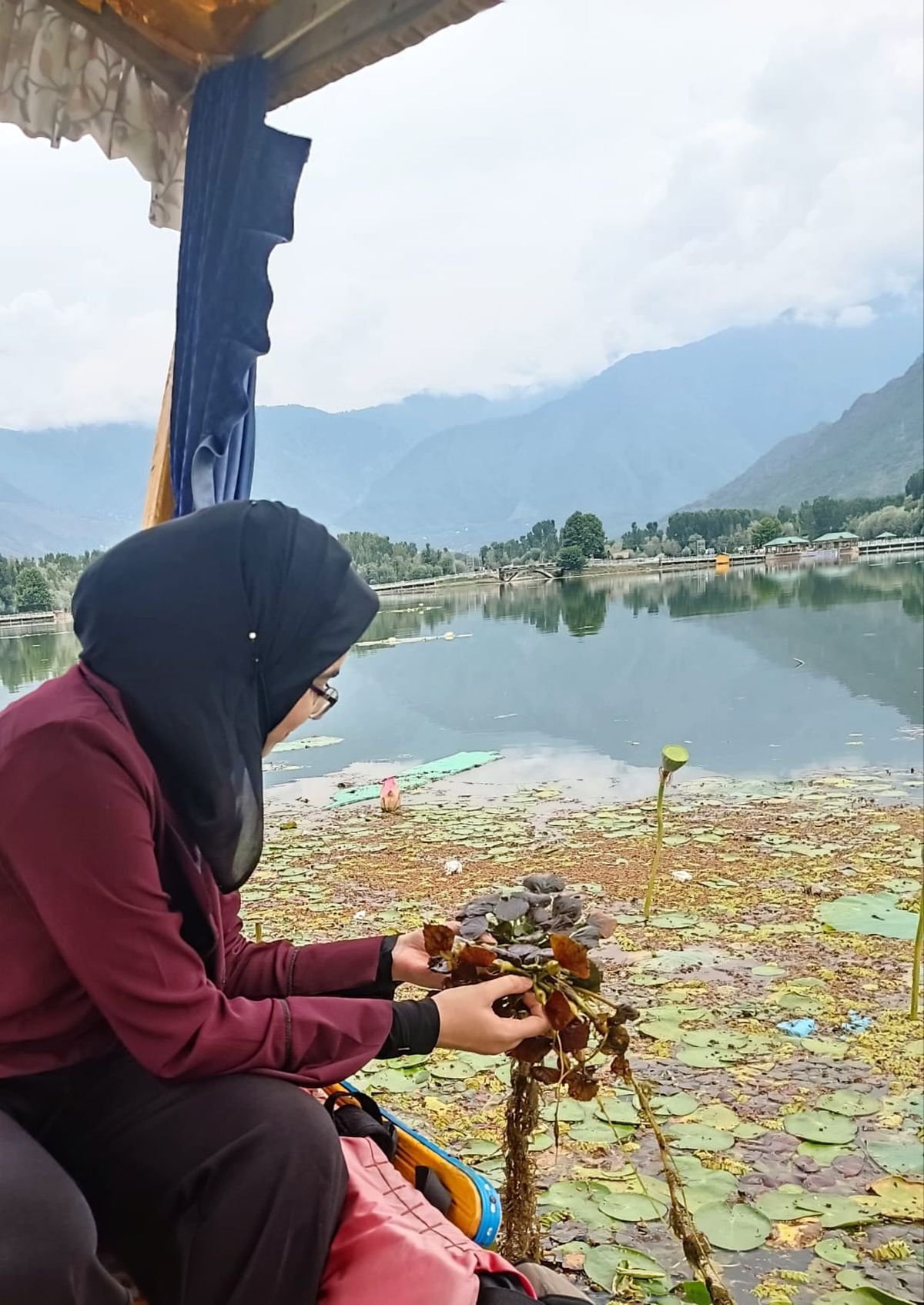

The weeds have long been a signature sight on Dal Lake. They spread through its waters, obstruct navigation and add to the ecological pressures facing one of Kashmir’s most recognisable natural landmarks. Workers remove them, gather the vegetation and dispose of it, often treating the material as another problem that needs clearing from the lake.
But Syeda Nahal Zahra sees something else in those piles of unwanted vegetation.
She sees a possible source of agricultural nutrients, a way to reduce dependence on chemical fertilisers and an opportunity to turn an environmental problem into an economic resource.
An environmental researcher and innovator from Kashmir, Zahra holds a bachelor’s degree in agriculture and a master’s degree in environmental sciences from Sher-e-Kashmir University of Agricultural Sciences and Technology of Kashmir (SKUAST-K), where she graduated as the topper of her master’s batch. Her research focuses on sustainable agriculture, biochar technology, waste-to-wealth solutions and the management of invasive aquatic weeds.
She is currently leading a project supported by Green Hub and the Royal Enfield Social Mission, which explores how weeds collected from Dal Lake can be converted into biochar for agricultural use. Her work also extends to pest management, where she holds a published patent for a Biochar Acaricide Dispensing Spray Device.
Her research has earned her the Young Environmentalist Award and the Young Professional Award. In 2026, she was named among the 50 Icons of Kashmir in the Environmental Science category. She also engages with international environmental organisations, including the International Union for Conservation of Nature (IUCN), the Society of Environmental Toxicology and Chemistry (SETAC) and the Greenhouse Gas Management Institute (GHGMI).
Her work brings an important question to the debate over Dal Lake’s future: can the material removed to protect an ecosystem become part of the solution to problems elsewhere?

In this interview, Zahra discusses how she developed the idea, the science behind biochar, her efforts to bring the technology to farmers, the challenges of taking research beyond university laboratories and why she believes Kashmir’s young scientists should lead environmental innovation.
Dal Lake is deeply connected to Kashmir’s identity, its landscape and the lives of its people. You grew up watching its ecological decline. Was there a particular moment when you decided to move beyond studying the problem and develop a practical solution?
Dal Lake has always been part of my identity. Growing up, I loved its beauty, but I also watched aquatic weeds gradually spread through its waters and create ecological problems. For years, the usual response involved removing the weeds and dumping them somewhere.
During my master’s programme at SKUAST-K, my research guide, Dr. Javaid Iqbal Ah Bhat, introduced me to biochar technology. That was a turning point for me. I began thinking about the weeds differently. Instead of treating them as waste that needed disposal, I wondered whether we could convert them into something useful.
I realised that the material we were removing from Dal Lake could have agricultural value. That idea became the foundation of my research. I wanted to develop a practical solution that could help the lake while also benefiting farmers.
Let’s explain the science for readers who may be unfamiliar with biochar. What exactly is it, and how do you turn aquatic weeds into something that can improve agricultural soil?
Biochar is essentially a highly porous, carbon-rich charcoal produced by heating organic material in the absence of oxygen. This process is called pyrolysis.
Its porous structure allows it to retain water and nutrients in the soil. It can also support beneficial microbial activity, which contributes to soil health.
My research involved experimenting with different organic materials. During my master’s programme, I personally collected and segregated kitchen waste from the hostels at SKUAST-K’s Shalimar campus. This included fruit peels, eggshells and used tea leaves. I processed these materials myself and studied their potential for biochar production.
We also explored combinations of Dal Lake’s aquatic weeds with sheep dung and kitchen waste. The weeds contain nutrients such as nitrogen and potassium, while sheep dung contributes organic matter and bulk to the mixture.
Combining these materials allows us to use resources that would otherwise go to waste. The resulting biochar can help soil retain moisture and nutrients while supporting beneficial microorganisms.
The larger idea is quite simple. We have an environmental problem in Dal Lake and organic waste coming from households. Both can become valuable resources through appropriate scientific processing.
Your research has also moved into an unexpected area: livestock and crop protection. You hold a published patent for a Biochar Acaricide Dispensing Spray Device. How did an environmental researcher become interested in developing a pest-management tool?
I wanted to explore the other applications of biochar. During a discussion with a colleague working in insect research, we began talking about the problems local farmers face with ticks and mites affecting livestock and crops.
That discussion led us to explore whether biochar could help deliver naturally derived acaricidal compounds.
Biochar has a highly porous structure and a large surface area. These properties make it a potentially useful carrier for active compounds. Our idea involves processing biochar into a fine powder, dispersing it in a liquid to create a suspension and developing a formulation that can be applied uniformly to the target area.
The published patent covers the device concept. We are still developing the specific active organic component and testing the complete formulation to establish its efficacy.
We are also working on the prototype. The broader objective is to develop a practical application that could eventually help farmers manage pest problems affecting their livestock and crops.
So biochar could potentially serve two different purposes: improving agricultural soil and helping deliver natural pest-control compounds. How far have you taken the Dal Lake project towards actual use on farms?
We are currently at the initial pilot stage. Our target is to work with 10 to 15 farmers and demonstrate the benefits of biochar under actual agricultural conditions.
I am providing the biochar to participating farmers free of cost at this stage. We want farmers to understand how it works and give us an opportunity to document the results before we think about commercialisation.
One of our targets is to achieve a 10 per cent reduction in chemical fertiliser use. We want to assess whether biochar can help farmers reduce their dependence on conventional fertilisers while maintaining agricultural productivity.
After the winter season, we plan to coordinate with the existing Dal Lake weed-removal activities and organise local collection of the vegetation.
The intention is to connect the lake’s weed-management work with agricultural needs. We want to demonstrate that material removed from the lake can support farming rather than simply becoming another disposal problem.
The connection between lake conservation and farmers’ livelihoods is particularly interesting. Kashmir has a large agricultural community, and farmers often face rising input costs. What would make this model economically sustainable once the pilot phase ends?
The first step is to demonstrate that the technology works. Farmers need to see practical benefits before they adopt a new agricultural practice.
We are keeping commercialisation aside until we have documented the results. The pilot will help us understand how biochar performs in local agricultural conditions and whether it can contribute to reducing chemical fertiliser use.
The next step involves organising weed collection around the existing removal activities at Dal Lake. This could create a local supply of raw material for biochar production.
I see potential for a local waste-to-wealth model in which aquatic weeds and other organic materials become useful agricultural inputs. Such an approach could connect environmental management with farming and create opportunities for local participation.
Your project has received support from Green Hub and the Royal Enfield Social Mission. Young researchers often have promising ideas but struggle to secure institutional or financial support. How did you get this project off the ground?
I learned about the Green Hub initiative through a friend working in wildlife research. I explored the initiative and decided to submit a proposal explaining how we could convert Dal Lake’s aquatic weeds into biochar.
I focused on presenting the problem and explaining how the proposed research could address it through a practical approach. The proposal received approval, which gave us the support to take the project forward.
My advice to young researchers is to develop proposals around real problems in their own communities. A theoretical idea can be interesting, but funders also want to understand how the research could work in practice.
Show them the problem, explain the science and present a practical way to address it. Research becomes much stronger when it connects with people’s actual needs.
You also engage with international organisations such as IUCN, SETAC and GHGMI. Kashmir’s environmental challenges have their own geographical and ecological characteristics. How do you bring those local realities into international discussions?
The Kashmir Himalayas have specific climate vulnerabilities, and our environmental challenges need to be understood in their local context.
When I engage with international organisations, I try to bring evidence and research into the discussion. I talk about the changes affecting Dal Lake and our wetlands, and I also explain the solutions we are developing.
For a long time, Kashmir has attracted researchers and environmental experts who come here to document ecological decline. That research is valuable, but I believe we also need to become producers of knowledge and solutions.
We should be generating research from Kashmir, developing technologies that respond to local conditions and sharing those findings internationally.
I want Kashmir’s scientific community to participate in global environmental discussions as innovators and problem-solvers.
That brings us to the other side of the exchange. You take Kashmir’s experiences to international platforms. What have you learned from those engagements that you want to bring back to the valley?
The biggest lesson is that research needs to move beyond academic publications and laboratory experiments.
We often conduct good research, publish papers and contribute to scientific knowledge. However, the real challenge begins when we try to apply those findings in the field.
International discussions have strengthened my belief that science should produce practical results for communities. We need to connect universities, researchers, farmers and institutions.
I also believe we should make better use of locally available resources. We do not always need expensive imported technologies. With good scientific understanding, local materials and appropriate methods, we can develop solutions suited to Kashmir’s environmental and agricultural conditions.
Dal Lake has featured in decades of environmental studies, restoration programmes and public debate. The recurring picture is one of ecological decline. Does working on a problem of this scale ever become discouraging? What keeps you invested in it?
It can be exhausting to hear negative news about the lake year after year. Anyone who cares about Dal Lake feels concerned when they see the problems continuing.
What encourages me is the growing interest among young people in Kashmir. I meet young people who care about environmental protection, research and finding practical solutions. Their involvement gives me hope.
I also believe we need to change how we look at environmental problems. We spend a lot of time discussing what we are losing. We should also spend more time asking what we can restore and what solutions we can develop.
Over the next ten years, I would like to see farmers throughout the valley using biochar and organic agricultural methods as standard practices rather than treating them as experimental alternatives.
That is the larger vision behind my work. I want scientific research to contribute to a healthier environment and more sustainable agriculture.
Let’s bring the discussion to policymakers and investors. Your pilot involves 10 to 15 farmers, and you have set a target of reducing chemical fertiliser use by 10 per cent. What kind of institutional support would help you move from a small project to a larger programme?
See, local researchers need financial and institutional support. Many promising ideas emerge from university laboratories, but researchers struggle to take them into the field.
I particularly advocate a dedicated government subsidy for small-scale biochar production using agricultural and aquatic waste.
The main challenges include the cost of collecting biomass, transporting it and accessing pyrolysis equipment. These costs can become major obstacles for young innovators and farmers who want to establish small production units.
Government support could make the necessary resources more accessible. It would help researchers test their ideas, encourage farmers to participate and create opportunities for local waste processing.
I believe this could become a grassroots waste-to-wealth movement. Supporting local science would also help Kashmir develop greater self-reliance in managing its environmental and agricultural challenges.
Your work has earned recognition through the Young Environmentalist Award and your inclusion in the 50 Icons of Kashmir 2026 list. What does that recognition mean to you, particularly as a young woman working in environmental science?
I feel very grateful for the recognition. It encourages me to continue my research, but I also see it as a responsibility to help other young people find opportunities in science.
My journey began with very practical work. I personally collected and segregated kitchen waste from university hostels because I wanted to test an idea and establish that it could work. Research can involve a lot of groundwork that people rarely see.
I want young students, especially young women interested in science, technology, engineering and mathematics, to understand that their geographical location should never limit their ambitions.
Being in Kashmir does not prevent you from doing world-class scientific research. You can begin by observing the problems around you, asking questions and developing solutions through research.
You will face difficulties, and some experiments may fail. That should never become a reason to abandon an idea.
I started with the resources available to me and a problem I could see around me. I want the next generation to participate in science, lead research and develop innovations of their own.
Dream big, but build something meaningful for the place you call home.