
Tehran – A fragile opening in the Gulf collapsed on Saturday after Iran reinstated strict control over the Strait of Hormuz and fired on vessels attempting to transit, following Donald Trump’s decision to press ahead with a naval blockade despite Tehran’s earlier move to reopen the waterway.
The escalation has renewed fears for the global economy, with roughly a fifth of the world’s oil supply passing through the strait, and comes days before a ceasefire deadline that diplomats are scrambling to extend.
Iran’s Khatam-al-Ambiya joint military command said “control of the Strait of Hormuz has returned to its previous state … under strict management and control of the armed forces”, warning that restrictions would remain as long as the US continued to disrupt Iranian shipping. Command spokesman Lieutenant-Colonel Ebrahim Zolfaqari accused Washington of “banditry and piracy under the guise of a so-called blockade”.
Tehran’s move marked a sharp reversal from Friday, when foreign minister Abbas Araghchi announced a limited reopening of the strait to commercial traffic as part of a broader ceasefire framework linked to Lebanon. Iranian officials said the arrangement would allow only designated routes under naval authorisation — a controlled concession intended to support negotiations.
That opening quickly unravelled. Trump said the US blockade would remain “in full force and effect” until a comprehensive agreement with Iran was finalised and claimed Tehran had agreed never to close the strait, an assertion Iranian officials flatly rejected.
The US stance drew an immediate backlash in Tehran. Deputy foreign minister Saeed Khatibzadeh warned Washington was “risking the international community” and jeopardising the entire ceasefire package, while lawmakers said the strait would return to its previous restricted status, including requirements for authorisation and tolls.
Within hours, tensions spilt into direct confrontation. Iranian Revolutionary Guards gunboats opened fire on a tanker in the strait, while a container vessel was struck by an unidentified projectile, damaging cargo. Two Indian-flagged ships, including a supertanker carrying Iraqi oil, were forced to turn back after coming under fire, according to maritime tracking data.
Shipping through the chokepoint has since been confined to narrow corridors requiring Iranian approval, according to data firm Kpler, while US Central Command said it had turned back 21 vessels since the blockade began earlier in the week.
The renewed standoff underscores how both sides are seeking leverage ahead of negotiations over Iran’s nuclear programme and a broader settlement to end hostilities. For Washington, the blockade is a means of sustaining pressure without returning to full-scale war. For Iran, controlling Hormuz remains its most powerful countermeasure, capable of driving oil prices higher and amplifying global pressure on Washington.
Friday’s brief reopening had triggered a drop in oil prices, but the latest reversal threatens to prolong the energy shock already rippling through markets.
Diplomatic efforts are intensifying to prevent a full breakdown. Pakistan has stepped in as a mediator, with foreign minister Ishaq Dar saying officials were working to “bridge” differences between the two sides and prepare a new round of talks expected early next week. Senior Pakistani officials have been holding meetings in Tehran and with regional leaders in Turkey and Qatar.
But prospects for progress remain uncertain. Khatibzadeh said Iran was not ready for direct talks while the US maintained what he called a “maximalist position” and dismissed Washington’s demand that Iran surrender its stockpile of enriched uranium as “a non-starter”. Trump, meanwhile, said the US would “go into Iran and get all the nuclear dust”, referring to material believed to be stored at heavily damaged nuclear sites.
In a further show of defiance, Iran’s supreme leader, Ayatollah Mojtaba Khamenei, said the country’s navy stood ready to deliver “bitter defeats” to its enemies, praising recent strikes against US and Israeli interests.
With ships under fire, oil flows constrained, and diplomacy under strain, the Strait of Hormuz has once again become the focal point of a confrontation with global consequences – and diminishing room for compromise.
‘Hormuz Rules Set on Battlefield, Not Social Media’
Iranian officials have made clear that access now comes with conditions. Chief negotiator Mohammad Baqer Qalibaf pushed back forcefully against statements made by Trump, who had claimed on social media that Iran had “agreed to never close the Strait of Hormuz again” and that a US “naval blockade will remain in full force and effect as it pertains to Iran, only, until such time as our transaction with Iran is 100% complete”.
In a sharply worded response posted on X, Qalibaf wrote: “The US president made seven claims in the span of one hour, all seven of which are false.”
He warned that “if the blockade continues, the Strait of Hormuz will not remain open,” and stressed that any passage would be tightly regulated: “Passage through the Strait of Hormuz will take place based on a ‘designated route’ and with ‘Iran’s authorization.’” He added: “Whether the strait remains open or closed and the rules governing it will be determined on the battlefield, not on social media.”
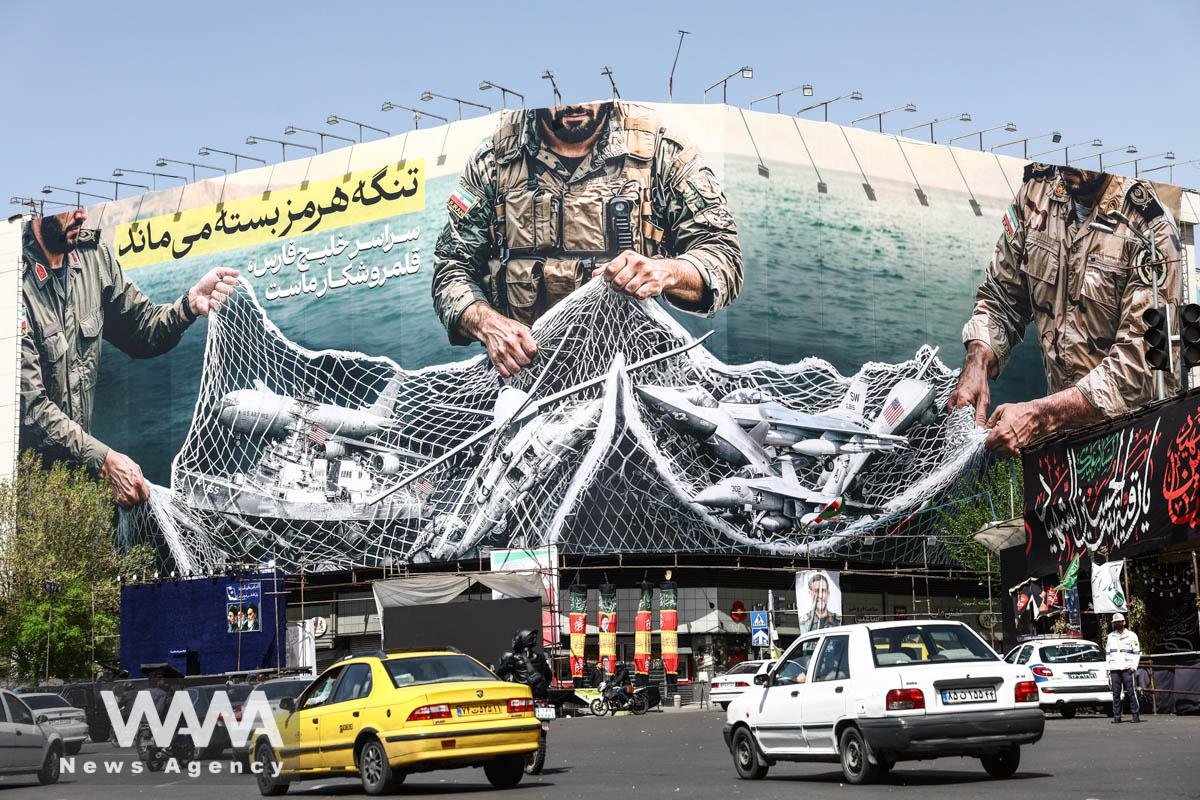
The remarks reflect a broader shift in tone from Tehran, where officials have increasingly framed control of the strait as both a strategic necessity and a demonstration of sovereignty. The Islamic Revolution Guards Corps (IRGC) Navy reinforced that message, announcing what it described as a “new order” governing maritime traffic.
Under the new rules, all commercial vessels must travel along routes designated by Iran and receive explicit authorisation from its naval forces, while military vessels are barred entirely. The measures, the IRGC said, were being implemented in line with ongoing ceasefire arrangements and reflect Iran’s control over the northern stretch of the waterway.