
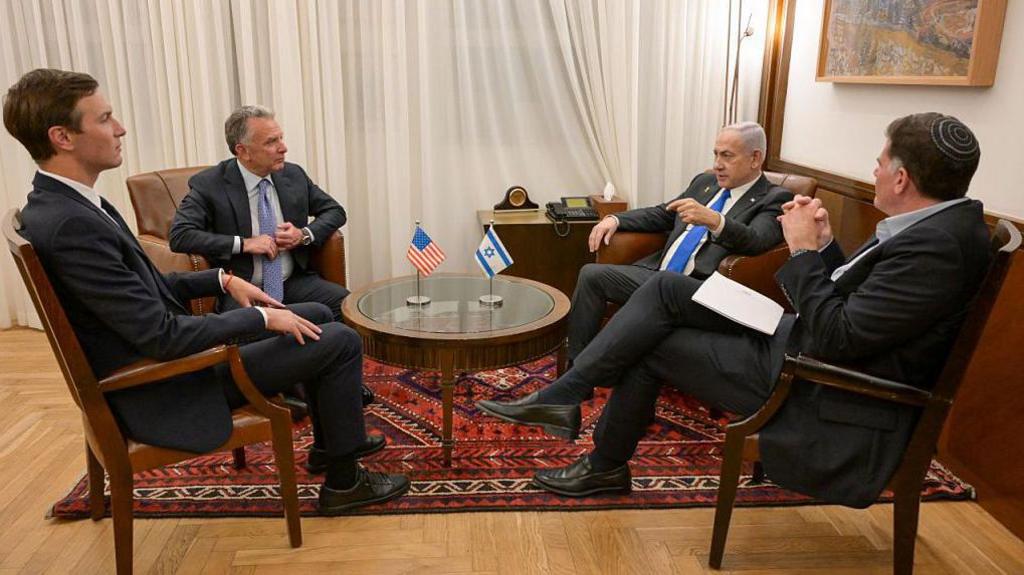
Jerusalem, October 10(HS): In a breakthrough hailed as a “momentous development,” Israeli Prime Minister Benjamin Netanyahu announced that his cabinet has approved US President Donald Trump’s Gaza ceasefire and hostage release plan — a sweeping proposal marking the first major progress toward ending two years of devastating conflict.
The agreement, negotiated with intense US mediation led by Trump’s envoy Steve Witkoff and senior adviser Jared Kushner, would initiate a phased end to fighting, facilitate the release of Israeli hostages, and open Gaza to massive humanitarian relief.
Netanyahu credited what he called Trump’s “extraordinary leadership,” saying, “We are about to achieve one of our central war aims — the return of the hostages, both the living and the dead.”
Key Provisions of the Agreement
Under the first stage of Trump’s 20‑point peace plan, a ceasefire will take effect within 24 hours, followed by a partial Israeli military withdrawal that leaves Israel controlling about 53 percent of Gaza. Hamas is required to release 48 hostages, including the 20 believed to be alive, in exchange for Israel freeing 1,700 Palestinian prisoners and the remains of several detainees.
Hundreds of trucks carrying food, medicine, and relief supplies will then enter Gaza daily through corridors opened under UN supervision. The ceasefire will be overseen by a multinational monitoring force of 200 troops, coordinated by US CENTCOM and including contingents from Egypt, Qatar, Turkey, and the UAE.
Future stages envision deeper Israeli withdrawals and demilitarisation of Gaza, with governance transitioning to an apolitical Palestinian technocratic committee, later to be handed over to a reformed Palestinian Authority.
The framework explicitly rules out any governance role for Hamas but offers its members amnesty or safe passage abroad if they renounce violence.
Global Reactions and Humanitarian ResponseThe announcement sparked celebrations in Jerusalem, Tel Aviv, and parts of Gaza, where residents spoke of “relief and disbelief” after years of siege and bloodshed.
UN Humanitarian Chief Tom Fletcher called the plan “a lifeline for tens of thousands,” noting that the UN has 170,000 tonnes of food, medical supplies, and tents ready for immediate dispatch once the ceasefire holds.
Former Oslo Accords negotiator Jan Egeland described the deal as “the best chance for lasting peace in decades,” saying his organisation was prepared to move hundreds of aid trucks into Gaza within hours.In Ramallah, Palestinian President Mahmoud Abbas expressed cautious optimism, calling the agreement “a historic moment” that could “end the bloodshed” and restore stability in the region. He confirmed that the Palestinian Authority has begun preparing to assume administrative responsibilities in Gaza, including forming a new police force.
Political and Regional ImplicationsWhile Trump’s plan has drawn international praise, several contentious issues remain unresolved — including Hamas’s disarmament, the extent of Israeli withdrawal, and the future political structure of Gaza. Netanyahu has reiterated that the Palestinian Authority “will play no role” in governing Gaza, even as Washington presses for gradual integration under the peace roadmap.
Despite scepticism among hardliners, analysts say the deal marks a turning point. For Israel, it offers an end to prolonged attrition and a chance to recover hostages; for Palestinians, it opens the door to reconstruction and potential recognition; and for Trump, it cements a rare diplomatic triumph that has so far eluded his predecessors.
As dawn breaks over the battered enclave, celebrations and gunfire ring out in mixed relief and disbelief — a fragile peace edging into view after years of devastation. Whether this ceasefire can endure will test the resolve of leaders on all sides to turn a truce into a lasting settlement.
—————
Hindusthan Samachar / Jun Sarkar