
I have spent years watching trucks loaded with sand and clay pull onto highways across Jammu & Kashmir, and I have spent those same years filing the cases meant to stop them.
Today, I am writing this letter because local institutions have shown that they cannot, or will not, act.
This account draws largely on documents from my own litigation and the findings of a government committee.
Riverbed mining in Kashmir began generations ago with people using shovels and baskets, at a scale the land could handle. I watched that change roughly a decade ago, when hydraulic excavators like JCBs and LNTs replaced hand tools, and I watched it accelerate again once government infrastructure projects created demand contractors were eager to meet.
Rivers such as the Rambiara, Sukhnag, Doodh Ganga, Romshi and Shali Ganga became mining sites, often without environmental clearance and sometimes even inside protected trout fish beats.
Mining continued during the monsoon, when riverbeds are most vulnerable and the risk of floods is highest. I raised these violations with the National Green Tribunal after the Flood Control Department, Mining Department and police in J&K failed to act.
I took the fight to court, and both the NGT and the Supreme Court issued rulings in my cases.
The halt achieved in parts of Budgam district proves regulation works when someone enforces it.
On August 22, 2025, the Supreme Court ruled in my case, Raja Muzaffar Bhat vs Government of J&K, NKC Projects Pvt Ltd and others, ordering the J&K Pollution Control Committee to act against a company that damaged the Shaliganga stream.
Regulators imposed an environmental compensation of Rs 3.10 crore on NKC Projects in February 2026. That fine remains unpaid, and I understand the figure has since doubled through accumulated penalties.
A court order without a collection mechanism is a suggestion, rather than a sanction, and I have watched that lesson repeat itself for years.
Beyond the rivers lies a second crisis, one built into geology older than any legal system.
Kashmir’s karewas, plateau-like deposits of alluvial soil formed when the Pir Panjal range dammed a lake covering 5,000 square kilometers during the Pleistocene epoch, took millions of years to become the fertile terraces that grow saffron, almonds and apples.
Kashmir saffron earned a Geographical Indication tag in 2020 specifically because of the soil these plateaus provide.
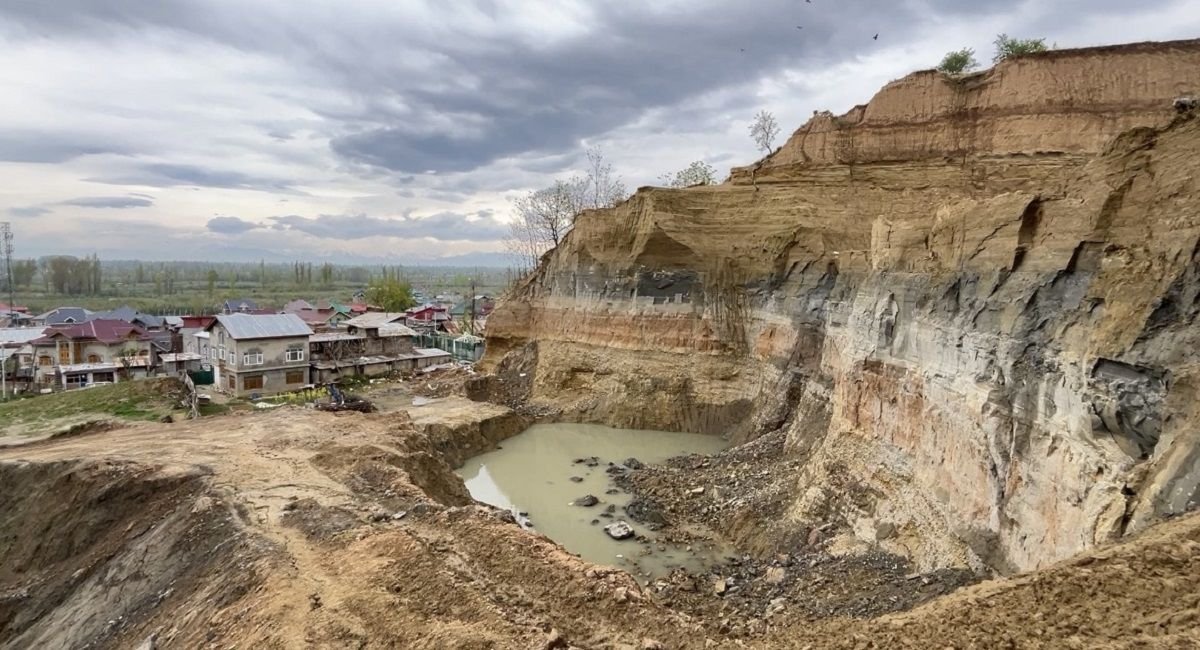
But between 1995 and 2005, builders flattened large sections of karewa in Pulwama, Budgam and Baramulla to source clay for the Qazigund-Baramulla railway. Between 2020 and 2025, the Srinagar Ring Road project consumed hundreds of acres more, and I watched both projects proceed with no meaningful environmental scrutiny.
A joint committee convened under NGT case OA No. 93 of 2026, staffed by officials from the Ministry of Environment, the Central Pollution Control Board, the state pollution control committee and district magistrates from Pulwama and Budgam, inspected the villages of Zadoora and Gowharpora Kultreh in April.
Their report puts a number on the damage: 13.05 lakh metric tonnes of sand, clay and bajri removed from Budgam sites alone, split between 415,000 tonnes at Kuzwera and 890,000 tonnes at Gowherpora, with the Zadoora quantity recorded separately as 2.996 lakh cubic metres.
In Brinjan village, roughly 4,000 kanals, about 500 acres, of high-value farmland and horticultural land have been degraded or flattened outright, land that could otherwise sustain high-density orchards of apple, walnut and cherry for generations of local families.
Officials told the committee that disposal permits issued over the preceding five years fell under an exemption from prior environmental clearance.
I want to underline the committee’s own response: exemption from one requirement never cancelled the rest. Investigators found no evidence that project proponents gave the pollution control committee the fourteen days’ notice the rules demand, and standard procedures covering topsoil preservation, replanting, benching and drainage went largely ignored.
Between April 2021 and March 2026, authorities in Budgam alone made 113 seizures of vehicles and machinery, collected about Rs 25.25 lakh in compounding charges, and filed fourteen FIRs against repeat offenders.
Numbers this specific do not describe negligence to me. They describe a system that knows exactly what is happening and lets it continue.
I see the consequence as geological instability with a body count waiting to happen.
Hyathpora Nagam, Watrihail Muqam and Brinjan in Budgam, along with Zangam, Kanisathoo colony and Singhpora Pattan near Baramulla, Bijbehara in Anantnag, and Newa in Pulwama, now stand as landslide hotspots, their slopes stripped of the vegetation that once anchored them.
Silt washes into irrigation channels and stream networks during heavy rain, accelerating downstream flooding.
I have asked repeatedly for drone and CCTV surveillance of these sites through multiple written appeals to the government. Police have not stopped the machinery, and administration departments covering revenue, mining, agriculture and horticulture have not enforced statutes already on their books.
I am asking you, Dr Vatsa, to send an expert team to Srinagar and to constitute a joint flood-risk assessment involving the Central Water Commission, the state disaster management authority, scientists from the G B Pant National Institute of Himalayan Environment, and hydrological experts, backed by drone and GIS monitoring of high-risk zones.
All of it is overdue.
Kashmir’s rivers and karewas took millennia to build the ground my community lives and farms on. Trucks are removing that ground faster than any institution has agreed to notice.