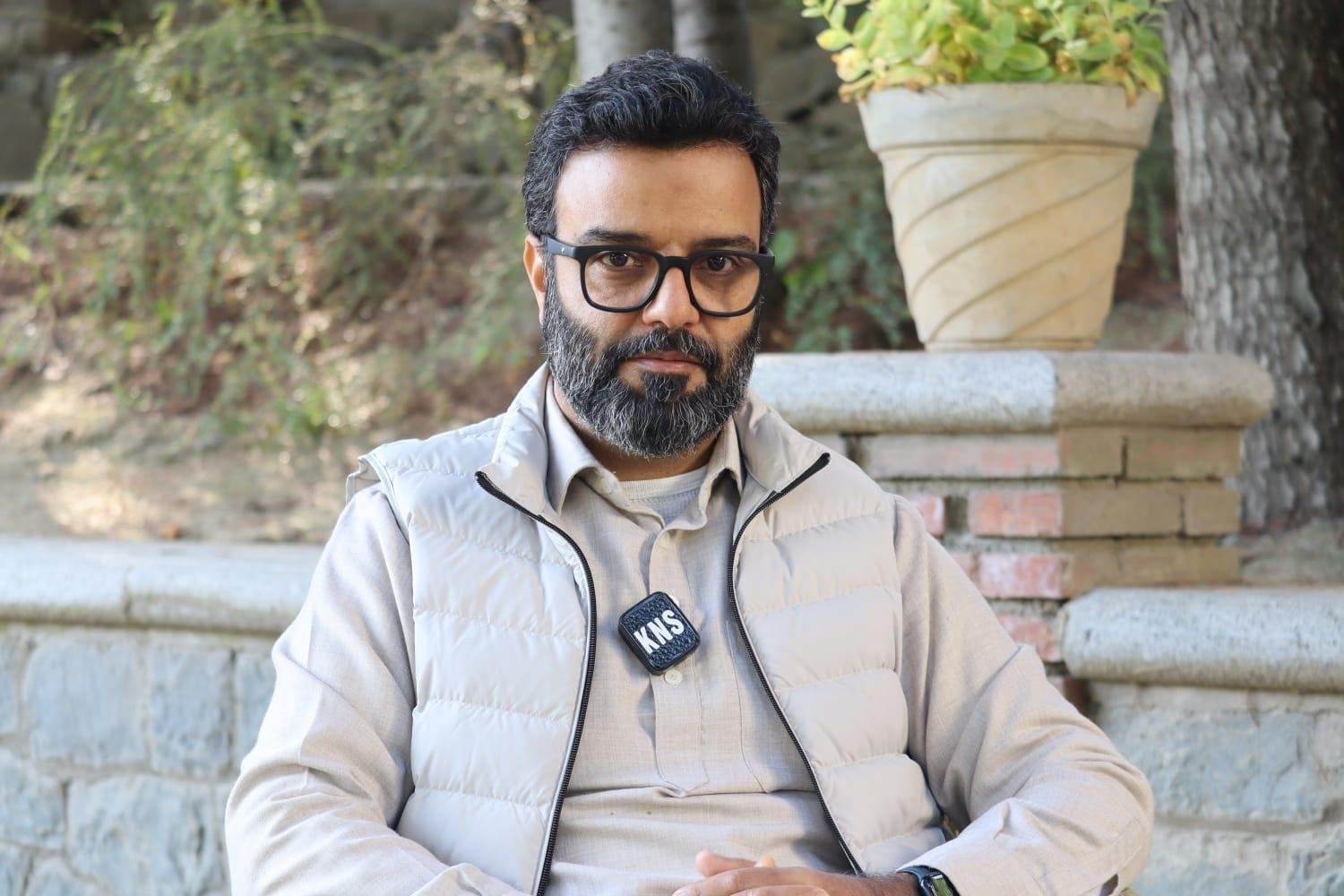
By Ali Sajid and Farah Zaidi

We left Srinagar at seven on a cold autumn morning, heading towards Kupwara.
The mountains were beginning to take on their late autumn colours, and there was a sense of anticipation about the journey ahead.

Our destination was Jumagund, a remote cluster of settlements in the upper reaches of Kupwara, along the Line of Control (LoC).

Jumagund is hardly a conventional tourist destination. Access is regulated, and our visit had been arranged with prior permission and coordination with the Army.
We wanted to see a part of Kashmir that remains largely outside regular travel itineraries and, more importantly, meet the people who have made their homes in this difficult mountain landscape.

After about two and a half hours, we reached Zirhama, a village at the foothills of Puta Khan Gali. The road began climbing through narrow bends and increasingly rugged terrain.
Traffic was sparse. We passed only a few vehicles, including a passenger transport vehicle and a construction truck.
By around 11:30 am, we reached Puta Khan Gali, where the Army personnel welcomed us with traditional Kashmiri kehwa and pakodas.
After a brief stop, we continued towards Jumagund, taking the road that descended from the mountain pass.
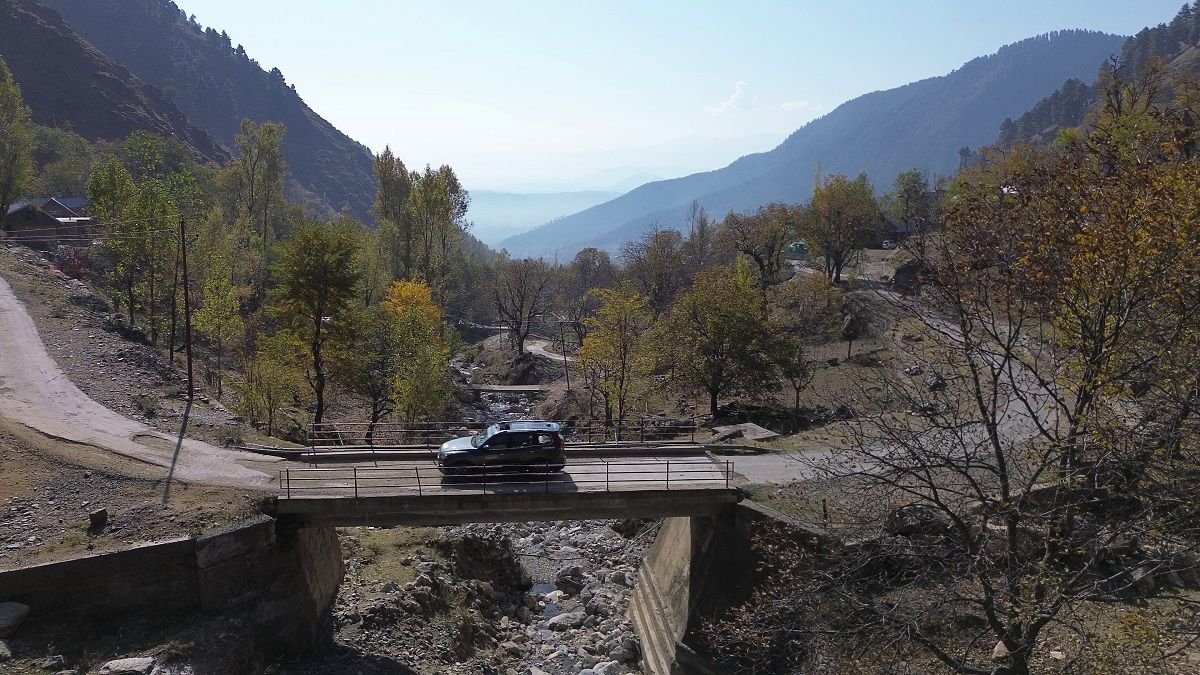
The drive that followed was among the most beautiful we have experienced in this part of Kashmir.
Mountain slopes were covered in patches of crimson and golden foliage, set against the deep green of evergreen pine forests. Some trees had already shed their leaves, while others still held their autumn colours. The narrow road followed the mountain contours, passing through forests and open slopes.
We stopped frequently to take photographs and enjoy the scenery.
At one point, we found ourselves beside a clear stream flowing through a narrow valley surrounded by tall trees. We unfolded our camping chairs, warmed our packed lunch and ate beside the water.

There were few signs of human activity. The sound of flowing water, rustling leaves and occasional birdsong made the place feel far removed from the bustle of city life.
As we continued downhill, the valley opened up.
A river flowed along its floor, while the road followed its course along the mountainside. We noticed workers engaged in forestry-related activities, and soon the first houses appeared.

These were old wooden structures, tucked against the mountain slopes and seemingly built around the demands of their surroundings.
The houses gave the landscape an old-world character, although there were signs of modern connectivity. Mobile networks worked intermittently, and electricity infrastructure was visible along the route.
We eventually reached Chanjwali and discovered that Jumagund was not a single village but a collection of eight small villages and hamlets, each with its own settlement and community.
Our destination was Attad, where we were expected to stay with a local resident, Mushtaq.

After asking a few children and other residents for directions, we continued towards his hamlet.
The road changed considerably after Chanjwali. The paved stretch gave way to narrow, unpaved tracks with steep gradients, sharp bends and uneven surfaces. We engaged the 4X4 system of our Scorpio-N and proceeded carefully. Along the way, we passed Goolnera, Doga and Kuchiban before reaching Attad.
It was around four in the afternoon when we arrived.

Mushtaq was waiting for us and walked towards the vehicle to welcome us. After parking, we collected our essentials and walked the short distance to his house.
Attad was a tiny settlement with barely seven or eight houses. Mushtaq’s home was a modest wooden structure overlooking the valley, with views extending towards the LoC landscape.

Our room was clean and warm. Tea and freshly prepared rotis were served soon after we settled in.
After resting for a while, we stepped outside to explore the hamlet. Children were playing with whatever they could find, including simple wooden sticks. Chickens wandered around the houses, goats and sheep moved along the slopes, and horses grazed nearby. Birds could be heard in the surrounding trees.

There was something refreshing about these countryside scenes. Life seemed closely connected to the land, animals and changing seasons. The children had their games, households had their routines, and the surrounding mountains provided the setting for daily life.
Mushtaq helped us understand the geography of the area and its proximity to the LoC.
Living in such a location gives residents a different relationship with the border. It is not simply a line discussed in news reports or marked on maps. It is part of the landscape surrounding their homes.
The Army, too, is an integral presence in these settlements, and our visit gave us an opportunity to understand another dimension of life in the region.

As daylight faded, we returned to Mushtaq’s house. His family was preparing dinner in the kitchen, where a traditional chullah burned. The fireplace provided warmth and served as the centre of household activity.
We were first served locally prepared saag, rotis and Kashmiri nun chai. Before long, another villager joined us, and conversations began. There was no formal gathering or elaborate hospitality ritual. People simply came together, shared stories and made room for their guests.

Dinner was served beside the burning chullah. Rice, potatoes, rajma, Kashmiri saag and chicken made up the meal, prepared with locally sourced ingredients. The family lived in the same house, and its simple arrangements gave a glimpse of domestic life in a remote mountain settlement.
There were no conventional beds. Our bedding had been spread on the floor, and the toilet was outside the house. The arrangements were basic, but the room was warm and the bedding comfortable.
We had come expecting a remote mountain experience, but the ease with which the family welcomed us made the evening particularly memorable.
Night brought another side of Jumagund into view.
At intervals, sharp reports echoed through the valley. Mushtaq told us that these were sounds of gunfire. They continued through the night, interrupting the stillness of the surroundings. We found the sounds unsettling, although residents were accustomed to living with the realities of a border region.
The following morning, we noticed a mark on the exterior wooden wall of the house.

When we asked Mushtaq about it, he explained that it had been left by a splinter during Operation Sindoor.
It was a small mark on an otherwise ordinary wooden wall, but it gave us a direct understanding of how close the consequences of conflict could come to a family’s home.
Our exchanges also turned to the changing mountain seasons. Residents recalled that November had once been a time when snowfall could already be expected.
During winter, snow accumulation could reach several feet, sometimes as much as ten to twelve feet, according to local recollections.
Our visit, however, coincided with relatively mild weather.
A single visit cannot establish a climatic trend, but the memories of people who have lived in these mountains for generations share an important perspective on changing seasonal conditions. Their recollections of earlier winters provide a useful account of how the mountain environment has changed in their experience.
The next morning began with the sounds of the household coming to life.
Our room was directly above the kitchen, and we could hear wood being split and prepared for the chullah. We later learnt that one of the family’s daughters was arranging the firewood.
The household had a simple but practical arrangement for hot water. A metal tank placed above the kitchen chullah was heated by the fire below. Breakfast consisted of tea, freshly prepared rotis and boiled eggs.
After breakfast, we spent more time talking to residents, taking photographs and observing the morning routines. When it was time to leave, Mushtaq decided to accompany us for part of the return journey.
Our expedition was not quite over. We had also been invited for lunch by an Army officer serving in the region. We retraced our route and continued towards the location where the officers were stationed.
The drive offered another opportunity to enjoy the narrow mountain roads, steep gradients and sweeping views.
The weather had changed considerably. Clouds had gathered over the mountains, and as we reached our destination, the first snow flurries of the season began falling.
It was our first encounter with snowfall that autumn.
The officers welcomed us warmly, and we spent time exchanging experiences over a generous lunch. The interaction gave us another perspective on the responsibilities and experiences of people serving in these remote mountain areas.
When we began our return journey, light snow was still falling. Mushtaq accompanied us for part of the way before we said our goodbyes and continued towards Zirhama.
What remained with us after leaving Jumagund was the contrast between its reputation as a border region and the ordinary lives unfolding within its eight settlements.
The gunfire at night and the splinter mark on Mushtaq’s house showed us what it means to live so close to the LoC.
At the same time, the family gathering around the chullah, children playing outside, animals grazing on the slopes and villagers sharing meals gave us a glimpse of the simple, everyday life that continues here.
Jumagund is usually seen through the geography of the border. Spending time there brought its homes and people into view.
Behind the maps and military positions are families preparing for long winters, children growing up in mountain hamlets and people going about their daily lives in a landscape few outsiders get to experience.
We had set out to explore a remote corner of Kupwara. We returned with memories of autumn forests, difficult mountain roads, a warm wooden home, shared meals, conversations around a chullah and the first snowfall of the season.
The landscape was beautiful, but the people we met gave the journey its meaning.
- The authors are co-founders of Kashmir Off Road, a family-led Himalayan exploration and storytelling platform.