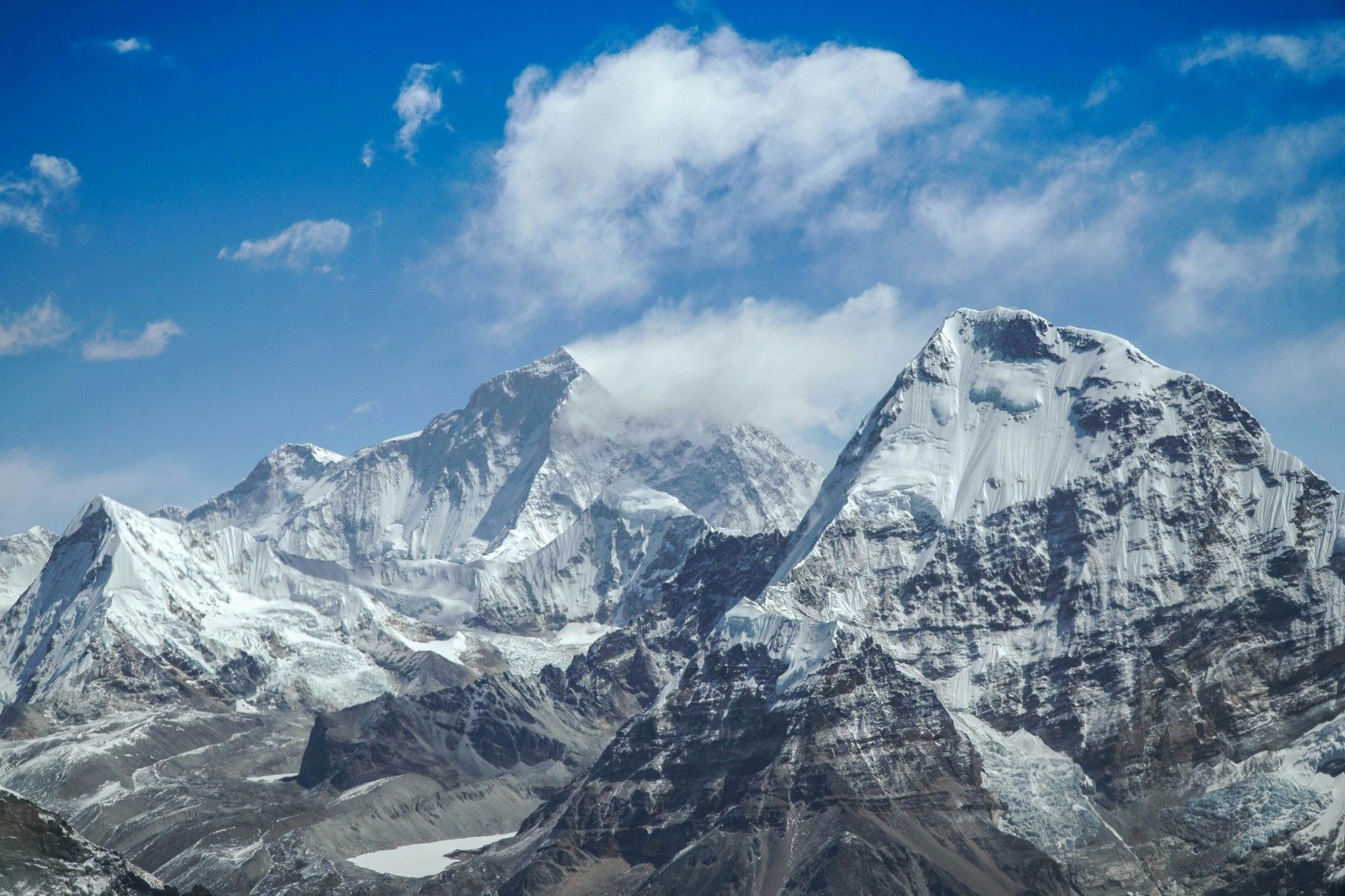

Srinagar – The western Himalaya, encompassing Ladakh, Jammu and Kashmir and Himachal Pradesh, is warming faster than the central and eastern stretches of the Himalayan range and could lose vast quantities of seasonal snow by the end of this century if greenhouse gas emissions remain high, a new scientific study has warned.
The study, based on 120 years of observed temperature records and projections from eight global climate models, finds that the western Himalaya consistently emerges as the most climate-sensitive section of the Indian Himalayan region—warming more rapidly and losing more snow than other parts of the range under every emissions pathway examined.
Published in the Journal of Earth System Science, the research paints a particularly worrying picture for the mountains that feed major river systems and sustain millions of people downstream.
The study, titled “Vulnerability of the Himalayan region under climate change”, was led by researchers from the Department of Remote Sensing and Geoinformatics at Birla Institute of Technology (BIT), Mesra, in collaboration with the Indian Institute of Tropical Meteorology, Pune, and Ashoka University.
Its findings suggest that the fate of the Himalayan snowpack—particularly in Jammu and Kashmir, Ladakh and Himachal Pradesh—will depend heavily on how quickly the world cuts greenhouse gas emissions.
A Himalaya That Is Not Warming Equally
The Himalaya is often viewed as one vast, interconnected mountain system. But the new research suggests that climate change is unfolding unevenly across its length.
The researchers divided the Indian Himalayan region into three broad sectors—the western Himalaya, covering Ladakh, Jammu and Kashmir and Himachal Pradesh; the central Himalaya, largely comprising Uttarakhand; and the eastern Himalaya, including Sikkim, Arunachal Pradesh and the wider North-East.
Together, these regions contain more than 15,000 glaciers and form the headwaters of the Indus, Ganges and Brahmaputra river systems, on which roughly 1.5 billion people depend.
Using CRU TS v4.07 temperature observations spanning 1901 to 2020 and an ensemble of eight CMIP6 global climate models, the researchers reconstructed past warming trends and projected future changes up to 2100 under five different emissions scenarios.
The results point repeatedly towards the western Himalaya as the region under the greatest pressure.
“The Himalaya is often discussed as a single system, but our observations and models both say otherwise. The western Himalaya consistently emerges as the most sensitive stretch—it warms the most and loses the most snow under every pathway we tested. That has direct consequences for the states that sit in it,” said Protyusha Mukhopadhyay, the study’s lead author from BIT Mesra.
Nearly 1°C of Warming Already Recorded
The warming is not a distant future scenario. It has already happened.
Compared with the first three decades of the twentieth century, winter temperatures had risen by close to 1°C across all three Himalayan sectors by the period ending in 2014.
The western Himalaya recorded winter warming of 1.06°C, compared with 0.96°C in the central Himalaya and 1.09°C in the eastern Himalaya.
Spring warming was even more pronounced in the west, reaching 1.08°C, compared with 0.83°C in both the central and eastern Himalayan regions.
The researchers found that the warming has accelerated in recent decades, with warmer-than-normal years increasingly becoming the norm across the Himalayan belt.
In other words, the mountains are no longer experiencing occasional warm anomalies. A new, warmer climatic baseline is taking shape.

A 7°C Warmer Winter?
The most alarming projections emerge under a high-emissions future.
If the world continues on a fossil-fuel-intensive trajectory, winters in the western Himalaya could become 7.18°C warmer by 2081–2100 compared with the 1901–1930 baseline, according to the study.
The projected warming is lower, though still dramatic, in the central Himalaya at 6.71°C and in the eastern Himalaya at 5.82°C.
Spring temperatures follow a similar pattern.
By the end of the century, the western Himalaya could see spring warming of 6.91°C under the high-emission scenario, compared with 6.41°C in the central Himalaya and 5.16°C in the east.
The researchers say the implications are particularly serious because winters are traditionally the period when Himalayan snow accumulates.
“In the west and centre, winters are warming faster than springs. Less snow on the ground would mean a darker surface, which absorbs more heat, which melts more snow,” said Parthasarathi Mukhopadhyay, the study’s corresponding author from Ashoka University.
“It matters because winter is the season in which snow is supposed to build up; warmer winters mean less snow banked for the melt months that follow.”
That creates a dangerous feedback loop. Less snow exposes darker land surfaces. Darker surfaces absorb more solar radiation. More heat then leads to further snow loss.
The Himalayan Nights Are Getting Warmer Faster
Another major warning from the study is hidden in the difference between daytime and night-time temperatures.
Across the western and central Himalaya, minimum temperatures are rising faster than maximum temperatures.
In the western Himalaya, winter night-time temperatures increased by 1.23°C, compared with a 0.87°C rise in daytime temperatures.
During spring, minimum temperatures rose by 1.25°C, while maximum temperatures increased by 0.91°C.
The difference was even sharper in the central Himalaya during winter, where minimum temperatures rose by 1.20°C, compared with just 0.72°C for maximum temperatures.
The eastern Himalaya was an exception, with winter daytime temperatures increasing more than night-time temperatures.
But for the western Himalaya, warmer nights could have profound consequences.
Snow and ice depend not only on how warm afternoons become but also on whether temperatures fall low enough at night for refreezing to occur.
As nights become warmer, the window for snow and ice to refreeze shrinks.
“Rising night-time temperatures are the quieter half of this story and arguably the more consequential one,” said Dr Swagata Payra, co-author of the study from BIT Mesra.
“When the cold nights that let snowpack recover start disappearing, you change the melt cycle itself — not just how much snow falls, but when the water arrives downstream.”
That could alter river flows, water availability and the timing of meltwater reaching communities and agricultural areas downstream.
Spring Snow Could Take the Biggest Hit
The sharpest losses are projected during spring, when accumulated snow begins melting.
Across all three Himalayan sectors, spring snow losses exceed winter losses. But the western Himalaya stands apart.
Even under the lowest-emission pathway, spring snow over the western Himalaya is projected to decline by 24.2 kilograms per square metre by 2040, 27.4 kg per square metre by 2060, and 32 kg per square metre by the end of the century.
Under the highest-emission pathway, however, the projected loss rises dramatically to 95.9 kg per square metre by 2100.
The researchers say such losses could indicate an almost complete disappearance of seasonal snow in some pockets of the western Himalayan region.
The central Himalaya is projected to lose between 17 and 34.9 kg per square metre of spring snow by the end of the century, depending on the emissions scenario.
The eastern Himalaya fares comparatively better, with projected losses ranging between 5.5 and 11.1 kg per square metre.
Winter snow follows the same west-to-east pattern.
By the end of the century, western Himalayan winter snow loss could range from 9.5 kg per square metre under a low-emissions future to 53.2 kg per square metre if emissions remain high.
A Stark Difference Between Climate Choices
Perhaps the most important message of the study is that the most severe outcomes are not inevitable.
The models show that even under strong emissions reductions, warming in the Himalaya will continue.
But the difference between a low-emission and high-emission future is enormous.
By the end of the century, western Himalayan winters could warm by 2.55°C under a low-emissions pathway, compared with 7.18°C under a high-emissions scenario — a difference of more than 4.6°C.
The consequences for snow are equally stark.
In spring, the high-emission pathway could cause roughly three times more snow loss in the western Himalaya than the low-emission pathway.
For winter snow, the difference is even greater, with losses under the high-emission scenario more than five times those projected under the lowest-emission pathway.
“The models agree on where we are headed over the next two to three decades,” said Parthasarathi Mukhopadhyay.
“What remains open is the second half of the century, and that is determined by emissions rather than by anything intrinsic to the mountains. A low-emission pathway does not stop the warming, but it changes its magnitude by several degrees.”
What It Means for Jammu and Kashmir
For Jammu and Kashmir and Ladakh, the findings carry an especially serious warning.
The western Himalaya is not only projected to warm faster; it is also expected to experience the largest snow losses.
Snowfall and snow accumulation play a critical role in sustaining Himalayan rivers, agriculture, hydropower and water supplies.
A reduction in winter snow accumulation combined with faster spring melt could mean that water arrives earlier in the year, potentially affecting availability during the warmer and drier months when demand is highest.
The study also underscores the importance of looking beyond annual temperature averages.
A warmer Himalayan night, a shorter period of freezing, or an earlier spring thaw can reshape the entire rhythm of mountain hydrology.
East Safer From Warming — But Not From Disaster
The eastern Himalaya is projected to warm less and lose less snow than the western and central sectors.
But that does not mean it is safe from climate risks.
The study notes that the eastern Himalaya has already emerged as a hotspot for glacial lake outburst floods, or GLOFs – sudden and potentially catastrophic floods caused when natural barriers containing glacial lakes fail.
Retreating glaciers can leave behind unstable lakes, creating new hazards even in regions where projected warming is relatively lower.
Protyusha Mukhopadhyay warned that this risk could eventually spread westward as glaciers continue to retreat and new glacial lakes form.
The danger, the researchers point out, is not determined by temperature alone.
More Monitoring, Better Warnings
The authors have called for region-specific climate services and adaptation policies rather than treating the entire Himalaya as a single climatic unit.
They recommend stronger monitoring networks that combine ground observations, satellite data and sustained high-resolution climate modelling to track changes in glaciers and snow cover in near-real time.
The study also calls for improved early-warning systems, sustainable water management, community-level resilience programmes and greater transboundary cooperation.
A major gap, according to the researchers, is the lack of sufficient on-the-ground measurements to fully understand how snow and glacier melt translate into river flows.
Scientists can estimate temperature and snow changes with increasing sophistication, but uncertainties remain over exactly how much meltwater enters rivers, when it arrives and how these patterns will change as warming intensifies.
That makes sustained field observations as important as climate modelling.
The broad warning from the study, however, is unmistakable.
The western Himalaya — home to Jammu and Kashmir, Ladakh and Himachal Pradesh — is already warming rapidly. Winters are becoming less cold, nights are warming faster than days, and the snow that has long served as a natural water reservoir is projected to shrink sharply.
How much of that snow survives the century, the researchers say, will depend heavily on decisions made far beyond the mountains.
The study was led by Protyusha Mukhopadhyay of the Department of Remote Sensing and Geoinformatics, BIT Mesra. Co-authors include T. P. Sabin of the Indian Institute of Tropical Meteorology, Swagata Payra and Akhouri Pramod Krishna of BIT Mesra, and Parthasarathi Mukhopadhyay of Ashoka University.
The research, “Vulnerability of the Himalayan region under climate change”, was published online on June 9, 2026, in the Journal of Earth System Science.