
By Gowher Bhat
Jumu’atul-Wida arrives at the hinge. The name itself is a door closing.
Jumu’ah means Friday, and Wida: goodbye. Arabic offers no softening between them.
The day comes once each year, and Kashmir receives it with full weight. The valley knows about endings. It has watched many beautiful things depart.
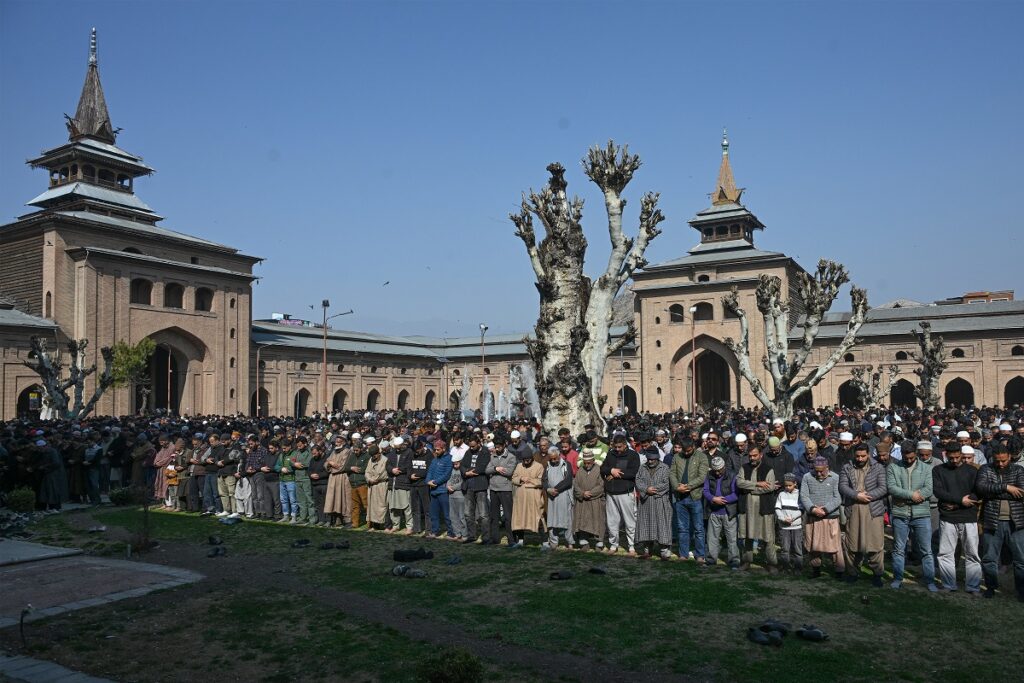
By mid-morning, the old city flows toward Jamia Masjid. Men in white kurtas move through streets that narrow and widen like verses. Women walk in groups, their pherans brushing stone. Children press ahead with prayer mats rolled tight. The mosque rises at the center, wooden and old, holding centuries of feet in its yards.
Today, it will hold more. Crowds spill through doors and spread onto flat surfaces. They press shoulder to shoulder until the building seems to breathe with one lung.
The sermon finds its own pace here. The cleric does not rush. He moves through Kashmiri, through Urdu, sometimes touching Arabic for divine blessing. He speaks of continuation, asks what remains when fasting stops, and pushes the crowd to keep the nightly prayers alive, the giving, the attention to those who have less.
The words land differently in this valley. Kashmiris have learned to hold rituals through hard seasons. They know that the body remembers when the heart forgets.
Charity moves through the crowd like another language. Zakat gets calculated and weighed. Sadaqah flows free, without record. Hands open that stayed closed all year. Food moves through neighbourhoods in parcels and bags. Money reaches those who need it without the slow work of institutions.
The giving holds special weight in these final hours. People treat it as proof of change before the month ends. The poor receive the signal that they were seen.
The timing holds its own teaching. Jumu’atul-Wida falls inside Ramzan’s last ten nights, a period already set apart. Somewhere in these nights hides Laylat al-Qadr, the Night of Power, which the Quran ranks above a thousand months. Believers stay awake through darkness, reading and praying, waiting for mercy to concentrate.
The Prophet, peace be upon him, pushed himself hardest here, sleeping little, asking constantly. Jumu’atul-Wida borrows this intensity. It becomes a daylight version of the same struggle, a final push before the finish line.
Kashmir responds with its own customs. After prayers, people walk to shrines and sanctums. The old city fills with walking groups, families greeting relatives they have not seen since Ramzan began. Markets stay open but move slower. Shopkeepers stand in doorways, watching crowds with different eyes. Everyone feels the shift coming.
Eid al-Fitr waits with its celebrations, but first comes this farewell, this accounting.
The farewell feeling means everything to Kashmir. The valley keeps it closer to the bone. The history has taught people to value collective moments.
When thousands gather safely in one space, the gathering itself becomes the point. The sermon matters, so do the shoulder-to-shoulder prayer and the shared breath of a community acting as one body.
Scholars still debate whether Jumu’atul-Wida counts as formal observance. The name appears nowhere in the Quran. Early Muslims did not mark it separately. The tradition grew on its own, spreading through societies that needed a ritual for goodbye. Kashmir embraced it fully.
The valley made it its own, adding shrine visits, family walks, the particular mood that settles over the old city.
This is how practice stays alive. It travels, then it roots, and then it becomes local.
Morning comes differently after this Friday. The predawn meal continues a few more days, but the end is visible. People count what remains, tally fasts completed, plan Eid purchases. Sermons shift toward celebration. But something of Jumu’atul-Wida stays in the air, a question that will not close: Did the month work?
The answer arrives months later, in ordinary time, when the test comes without warning.
- The author is a Pulwama-based educator.