
By Jamsheed Rasool
The air in Srinagar in February bites past the wind. It’s a sharp, clinical cold that finds the gaps in your pheran and reminds you exactly how far 3 kilometers can feel when you are on two wheels.
At that hour, the city is a ghost of itself: the Jhelum a dark, silent ribbon and the streetlights casting long, amber shadows over the frost-covered tarmac. You arrived at Ramadan Hospital looking less like a father-to-be and more like a man who had just survived a Himalayan expedition on a moped.
The scene at the desk is dismal. There is a specific silence in a Kashmiri hospital at 5:30 AM during Ramzan. The hallways smell of floor cleaner and the faint trail of someone’s pre-dawn noon chai.
The security guard, likely still adjusting his cap after his own Fajr prayer, saw the panic in your shivering frame. He saw a man-on-a-mission rather than a “loser moped rider”. He led you to the reception, a Formica island in a sea of sterile white tiles.
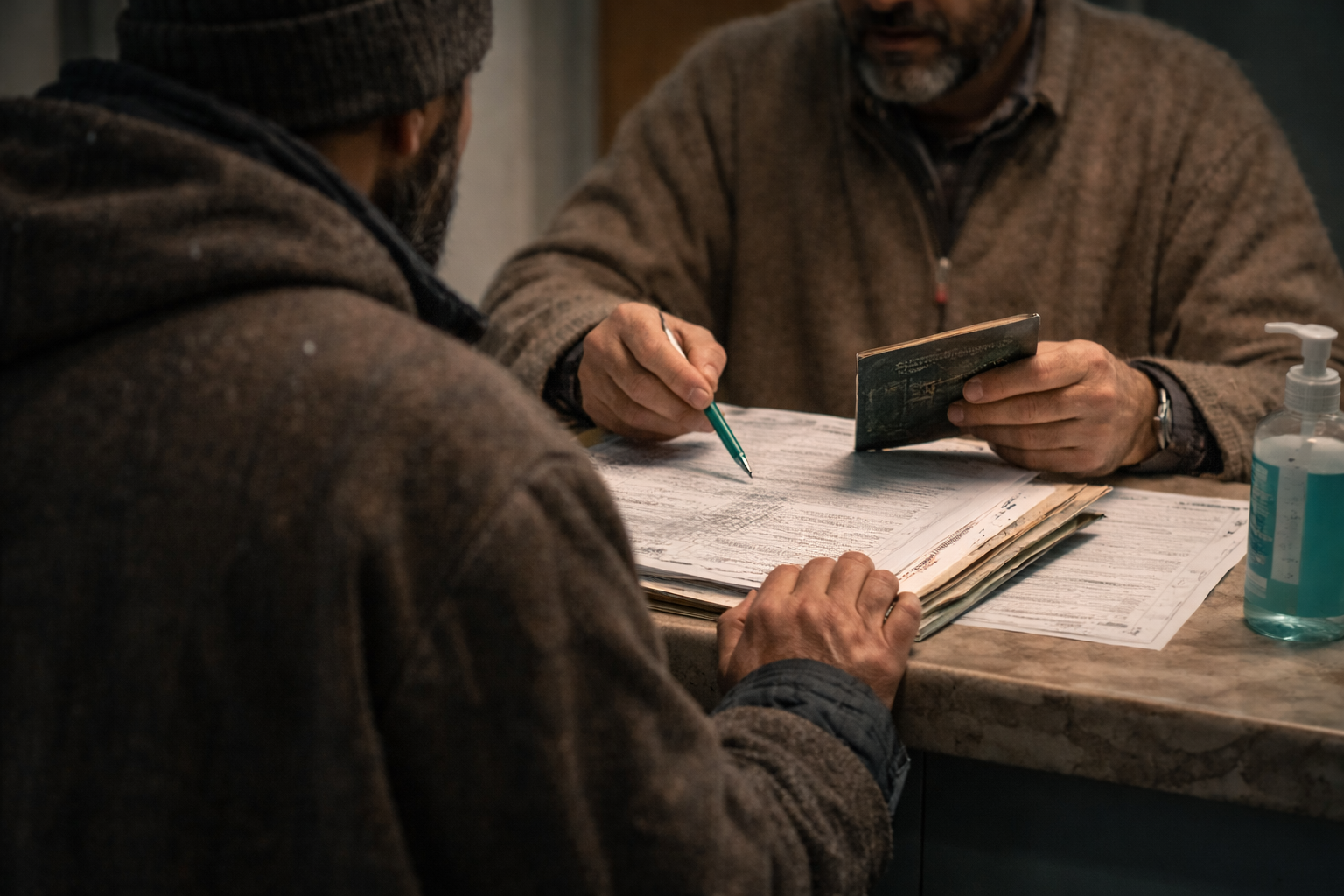
You stand there, fingers still numb from the handlebars, fumbling with your wallet and the plastic folder of my wife’s medical records.
The Forms: “Name of Patient”: ABC
You write with a shaky hand, the blue ink stuttering on the page because your pulse is racing faster than the moped’s engine ever could.
Outside, the sky is turning that bruised, pre-sunrise purple. Inside, the “Ramadan” signage feels like a silent omen of barakah. It’s the month of patience, and here you are, at the finish line of a nine-month marathon.
In a few hours, the sun will hit the tin roofs of the city, the “hipster” malls will open their glass doors, and the doctors will arrive in their heated sedans. But for now, it’s just you, the scratching of a pen on an admission form, and the anticipation of my wife arriving from her parents’ home, the bridge between your two families about to be personified in a single cry.
The sun hadn’t quite cleared the horizon yet, but the sky had shifted from that deep, ink-black to a bruised, electric violet. You stood by the wide glass doors of the Ramadan Hospital lobby, your hands still tingling from the moped’s vibration, watching the frost on the porch catch the first hint of gray light.
Then, the twin beams of a car’s headlights cut through the morning mist, sweeping across the “Designated Parking” signs and pulling up right into the porch, a privilege your moped had been denied.
The car door opened, and a gust of the February chill tried to follow my wife inside. She emerged from the backseat, wrapped in a heavy, charcoal-grey shawl, looking like a queen who had just survived a long journey. Her mother was on one side, her sister on the other, the family convoy that always accompanies a Kashmiri birth.
When she saw you standing there, shivering slightly in your over-sized jacket, her eyes crinkled. It was that look, part, “I can’t believe you rode that moped in this cold”, and part, “I’m so glad you’re here.”
As she stepped into the lobby, the sleepy, pre-dawn atmosphere of the hospital snapped into focus.
The night-shift nurses, who had just finished their own hurried pre-fast meals, suddenly moved with a new pulse. The squeak of rubber soles on the linoleum floors became a percussion of purpose.
The receptionist, who had been lazily filing your forms, stood up. The sterile folder you had just filled out suddenly became a living document, a ticket to the labour ward. Somewhere in the distance, the last echoes of the Sehri sirens or the morning calls from a nearby masjid were fading. The fast had officially begun. For millions, it was a day of abstaining, but for you and your wife, this was a day of profound giving.
You took the small bag from her brother’s hand, the one packed with baby clothes that had been washed and folded three times over. As the elevator doors slid open, the weight of the “loser moped rider” identity fell away.
In that clinical, yellow light of the elevator, you weren’t the guy struggling with the February wind anymore. You were the man your wife was looking at for strength. The “Ramadan” name on the hospital wall didn’t feel like a coincidence anymore. It felt like a silent witness to a miracle about to happen in the holiest of months.
The waiting room of the hospital was a study in suspended animation. By 8 am, the pale February sun was struggling to cut through the Srinagar haze, casting weak, rectangular patches of light on the green linoleum floor.
Because it was the month of fasting, the usual sensory markers of a hospital morning were missing. There was no steam rising from paper cups of Noon Chai, no rhythmic crunch of someone snacking on a hidden biscuit to calm their nerves. The air was thin, quiet, and purely expectant.
You sat on a hard plastic chair, your knees still feeling the ghostly vibration of the moped ride. Around you, the other men, including fathers-in-law, brothers, and fellow waiting husbands, were statues of restraint. To your left, an older man in a brown tweed pheran moved his thumb rhythmically over a set of dark wooden tasbih beads. Each click was a silent prayer for a daughter or a daughter-in-law behind the swinging double doors.
You felt the scratchiness in your own throat, the thirst of the fast beginning to set in, made sharper by the adrenaline. In any other month, you’d have walked to the canteen to kill time. Today, time had to be faced head-on, unbuffered by caffeine or sugar.
There is a strange irony in a maternity ward during Ramzan. While the world outside is practicing sabr through stillness and prayer, the women inside, my wife included, are engaged in the most violent, beautiful labour imaginable.
Every time the heavy doors swung open, a gust of “active” noise escaped: the sharp beep of a monitor, the hurried command of a doctor, or the low, guttural groan of a woman in the throes of creation. The waiting room would collectively hold its breath, eyes darting to the nurse in the blue scrubs, before exhaling in unison when she called a name that wasn’t theirs.
You looked out the window down at the parking lot. From this height, your moped looked like a lonely insect huddled against the grand SUVs of the senior consultants. You thought about the journey, the 3 kilometers of freezing wind, the hurried Fajr, the scribbled paperwork.
In the silence of the fast, your mind drifted to the “Bridges” we talked about earlier. You were standing on a bridge right now. Behind you was the life of a son, a husband, a guy on a moped. Ahead of you, somewhere behind those swinging doors, was a version of you that was a father.
Then, it happened.
It was a thin, jagged sound that sliced through the “Ramadan” quiet like a silver blade. It was a cry that didn’t care about the fast, the cold, or the Dogra kings of the past. It was the sound of the 2000-year-old Jhelum finding a new stream.
The nurse stepped out, her mask hanging from one ear, looking for the man who had arrived in the dark.
The silence of the waiting room was finally broken by the sound of the double doors swinging open. The nurse, her face etched with the professional fatigue of a long Ramzan night shift, stepped out.
You stood up so fast your chair scraped harshly against the linoleum. Your heart, which had been idling like a cold moped engine, was now revving at a thousand RPM.
“How is my wife?” you asked, the words catching in your dry, fasting throat.
“She is well. Alhamdullilah,” the nurse replied with a small, knowing smile.
“And… the baby?”
You looked at her, searching for the answer to the question that had been humming in your mind for months. She paused, a playful glint in her eyes despite the exhaustion. “That,” she said, “is a surprise for you. Just wait a few more minutes.”
She disappeared back into the sterile white beyond. Those few minutes felt longer than the three-kilometer ride through the freezing February wind. You sat back down, but your body wouldn’t settle. You looked at your hands, the hands of a “loser moped rider,” still slightly red from the cold, the nails short, the skin smelling faintly of the dawn’s lime and the metal of the handlebars. You wondered if these hands were meant for something as delicate as a surprise.
The door swung open a second time. This time, she wasn’t empty-handed. She carried a bundle wrapped tightly in hospital-grade white cotton, a tiny “Kashmiri cocoon.”
She walked straight toward you. The other families in the waiting room, including the old man with the beads, and the anxious aunts, all fell away. The world narrowed down to the space between your chest and her outstretched arms.
“It is a boy,” she said, her voice dropping into a softer, warmer register. “A beautiful, healthy boy.”
As she leaned forward to place him in your arms, a sudden, inexplicable stillness took over your body. The shivering stopped. The “moped rider” hands, which usually struggled with the finicky clutch and the heavy grocery bags from the market, suddenly found a perfect, instinctive geometry.
You tucked your elbows in, and cupped his head with a firmness you didn’t know you possessed.
He was the most “High-End” thing you had ever held. Looking down at his face, crinkled like a dried walnut and still flushed with the heat of his arrival, you realized the paperwork was done. The moped was parked. The fast was being observed.
But as his tiny, translucent fingers brushed against your calloused thumb, you realized the “GTM strategy” of your entire existence had just been rewritten. You weren’t just a son of the soil or a husband on a budget anymore. You were the bridge.
The heart of that morning wasn’t the sterile hospital walls or the looming mountains. It was the man behind the reception desk.
While I was shivering from the moped ride, he was shivering from a different kind of fever, the one that comes from a life spent waiting for a door that never quite opens. He was the Sultan of the Reception Desk, a man who seemed to be physically decomposing under the flickering fluorescent lights.
He looked like a character pulled from a 19th-century Russian novel, transported to a Kashmiri winter. His skin was the colour of old parchment, a sickly yellowish hue that suggested his lungs were as tired as his eyes. And then there were the sores, an angry, weeping map of herpes or some fungal equivalent that littered his jawline.
As I handed him my wife’s files, he reached up, scratched a crusting lesion with a jagged fingernail, and then, without a flicker of hesitation, pressed those same fingers onto the white sheets of the prescription.
“I had just managed to catch some sleep,” he muttered, his voice a gravelly rasp of self-flagellation. “Then you turn up.”
He blamed the sores on the cook. “Spicy, cold food for Suhoor,” he hissed, as if the chili powder had manifested directly through his pores. “That man is a butcher, not a cook.”
In between the coughing and the scratching, he spoke of home, a village in the highlands that sounded like a fever-dream of Eden. He spoke of a brooklet that snaked through the moss, of plane trees that touched the clouds, and a village pond where the water was as clear as the air.
He spoke of the “Bigshot Politician” from the next village over. “He has the men by their throats,” the receptionist whispered, a mix of envy and disgust dancing in his yellowed eyes. “He moves the psychology of the valley. I could have been him. But I am a straight arrow. And look at me, writing names on paper until my fingers ache.”
Then came the mantra. The spell that kept his heart beating.
“Today is my last working day. I am leaving for Kuwait next week. My Visa has arrived.”
I looked at him, at the consumption in his chest and the infection on his face, and I was startled by his absolute, terrifying confidence. To him, the moped-riding father in front of him was the one trapped. He was already gone.
That was the same day the news broke: Khamenei had been killed in an air raid. The world felt like it was tilting on its axis. When I mentioned it, hoping for a shared moment of grief or political outrage, he only became irate.
“Kuwait is far, far away from Iran!” he snapped, slamming a stamp onto a form. “Let them bomb. My flight is in three days. The desert doesn’t care about the mountains.”
Weeks later, I returned. The February frost had turned into the wet uncertainty of early spring. I walked to the desk to collect my son’s birth certificate, expecting a new face, perhaps someone healthy and local.
Instead, there he was.
The yellow skin was still there. The sores had moved, “some infection on my backside,” he grumbled, shifting uncomfortably in his chair. He looked even more diminished, a ghost haunting his own workstation.
“They served me spicy cold food again,” he complained, his fingers trembling as he gripped the pen. “My fingers are aching. These sheets of paper… they never end.”
He looked up at me, and for a second, I thought the delusion had broken. But then, the old spark of desperate hope flared up in those jaundiced eyes.
“But fortunately,” he whispered, as if sharing a state secret, “my visa from Kuwait has come. I am leaving tomorrow.”
He was the Jhelum in reverse, always flowing toward a sea he would never reach, anchored to that desk by a piece of paper that was likely as phantom as the clear air of his highland village.
- Jamsheed Rasool is a senior scribe and short story writer from Srinagar with more than 15 years of experience in media, education, and corporate sectors. His work, published in various outlets, focuses on the human stories and changing dynamics of his homeland. He can be reached at [email protected].