London – US President Donald Trump has once again ignited international controversy by renewing his call for the United States to annex Greenland, declaring the vast Arctic island vital for American national security. The remarks drew sharp rebukes from European leaders, Denmark and Greenland’s own government, which dismissed the idea as a dangerous fantasy.
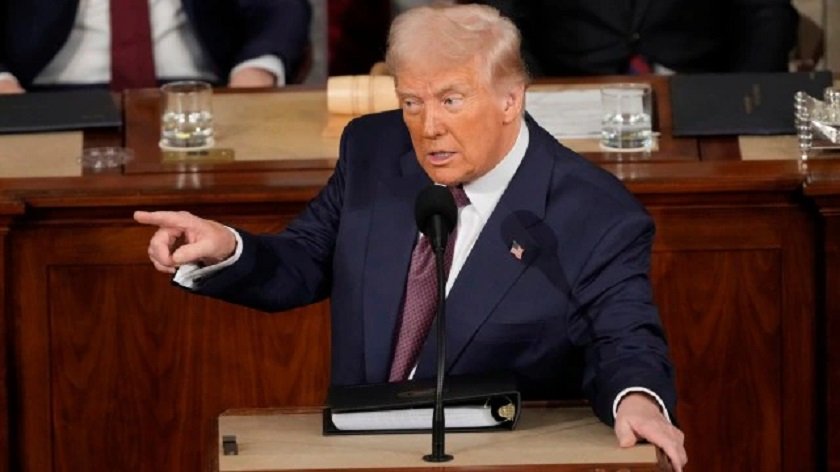
Speaking to reporters, Trump insisted, “We need Greenland from the standpoint of national security,” reviving a proposal he has repeatedly floated in recent years. His comments came days after Denmark’s prime minister urged him to “stop the threats” over the semi-autonomous Danish territory.
Greenland’s Prime Minister Jens Frederik Nielsen responded firmly, saying, “That’s enough now,” and stressed that the island’s future would be decided solely by its people. “US control over Greenland is a fantasy,” he said, underscoring the island’s opposition to annexation.
Nielsen said, “No more pressure. No more insinuations. No more fantasies of annexation. We are open to dialogue. We are open to discussions. But this must happen through the proper channels and with respect for international law.”
Earlier, Denmark’s Prime Minister Mette Frederiksen had said, “The US has no right to annex any of the three nations in the Danish kingdom.”
Frederiksen added that Denmark “and thus Greenland” was a NATO member and covered by the alliance’s security guarantee and said a defence agreement granting the US access to the island was already in place.
The Danish prime minister released her statement after Katie Miller – the wife of one of Trump’s senior aides, Stephen Miller – posted on social media a map of Greenland in the colours of the American flag alongside the word “SOON”.
Greenland, the world’s largest island, occupies a strategically crucial position above the Arctic Circle, guarding the North Atlantic and Arctic approaches to North America. Its importance has grown as climate change melts Arctic ice, opening potential new shipping routes and intensifying competition among global powers, including the US, Russia and China.
The island is also rich in rare earth minerals—critical for smartphones, batteries, computers and other advanced technologies—making it increasingly attractive amid Western efforts to reduce dependence on China for such resources. However, mining remains difficult due to Greenland’s harsh climate and strict environmental regulations.
The United States already maintains a military foothold in Greenland through the Pituffik Space Base, a key installation for missile warning, missile defence and space surveillance under a 1951 defence treaty with Denmark. Greenland also forms part of the strategically vital GIUK Gap, where NATO tracks Russian naval movements in the North Atlantic.
Despite its geopolitical significance, Greenland—home to about 56,000 mostly Inuit people—has long remained on the fringes of global attention. Now, as Arctic security and global trade reshape international priorities, the island has become a focal point of rising geopolitical tension, with its leaders making clear that sovereignty is not up for negotiation.
The back and forth over the future of Greenland comes in the wake of a major military operation against Venezuela on Saturday, seizing its president Nicolás Maduro and his wife and removing them to New York.
Trump later said the US would “run” Venezuela and US oil companies would “start making money for the country”.
The situation has reignited fears that the US may consider using force to secure control of Greenland, a vast island in the Arctic – something the US president has previously refused to rule out.
Trump has claimed that making it part of the United States would serve American security interests due to its strategic location and its abundance of minerals critical to high-tech sectors.
The Trump administration’s recent move to appoint a special envoy to Greenland prompted anger in Denmark.