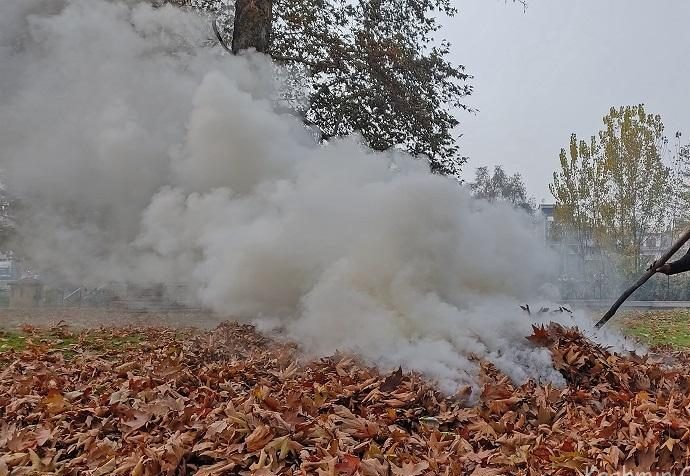
The chinar leaf falls in a particular fashion, spinning once before it settles, and by late September the pavements of Srinagar are covered with them, red and brown and curling at the edges.
This has been the visual signature of Kashmiri autumn for generations. Now it comes with a smell that has nothing to do with the season.
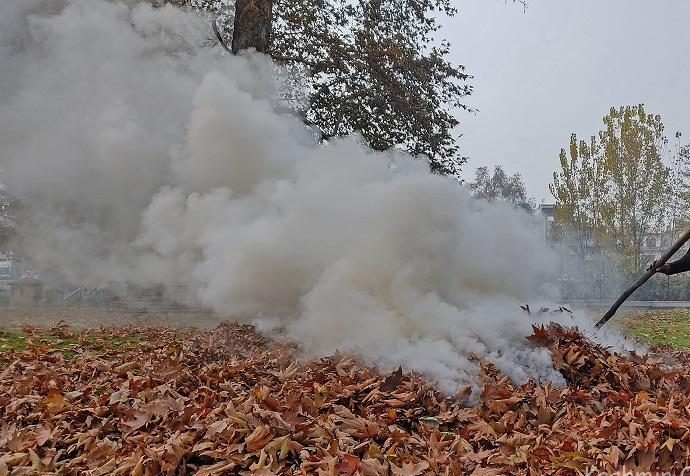
Walk through any mohalla between October and December and the smoke finds you before the leaves do, rising from small piles set alight by sweepers, orchardists, and ordinary residents who have never been told, or never believed, that this habit is killing them.
Last winter, the Air Quality Index in Srinagar and Baramulla crossed 250, a level at which breathing the outside air does measurable harm to the heart and lungs. The government’s own account of the same period reads very differently.
In July, Union Environment Minister Bhupinder Yadav told Parliament that particulate pollution in Srinagar had fallen by nearly 40 percent under the National Clean Air Programme, with PM10 levels dropping from a baseline of 132 micrograms per cubic metre to 80. Jammu, he said, improved by close to 29 percent.
Jammu and Kashmir has received Rs 223.70 crore under that programme since 2019, all of it through the Centre’s Control of Pollution scheme, since the Finance Commission’s separate challenge fund is reserved for cities with populations above a million.
The trouble is that the season in which these measurements were likely taken is not the season in which Kashmiris are actually choking.
PM10 readings tend to be lowest in spring and summer, when the air is washed by rain and warmed enough that nobody needs a fire. The real test comes when the leaves fall, firewood goes into the stove, twigs and dead wood are turned into charcoal, and trees stripped bare stop performing the daily work of photosynthesis that once helped clean the air above the city.
A report that flatters the government in July says almost nothing about what happens to a grandmother’s lungs in November.
The National Clean Air Survey for 2026, the Swachh Vayu Survekshan, tells the harder story.
Srinagar has fallen to 26th place among 39 Indian cities with populations over ten lakh. In 2023, it stood at 4th, held up as a model. The city now scores 162.6 points, trailing even Delhi, whose toxic winters are a national byword, at 21st with 172. Lucknow tops the list, followed by Indore, Jabalpur, and Bhopal.
Somewhere in that three-year slide from 4th to 26th, someone should be asked what changed, and why a government report delivered the same month could describe a 40 percent improvement.
Part of the answer is structural. Srinagar has no functioning mechanised road sweeping, no system for processing construction and demolition debris, and a growing number of unregistered vehicles and illegal stone crushers adding their own dust to the air.
But the piece within easiest reach of a fix is also the most stubborn: the open burning of municipal solid waste and dry leaves, done by residents and, just as often, by the sanitation staff paid to clean the city.
Apple orchardists across the valley burn pruned branches and fallen leaves as a matter of routine, unaware or unconcerned that they are producing black carbon, the soot that settles not only in human airways but on the glaciers that feed Kashmir’s rivers.
Former SKIMS director Dr Parvez Koul said in 2023 that roughly 10,000 people die every year in the Kashmir valley because of air pollution, much of it traceable to this type of burning.
That number rarely enters the debate when officials discuss NCAP funding or survey rankings, perhaps because it cannot be presented as progress.
Its real cost is seen in hospital wards, in older residents struggling to breathe through winter, and in children whose coughs last long after the season ends.
None of this needs new technology. Shredded leaves and pruned branches become compost, not smoke, if municipal bodies and orchardists are shown how and made to do it.
Deputy Commissioners have the authority to convene the agriculture, horticulture, police, and revenue departments alongside orchard associations, numbardars, and chowkidars, and to issue an outright ban on burning before the leaves finish falling this year.
Awareness campaigns through religious and social organisations can do part of the work. Penalties for those who ignore the ban can do the rest.
What Srinagar cannot afford is another year of comparing a summer statistic to a winter reality, while the smoke that rises every autumn keeps writing its own account of what the air has become.